Archive for 2009

Google Maps Search Results and Local Business Center Analytics

July 25, 2009

Drilling deeper into my Google Local Business Center account analytics has produced some unexpected findings.

Long before there was a Google Local Business Center, I became convinced of the importance of having my website appear consistently atop Google search results for heavily searched keywords.

So much so that I spent several years running my first major website: MarketingPrinciples.com as a test site for what worked and what didn’t within Google.

After testing confirmed a particular strategy or tactic, I would then apply it within the site or a client’s site.

Although MarketingPrinciples.com isn’t the traffic generation machine it once was  – with over 500,000 visitors annually – it still generates some interesting results from my original programming.

Most notably – MarketingPrinciples – according to my Google Local Business Center analytics appears first for “google search” in Google Maps queries  – above Google’s office locations.

Google Maps Google Search

Google Maps Google Search

Granted, the search query isn’t exactly a barn burner for producing clients for my marketing consulting practice.

However as a result of my early research and trials, my site and brand are receiving approximately 50,000 impressions from across the United States annually.

Google Local Business Center Analytics

Google Local Business Center Analytics

I think the results are acceptable for a guy and his laptop.

An aside: I searched for “google search” in Google Maps from several different computers with different IP addresses and got the same results.

What does your Google Maps search for “google search” produce?

Google Adwords Online Marketing Challenge Metrics

July 24, 2009

Google has announced the winners of the 2009 Google Online Marketing Challenge – a global university competition that gives undergraduate and post-graduate students hands-on exposure to online marketing.

The team from Deakin University, Australia was the winner of the global competition.

When asked how their team constructed the winning campaign, team spokesperson Andrew Kidd shared the following insight:

After discussions with the business owners, we decided we needed to conduct three separate campaigns. One would promote the play center to customers outside a 10 kilometre geographic radius, another would attract more mothers’ groups to the center, and the third one would attract more party and group event bookings. Visitors to their website more than doubled compared with the same period last year. We knew we had developed a strong campaign — but to win the global competition is outstanding.

Google judged competitors entries by the following metrics:

A proprietary Adwords algorithm examined over 30 different variables within an account to determine the top 50 teams in each of three regions (The Americas, EMEA and APAC).

Expert Googlers reviewed these 150 accounts to determine the top 5 in each of the three regions.

A Global Academic Panel selected winners from these 15 teams based solely on the quality of a team’s written reports.

The Google Adwords campaign statistics algorithm rated the teams with five key metrics:

Adwords Account Structure – Did the team set up their Adwords campaign in an efficient manner? Was it structured against product/service lines and themes? Did it contain Ad Groups with relevant Ad texts/variations and keywords?

Adwords Optimization Techniques – Did the team take advantage of tools and methods to get the most out of their campaign? Did the team follow the best practice encouraged in the Challenge guides and Adwords support materials?

Adwords Account Activity & Reporting – Did the team review and change their approach over time to get the most from campaigns? Was the account regularly monitored and did the team check and iterate to the Adwords reports available?

Adwords Performance & Budget – How effectively did the team use the available daily budget across keywords throughout the competition?

Adwords Relevance – How relevant were the team’s Adwords ads what click-through-rates (CTR) were achieved?

Congratulations to the winners.

Twitter 101: A Twitter User Guide

July 23, 2009

Twitter has just released Twitter 101, a guide for using Twitter.

Twitter 101

Twitter 101

The guide explains what Twitter is, how to get started using Twitter, common Twitter terms, Twitter best practices and some Twitter case studies.

With Twitter growing so rapidly while having problems engaging and retaining its audience, this guide should help explain and clarify Twitter’s unique value proposition to both new and old users alike.

How To Create and Search Your Own Twitter Followers List

July 22, 2009

Yesterday I wrote a post about how to create and search a list of Twitter updates in both WordPress and Google.

Today, I am going to tackle a similar problem: Searching Twitter Followers and Following lists.

Until Twitter makes searching Twitter account followers and following lists part of Twitter search, finding someone who follows you or who is following you isn’t very easy to do.

Creating a searchable list isn’t too dificult it just requires some time.

Go to your Twitter account and click on your followers link and select list view.

This will produce a list of 20 followers per page.

Twitter Followers List

Twitter Followers List

Copy the list of followers from each page.

Depending on how many followers you have will determine how many pages you will have to scroll through and scrape to create your own searchable list.

I have 873 followers at the moment so I had to visit 43 pages to create my list.

Paste the list of followers into a Word document or Excel if you extracted tables and save.

You can now sort either the Word or Excel documents alphabetically to create your first archived list of Followers in a searchable hierarchy.

To archive your Twitter followers list in the cloud, import it into a Google indexed WordPress blog and wallah! – you will have a instant browser searchable WordPress file with a list of all your followers.

After the Googlebot visits your site, your list of followers will also be archived in Google’s search engine results pages.

I have posted my current list of Twitter followers over on TimothyCohn.com

Making Twitter Updates Searchable

July 21, 2009

I have posted over 16,000 words 140 characters at a time to Twitter since I began Tweeting in May of 2008.

Recently I became concerned about the Twitter cloud’s ability to archive my Tweets for a prolonged period of time.

I don’t have the same concern about WordPress’ ability to archive my blog posts so I thought I would mash the two together to create a searchable archive of my Twitter updates both here in my WordPress blog and ultimately in Google’s search engine results pages via the Googlebot crawl.

To create a searchable archive of your Twitter updates, Go to your Twitter Updates link @Twitter.com to scroll, scrape and copy all of your Twitter Updates into a Word document or Text editor.

Then create a new blog post in your WordPress blog and paste all of your Tweets into a post with or without each Tweets hashtag (#).

Once you have published your Tweet post in WordPress, visit your blog and search for any of your Tweets by date or keyword in your WordPress search box.

Your Twitter updates are now archived within WordPress.

Provided your blog is already in the Google index, your Twitter updates will then soon be locatable within Google search engine results pages too.

I have posted an example of searchable Twitter Updates on my personal blog @TimothyCohn.com.

Online Display Advertising Expenditures Increase Q1 2009

July 20, 2009

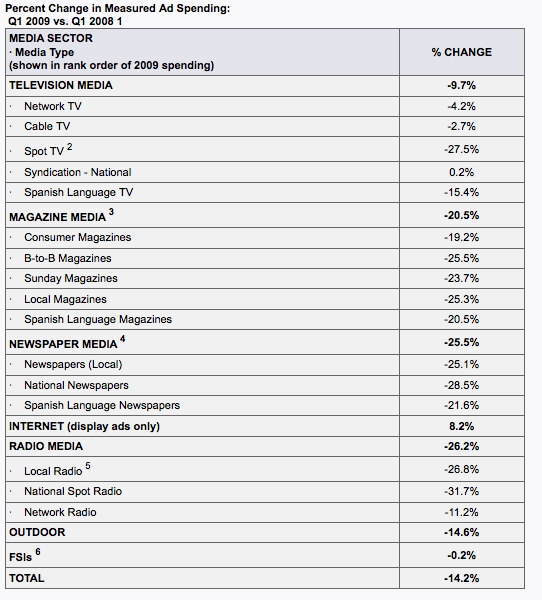
TNS Media Intelligence reports U.S. Advertising expenditures declined 14.2% in the first quarter of 2009.

From the TNS report:

Local media suffered most with aggregate expenditures sinking 25.4 percent in the first quarter of 2009. The rate of decline was similar across Spot TV (-27.5 percent), Local Newspapers (-25.1 percent) and Local Radio (-26.8 percent). Each of these segments was ravaged by deep spending cutbacks in core categories such as automotive, retail and local services.

For national media, combined ad spending fell 8.5 percent versus a year ago. Within this segment, performance was sharply defined along the lines of print versus television versus online.

National Newspapers (-28.5 percent), B-to-B Magazines (-25.5 percent), Consumer Magazines (-19.2 percent) and other print media were clustered on one track and their revenue declines were driven by fewer ad pages.

Network TV (-4.2 percent), Cable TV (-2.7 percent) and Syndication (+0.2 percent) occupied a middle tier and each of these saw business improve slightly at the end of the quarter, paced by Motion Picture and Restaurant category spending.  At an exclusive upper level, Internet display expenditures grew 8.2 percent as telecom, travel and local retail advertisers expanded their online marketing programs.

Q1 2009 Measured Ad Spending

Q1 2009 Measured Ad Spending

In addition to the increase in online display advertising expenditures, Dean DeBiase, CEO, TNS Media has alos identified several other noteworthy advertising industry trends:

“…some sectors and brands are approaching a depressed marketplace as an opportunity to gain share and are increasing spending accordingly.

The advertising industry, too, while struggling, is understanding this is a period for innovation and we are seeing efforts to reboot their approach through the advent of new technologies and tools such as addressable advertising, and the first steps to integrating ad measurement in a synergistic manner across all media platforms.”

Marketers who have been through the peaks and troughs of economic cycles before surely share DeBiase’s perspectve and thus have been busy taking market share through improved advertising measurement technologies and the return on investment these tools can produce.

Why People Go Online: To Pass Time?

July 19, 2009

A recent poll by Ruder Finn found 100% of respondents cited to “Pass time” as their top reason for going online.

Why People Go Online

Why People Go Online

“Educate self” and “Connect with others” were the second and third top reasons for people to go online.

These reasons along with all the others cited confirm internet media is almost exclusively populated by content consumers.

As such, the internet is now the content producer’s distribution channel of choice.

Google Webmaster Tools Reviews Actually Work

July 18, 2009

Several days ago I wrote about my frustration with WordPress.

I had moved my original WordPress domain to a new url  – SearchMarketingCommunications.com via their domain mapping service January 29th of this year.

To my dismay, I witnessed all of my Google search referrals vanish along with my WordPress domain from the Google search results.

To add insult to injury, my new domain went nearly six months without being re-indexed by Google even after authenticating and validating the new domain with Google Webmaster tools.

I contacted WordPress again and they said it wasn’t their fault the domain wasn’t in Google’s index.

Their response may have been intellectually sound, but it didn’t help me much.

I did however decide to take their advice and use Google Webmaster Tools message center to contact Google and ask for a review of my site.

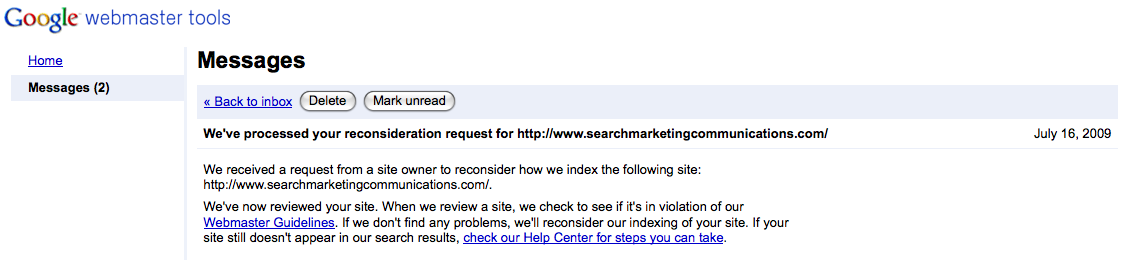
To my surprise, in my Google Webnaster tools inbox I received the following message:

Google Webmaster Tools Reconsideration Request

Google Webmaster Tools Reconsideration Request

A Google site search for Search Marketing Communications also yielded 17 pages.

Google Index Search Marketing Communications

Google Index Search Marketing Communications

This is 17 more pages from my new site than were found in Google’s index yesterday.

Although I have several hundred pages in SearchMarketingCommunications.com – 17 pages in the Google index is better than none.

Googlebot crawl stats show its crawling two pages per average visit.

Googlebot Crawl Stats

Googlebot Crawl Stats

I expect to see the average number of pages crawled increase with each Googlebot return visit to my site.

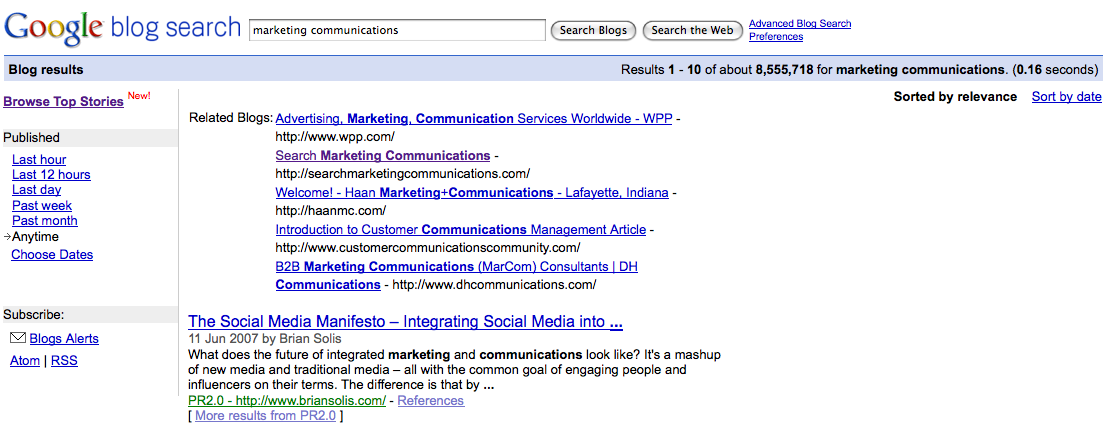
Another way to verify whether or not a blog is receiving optimum distribution is to check whether or not its in Google’s Blog Search.

Based on the following Google blog search results, it appears a successful Google Webmaster tools reconsideration request into Google’s index also yields placement in Google blog search.

Google Blog Search Marketing Communications

Google Blog Search Marketing Communications

I am cautiously optimistic this entire site will soon be available in Google’s index.

If and when this occurs, I will be sure to report on the outcome here @SearchMarketingCommunications.com

Nielsen June 2009 Social Media Stats

July 17, 2009

Nielsen’s June 2009 Social Media Stats reports continued online member community unique audience size growth for the seven of the top ten largest social media sites.

Twitter posted the largest year over year growth rate of 1,928%.

From Nielsen Wire:

Among the top 10 social media sites, Twitter.com was again the fastest growing, increasing 1,928 percent year-over-year, from 1 million unique visitors in June 2008 to 21 million unique visitors in June 2009–making Twitter the fourth most visited member communities site in June. Facebook continued to lead as the No. 1 U.S. social networking site for the sixth month in a row, with 87.3 million unique visitors in June 2009.

Online Member Communities Unique Audience

Online Member Communities Unique Audience

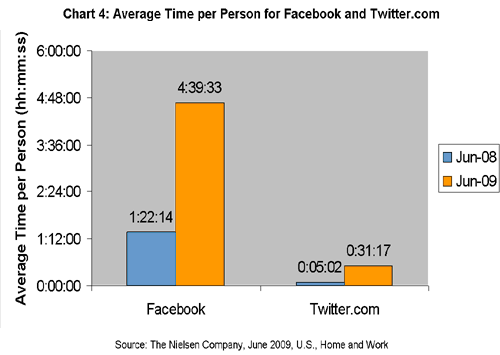
Although Twitter’s audience reach grew the most, Facebook’s audience penetration remained the highest @ 4:39:33 spent on the site.

Both Facebook and Twitter saw increases in the average amount of time spent per person by their respective audiences.

Facebook was also the No. 1 social networking site among the top 10 when ranked by average time per person, with visitors spending an average of 4 hours and 33 minutes on the site in June. This is a 240 percent year-over-year increase. The average time per person on Twitter increased 522 percent year-over-year, from 5 minutes and 2 seconds in June 2008 to 31 minutes and 17 seconds in June 2009, making it the fastest growing by time per person among the top 10.

Average Time Per Person Facebook vs. Twitter

Average Time Per Person Facebook vs. Twitter

Newspaper Circulation Data in the Top 200 US Markets on Google Maps

July 16, 2009

Mediaspace Solutions has created a useful Google Maps mashup combining circulation and traffic data for newspapers in the top 200 US markets.

Top 200 DMAs

Top 200 DMAs

The Mediaspace Google Maps mashups provides each newspaper’s category, DMA, Circulation, Sunday Circulation, Days Published, Website address, Sites unique visitors, Daily visitors and Page views.

Newspaper Circulation by DMA

Newspaper Circulation by DMA

The Mediaspace Solutions top 200 DMA tool is great for researching and visualizing the top 200 US newspaper markets.