Archive for the ‘Advertising’ Category

Tray Table Advertising: Will It Fly?

August 25, 2008

New York based Brand Connections has an exclusive license for selling ads on a patented tray table advertising system for passenger Airlines.

Imagine traveling with some brand’s message for 8 hours to Europe.

brand connections

brand connections

Tray Table Advertising gives new meaning to marketing to a “captive audience.”

Web Display and Search Advertising Combined; Their Sum Greater Than Parts

August 22, 2008

Gian Fulgoni chairman of comScore, recently wrote about his firm’s research on the impact online display and search advertising have on in-store retail sales.

How does comScore measure the impact online advertising has on retail offline sales? According to Fulgoni, “using the comScore panel, off line sales impact can be measured by linking panelists’ exposure to online ads with their in-store buying (through the use of retailers’ loyalty card data).’

Fulgoni draws two interesting conclusions from comScore’s
research:

1. “Search advertising provides higher sales lift than display advertising, but when combined, the synergy provides the highest lift…”

comScore Shoplocal.com Lift

comScore Shoplocal.com Lift

Search and Display Ads Lift

2. “While search advertising results in a higher sales lift than display advertising among the people exposed to the ads, the number of people reached by display advertising is typically markedly higher than the number of people reached by search advertising …

comscore shoplocal.com reach

comscore shoplocal.com reach

Online Advertising Reach

For media buyers planning to increase their brand message reach and lift consider the following;

1. An online display advertising campaign often reaches further than a search advertising campaign but online display ads will have less lift than search ads.

2. Search advertising will have more lift than online display ads but search ads may not reach as far as online display advertising.

Brand managers buying either online display advertising or search advertising but not both online display advertising and search advertising are likely diluting their brand’s message power – and along with it the ability to maximize their return on either form of online advertising they may have invested in.

Reaching the Internet Audience with Google Ad Planner

August 19, 2008

Google has begun inviting internet ad agencies into their display ad buying product called Google Ad Planner.

Google Ad Planner is still in Beta.

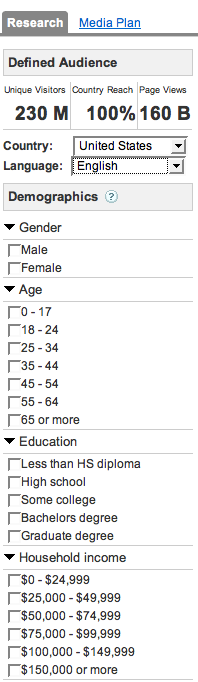
Google Ad Planner’s available US internet audience is 230 million visitors via 160 billion page views.

For brands looking to broaden their web reach and add lift to sales both online and off, Google’s Ad Planner product offers media buyers a simplified internet display advertising research and media buying tool.

The following audience segments are available for brands planning to target and increase their message touch points online.

Google Ad Planner

Google Ad Planner

You can request a Beta invite at Google Ad Planner.

Defined Internet Audience

Unique Visitors 230 M
Country Reach 100%
Page Views 160 Billion

Gender:

Male
Female

Age:

0 – 17
18 – 24
25 – 34
35 – 44
45 – 54
55 – 64
65 or more

Education:

Less than HS diploma
High school
Some college
Bachelors degree
Graduate degree

Household income:

$0 – $24,999
$25,000 – $49,999
$50,000 – $74,999
$75,000 – $99,999
$100,000 – $149,999
$150,000 or more

Share of Advertising Spend by Media

May 14, 2008

From MarketingCharts.com:

ad-spending-share-by-medium-nielsen-online

Nielsen Online, AdAcross
Month of February 2008

* Internet spending estimates are from AdRelevance. All others from Nielsen Monitor-Plus. Different methodologies employed by each company may lead to disproportionate comparisons.

Ad Spending by Medium
Medium Share of Spending
Network Television 25.5%
Cable Television 21.7%
Local Television 16.0%
National Magazines 12.4%
Internet 7.3%
Local Newspapers 4.9%
Syndicated Television 3.0%
Hispanic Television 2.8%
Local Radio 2.4%
Outdoor 1.4%
National Newspapers 1.1%
National Sunday Supplement 0.8%
Network Radio 0.5%
Coupon 0.2%
Local Magazines 0.1%
Local Sunday Supplement 0.0%

Microsoft and Yahoo vs. Google: The Battle for Audience and Keystrokes

February 7, 2008

The Redmond giant has sprung to its feet from its long and comfortable slumber.

Much like the browser business before it, Microsoft has realized it had better get into the search advertising business before its too late.

I think we all know who won the browser war. We also know how they did it.

Even with its proposed acquisition of Yahoo!, Microsoft may have already overslept and thus lost this battle.

On the surface this acquisition looks like a grab for a piece of the search advertising business.

However, just below the surface lie its real targets: the Internet audience and their keystrokes.

Internet Audience?

Keystrokes?

Both beachheads Microsoft has or has had control of nearly since their inception, keystrokes via the personal computer desktop and the Internet audience via browsers – not from birth but before the web’s infancy ended.

Like their importance to Microsoft’s franchise before, both have an equally and even greater importance going forward. Audience begets keystrokes and vice versa. However, It’s hard to control one if you don’t control the other.

Microsoft’s $44 billion offer to acquire Yahoo and its audience is an admission by Microsoft that if they aren’t able to augment their present audience now with an acquisition the size of Yahoo, they won’t ever be able to stem the audience gains being made by Google and their control of the largest and most valuable part of the internet audience – the search audience.

At this point, Microsoft’s not getting control of Yahoo’s audience is the single greatest risk facing their business – hence their offer price and the need to get the deal done. Maybe not today or tomorrow, but let unabated Microsoft faces continued losses in both audience and keystrokes.

Its not a market position Microsoft is familiar with or comfortable.

Why search is the most valuable audience on the Internet.

There are two types of audiences on the Internet. The old and familiar audience type, which is the one served and supported by display advertising.

Advertisers buy ads to reach an audience based on what content a publisher assembles to attract a particular audience. Ads are then priced and sold based on the desirability advertisers have in reaching that particular audience.

At any one time, a large percentage of the publisher’s audience is inactive – not interested in what the advertiser is selling.

Advertisers still have to pay to reach the publishers entire audience regardless of how many people may or may not be interested in the advertiser’s ads or products. Because display advertising is inefficient i.e., reaches more disinterested audience than audience of potential buyers – it sells for less and thus generates less income for publishers.

The other type of audience available to advertisers on the web is search advertising.

Unlike display advertising, search advertising reaches only an active audience – people who have explicitly requested advertisers information about their products or services – by their clicking on ads.

Search advertisers only incur costs to reach their audience when consumers click on their ads. Thus search advertising is significantly more efficient in delivering advertising messages to the exclusively active segment of the Internet audience – people who are actively searching for information.

By definition, search advertising only delivers advertisements to people actively seeking what the advertiser is advertising and selling. Because of this efficiency in targeting and delivery, search advertisers are able to reach more qualified prospects for less than through traditional media.

In turn, search advertising providers like Google are able to charge advertisers commensurate with the value the advertisers receive from reaching a efficiently targeted and active audience.

The result?

By my calculations, Google’s annualized gross revenue from advertising per visitor is roughly twice that of Yahoo’s and nearly four times Microsoft’s (gross advertising revenues divided by web property visits)

At a minimum, a search driven visit is worth at least twice – up to four times more than a non-search driven visit.

This is why Microsoft desperately needs Yahoo’s audience.

Although there are wide discrepancies over what percentage of search each company gets, Google receives between four to twenty times more search traffic than Microsoft and three to five times more search traffic than Yahoo, combined and assuming no market disruption – the two companies would still only generate one fourth to one half the search business of Google.

This acquisition also assumes Yahoo’s ad platform can continue to harvest one half the value Google does whether through Yahoo! or Microsoft’s search product without cultural distraction or interruption from the merger.

Even with their proposed clean room assembly, Microsoft’s acquisition of Yahoo! does not answer how they will make up difference (search volume + gross revenue per visitor).

By doubling their performance (revenue per visit) post merger to meet Google’s present level of performance, a MicroHoo search advertising business gross revenues per visitor would be half of Google’s.

In order for Microsoft to retain Yahoo’s audience, publishers and advertisers- the combined company will also need to produce:

Highly relevant search results for its audience, a functional ad platform for its advertisers, profitable ad distribution for its publishing partners and most importantly: a greater return on its advertisers’ investments.

Without which any new ad platform and search product may grab the attention of a larger audience and gain its keystrokes only to see it lost after they are unable to deliver what the internet audience has already come to expect, find and get from Google.

Of course, this also assumes Microsoft is somehow precluded from using its expanded platform and footprint to reroute ancillary chunks of audience to its new web properties acquired through the proposed acquisition along with their accompanying keystrokes.

In the absence thereof, there may be no stopping Google’s march.

Google’s Local Advertising Embedded with Google Maps

January 29, 2008

As I mentioned in my last post, Google has begun taking additional steps to bridge the gap between web search traffic and their advertiser’s foot traffic.

In researching the different types of Local OneBox results found both here in the United States and abroad, I found an Adwords ad format I hadn’t yet seen – an Adwords Ad with a Google Maps icon embedded within the Google Adwords advertiser’s ad.

By adding Google Maps images to local advertisers ads, Google has simplified and reduced the searching online to visiting off line and in person to three steps.

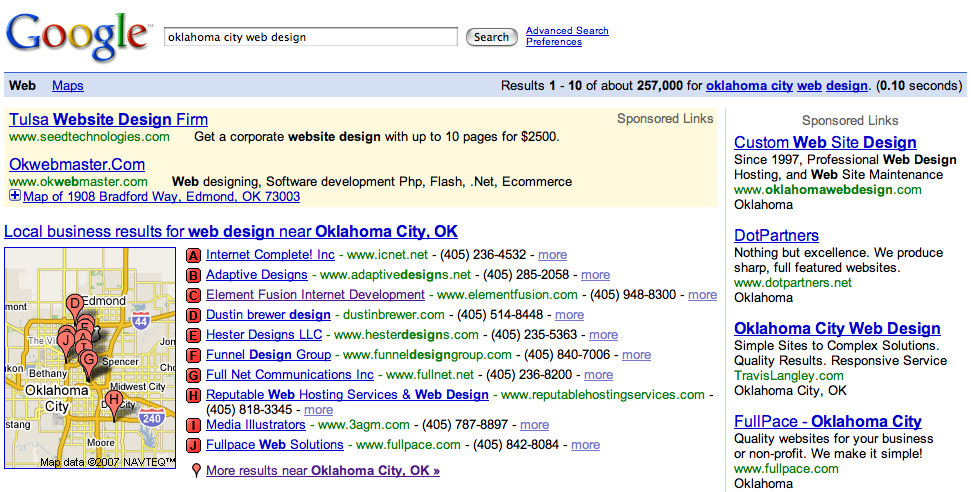
Step 1. The search for local products or services : Oklahoma City Web Design

The search for “Oklahoma City Web Design” produced the usual sponsored links both those above the new 10 OneBox results and those found along the right rail. However, after closer inspection I noticed the second listing had a maps icon embedded in the ad.

Google Local Adwords Ad + Google Maps

Step 2. Local product or service providers advertisement selected. Selection factors could include brands or services offered and their convenience to the searcher.

Google Local Adwords Ad + Google Maps Expansion

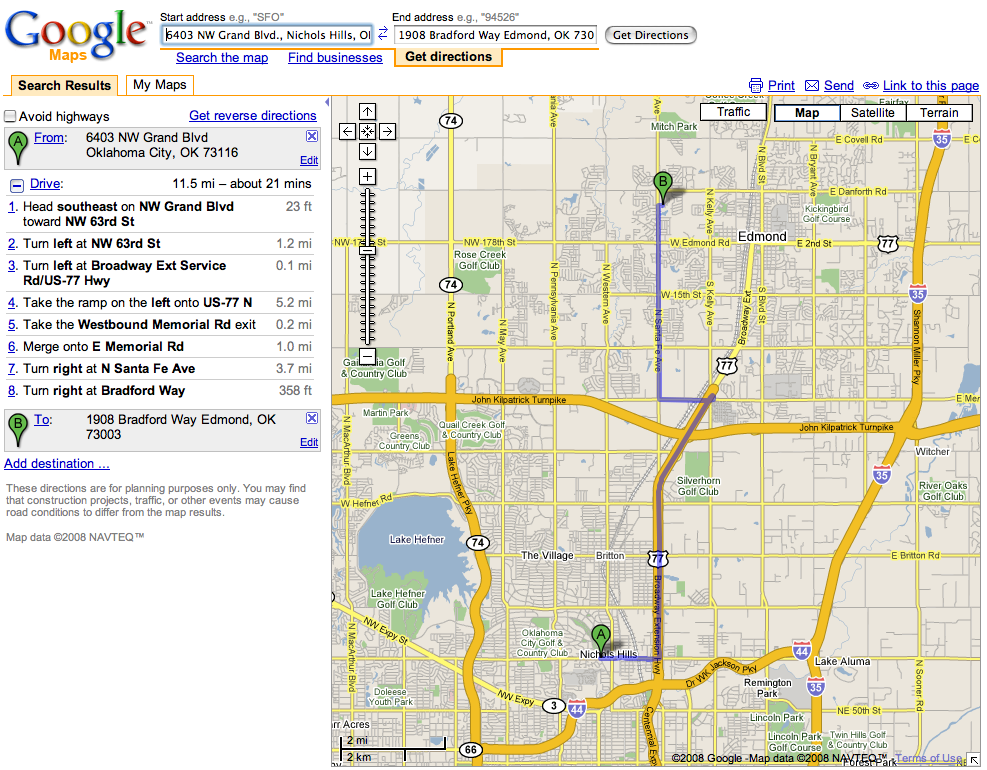
Step 3. After placing a call to the advertiser to verify their products availability and price, the searcher can then complete the three step process from searching online to buying off line by then getting directions to the advertisers location through Google Maps.

Google Local Adwords Ad + Google Maps Expansion + Directions

By adding the Google Maps feature to local Google Adwords advertisers ads, Google has bridged the gap between web search traffic and foot traffic in a fresh, unique and beneficial way.

Google Local Business Results and the Last Mile: Search Takes Two Steps Closer to Bridging the Gap Between Web and Foot Traffic

January 28, 2008

Google’s First Step…

As reported and since confirmed by Greg Sterling, Google is now showing up to 10 local business results for geographic specific queries.

Google told Greg the reason it’s showing more links is because usability testing revealed that many people didn’t realize there was additional local content available beyond the three listings, despite the “more results . . .” prompt. Accordingly, Google said that with the 10 links it is hoping to signal people that there is much more local content a click away.

Google also said that it wouldn’t always show 10 results; it might still show three sometimes or one if the query is very specific.

As Mike Blumenthal has noted, it has been nearly a year since Google last upgraded their Local OneBox. At the time it led to a significant increase in Google Maps usage.

It will be interesting to see if and how Google’s worldwide roll out of their new Local OneBox increases Google Maps usage like it did after implementing their last Local Business OneBox changes.

In my previous post about Google’s local business results being expanded, I wrote about how the listings appeared locally and some of the factors I thought contributed to the listings.

Sterling reported the ten results are based on a range of factors, including the “query, proximity, availability of ratings/reviews and their quality and several other variables.”

Since Google doesn’t publish exactly what factors influence their list, all we can do is study what they publish and draw our own conclusions as to which variables may matter the most.

The following are examples of searches I have ran, Google’s Local OneBox business results and my analysis of what variables I think generated the list.

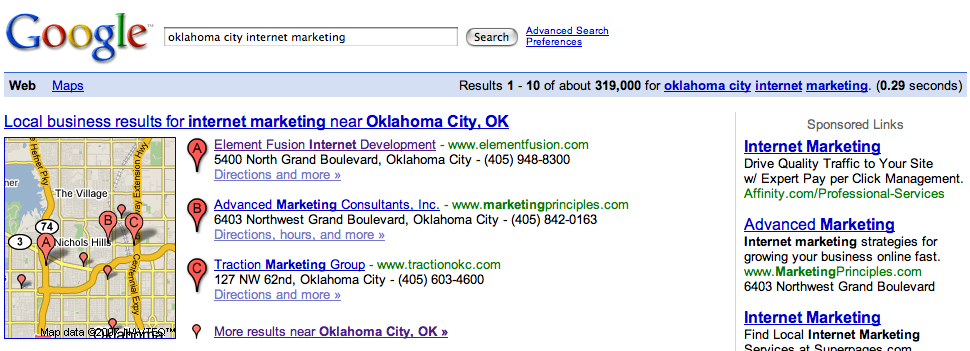
Google Local Business Results: Internet Marketing Oklahoma City –

Google Local Internet Marketing Oklahoma City

This query for a service (internet marketing) followed by the location (Oklahoma City) produced a “top of page” 10 listings OneBox result. I also found some Google Adwords ads displaying the recently discovered business address on the fourth line of the Adwords ad.

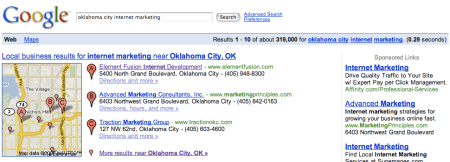
Google Local Business Results: Oklahoma City Internet Marketing –
Google Local Oklahoma City Internet Marketing

Searching for the same terms in a different order; placing the location first (Oklahoma City) and the service (internet marketing) last, produced a OneBox result with only three business listings. Some local Adwords advertisements still appeared with their specific address on the fourth line, which as mentioned previously only displayed a city or state.

Google Local Business Results: Business Marketing Oklahoma City –

Google Local Business Marketing Oklahoma City

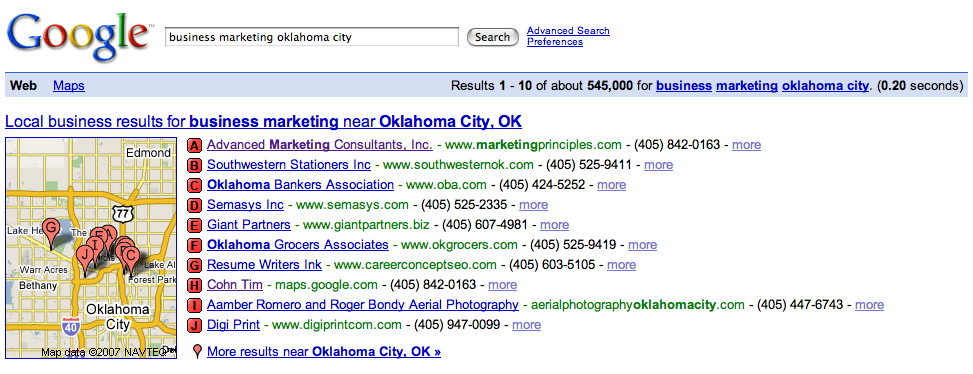
A slightly different search for a similar business category yields a new clue to at least one of the factors Google uses to generate its OneBox 10 local business listings.

A search for the service (business marketing) and the location (Oklahoma City) produces a different yet seemingly innocuous list of businesses. However, in this particular query and in addition to the expected listing for my business “Advanced Marketing Consultants” appearing, “Cohn, Tim” also appears as one of the results.

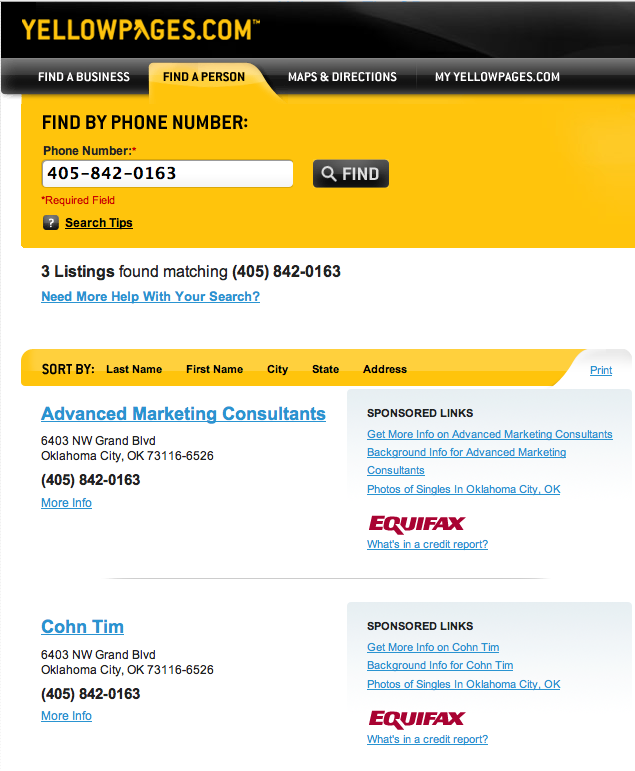
Cohn, Tim is one of my business phone listings in my local Bell telephone directory. The phone company apparently can’t sort and digitally publish business listings with an individual’s name like they can an individual’s residential phone data.

A search in YellowPages.com produces “Cohn, Tim” for my business phone number –

YellowPages.com

Yet, a search in Google for “Tim Cohn Oklahoma” produces both of my residential phone numbers and listings in correct order: Tim (first name) and then Cohn (last name) –

Tim Cohn Oklahoma

I haven’t investigated whether the phone company automatically reverses residential phone records before they are published to the web or whether Google reverses the data before they publish it.

Regardless, it looks like the business listing for “Tim Cohn” will remain forever memorialized in the vast telephone company data and its Internet counterpart as the business listing: “Cohn, Tim”.

Having accepted the fact that the telephone company seemed incapable of changing their listing results years ago, I decided to turn this particular piece of flawed data into my “control”.

When Cohn, Tim appears in print – whether online or off – its source is always local phone company data.

Thus at least a portion of this particular Google local OneBox list origins lies in business telephone directory data.

To its credit, Google has become proactive in allowing users to modify incorrect Google data as Barry Schwartz recently reported.

And unlike my attempts to get the phone company to correct how my business phone listing appears both in print and online, I am sure Google will let me append my business listing in their Google Local Business Center, but that will have to be the subject of another post.

Google Local Business Results: Chevy Oklahoma City –

Google Local Chevy Oklahoma City

Unlike with an old fashioned yellow pages search for listings with “Chevy Oklahoma City” keywords whether in the yellow pages or through directory assistance, Google can return results most likely relevant and matched to the searchers or callers intent.

Whereas, a yellow pages search or directory assistance call would take a couple of “passes” to yield the similarly accurate and desired result – businesses listings most likely to be known as “Chevy Oklahoma City”.

Brilliant!

If the telephone company can’t arrange and organize my single business listing correctly in their digital directories, how will they ever be able to compete with Google’s ability to anticipate and even provide multiple possible answers to each searchers question?

Google Local Business Results: Double Glazers Chelsea London (England) –

Google Local London

Google’s local business results aren’t just appearing in the US. A search for “double glazers” in the Chelsea section of London produces a list of double glazers midway down the search engine results page. I am not sure why some OneBox results appear at the top of the page and why others appear in the middle of the page but I believe it too must be based on Google’s understanding of the searchers intent.

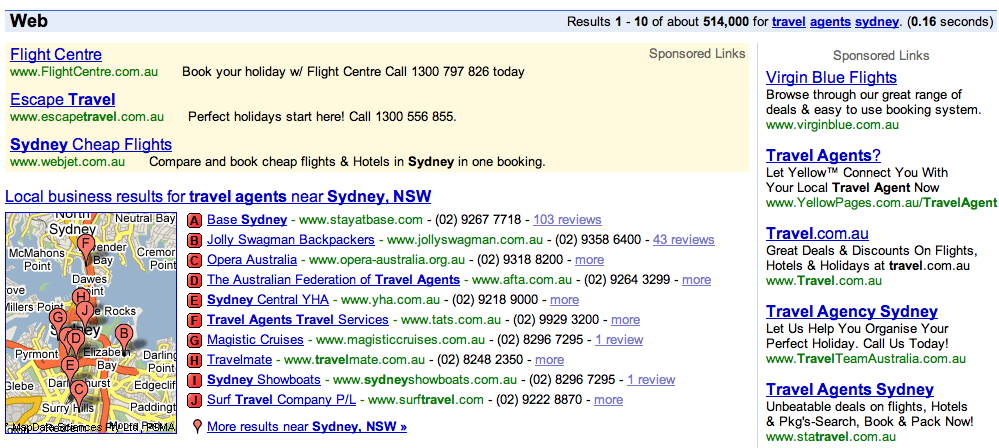
Google Local Business Results: Travel Agents Sydney (Australia) –

Google Local Sydney

This search in Sydney, Australia for travel agents also produces a OneBox result. Here the OneBox appears again at the top of the page above the organic results.

In my next post, I will show how Google’s local business results have taken a second step closer to bridging the gap between paid web search traffic and foot traffic…


Google Local Business Results Expanded

January 18, 2008

Google is now showing ten results for businesses under city, retail and service related queries instead of three.

This does two things:

1. It provides local businesses more exposure in local related searches. This in turn may aid Google’s efforts to generate more locally targeted advertising from retail and service businesses.

2. It reveals the lack of forethought shown by most businesses when it comes to choosing their free yellow pages category when ordering their phone line. If I had not spent years studying potential yellow pages categories for both mine and my client’s businesses, I too probably wouldn’t have given it much thought either. The data displayed under each query is only as informed as the person who placed the original order with the phone company.

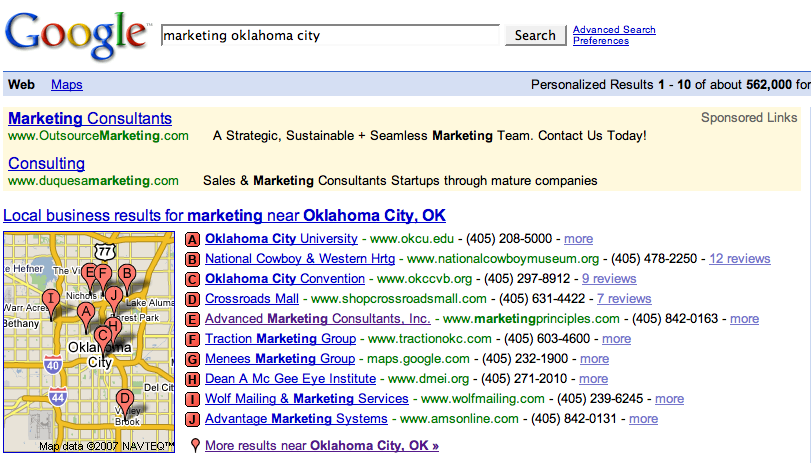
In the following example under a Google search for “marketing oklahoma city” you can see about half of the businesses listed are probably not in the business of providing “marketing” services in Oklahoma City.

Marketing Oklahoma City

However, in a search for “marketing consultant oklahoma city” you can see nearly all of the businesses listed likely provide marketing consultant services in Oklahoma City.

Marketing Consultant Oklahoma City

Fortunately my business listing – Advanced Marketing Consultants – appears within both searches today.

Yes, every business with a phone line will probably now appear in a local search result.

One question remains – will their listing be shown to the right audience?

The Internet Advertising Market

January 17, 2008

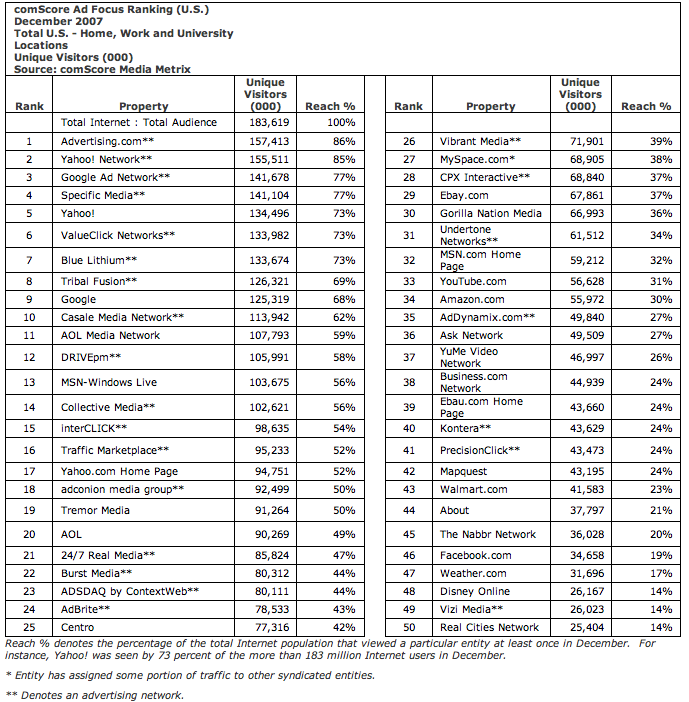
comScore Media Metrix has released its monthly analysis of U.S. consumer activity at top online properties for December 2007.

According to comScore’s Top 50 Ad Focus Ranking: “Advertising.com continued to lead the Ad Focus ranking of ad networks and sites accepting advertising, reaching 86 percent of the more than 183 million Americans online in December. Specific Media gained four spots to capture the fourth position reaching 77 percent of the online population. Collective Media gained seven spots to position 14, while Amazon.com climbed three spots to 34. YuMe Video Network, About, and Disney Online all entered the ranking this month capturing positions 37, 44, and 48, respectively.”

comScore’s Top 50 Ad Focus list is a great overview of the internet advertising market.

It also serves as a great starting point and road map for any business looking to expand their marketing presence online.

The following are the Top 50 Sources for Marketing and Advertising your business online according to comScore Media Metrix:
1. Advertising.com**
2. Yahoo! Network**
3. Google Ad Network**
4. Specific Media**
5. Yahoo!
6. ValueClick Networks**
7. Blue Lithium**
8. Tribal Fusion**
9. Google
10. Casale Media Network**
11. AOL Media Network
12. DRIVEpm**
13. MSN-Windows Live
14. Collective Media**
15. interCLICK**
16. Traffic Marketplace**
17. Yahoo.com Home Page
18. adconion media group**
19. Tremor Media
20. AOL
21. 24/7 Real Media**
22. Burst Media**
23. ADSDAQ by ContextWeb**
24. AdBrite**
25. Centro
26. Vibrant Media**
27. MySpace.com*
28. CPX Interactive**
29. Ebay.com
30. Gorilla Nation Media
31. Undertone Networks**
32. MSN.com Home Page
33. YouTube.com
34. Amazon.com
35. AdDynamix.com**
36. Ask Network
37. YuMe Video Network
38. Business.com Network
39. Ebau.com Home Page
40. Kontera**
41. PrecisionClick**
42. Mapquest
43. Walmart.com
44. About
45. The Nabbr Network
46. Facebook.com
47. Weather.com
48. Disney Online
49. Vizi Media**
50. Real Cities Network

comScore Top 50 Ad Focus

MerchantCircle.com

January 17, 2008

Over the past several months I have received telemarketing calls from MerchantCircle.com.

Each call has come after hours with the caller leaving the following voice mail message:

“Calling to let you know that after searching Google, a satisfied customer found your website on MerchantCircle.com and gave you a positive rating for being a good local business. To see your rating, go to MerchantCircle.com and enter your business telephone number into the blue box. Again, that’s MerchantCircle.com.”

Although flattered, I am highly certain after having visited their website after each voice mail – no such thing occurred.

To Merchant Circle’s credit, using an auto dialer to drum up local advertising business is somewhat innovative but in my particular case whom does MerchantCircle.com think they are kidding?

MerchantCircle.com