Archive for May, 2009

Google Searchology: New Search Options

May 12, 2009

Google hosted their second Searchology event today to update its users, partners, and customers on the progress Google has made in search.

Google also uses the event to announce new search features.

Today Google announced a new set of features called Search Options, which are a collection of tools that let searchers slice and dice results and generate different views to find information faster and easier.

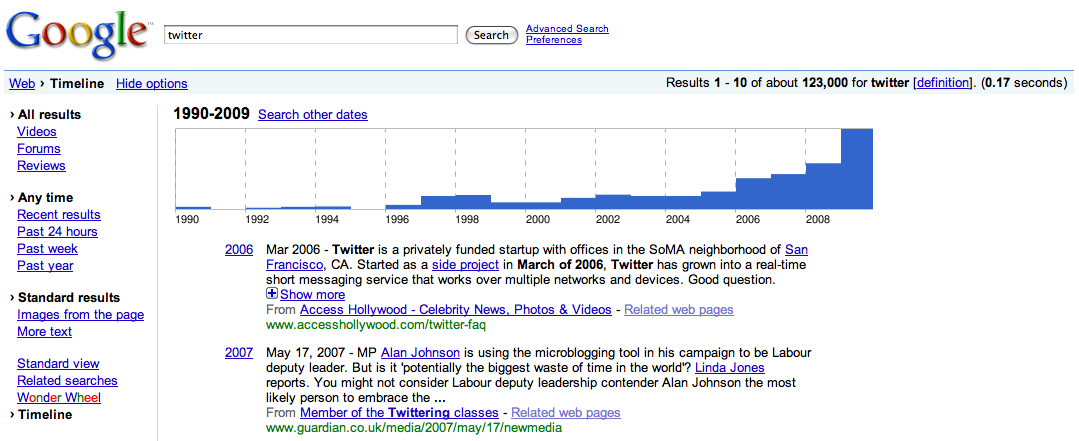
Two powerful new Google search options are the Wonder Wheel and Timeline.

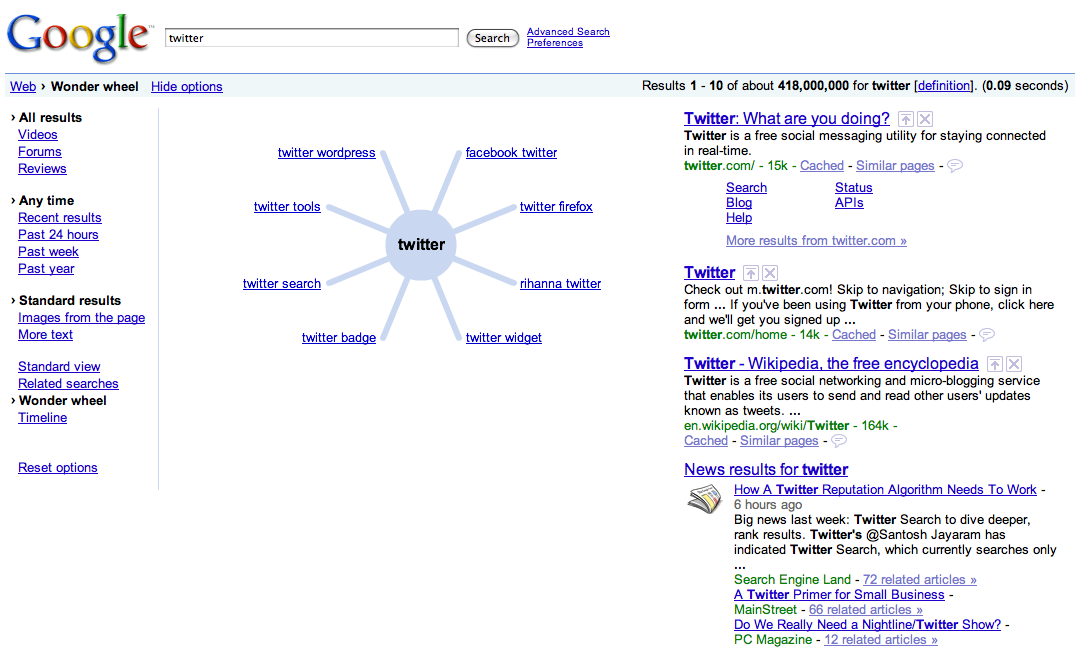
Wonder Wheel shows searchers other related terms most often used when searchers are searching for a particular topic while Timeline illustrates the search volume for a particular term within a specific time period.

Twitter Wonder Wheel

Google Wonder Wheel: Twitter

Above, The Google Wonder Wheel shows terms related to searches for Twitter.

Below, the Google search options timeline shows how Twitter has become an increasingly more searched for term on Google over time.

Google Timeline: Twitter

Google Timeline: Twitter

Bloggers: University of Phoenix Aggregation of Knowledge Initiative

May 11, 2009

Today while conducting research, I came across the following interesting forum post from Jay Dergaon:

I am conducting some research on behalf of the University of Phoenix.  They are looking into specific blogging initiatives and out reach to bloggers, internally and externally.

If you know of any students or faculty from The University of Phoenix that have a blog please let me know.  Also, if you’d be interested in writing or incorporating your blog into their new “aggregation of knowledge” initiative please let me know.

I wonder how many other higher education institutions in the U.S. include blogs or blogging in their curriculum?

Do any Universities in the United States teach blogging?

Can a student get a Bachelor of Science degree in Blogging yet?

Google Marketing Research Study: The Brand Value of Search

May 10, 2009

Google commissioned OTX, an independent marketing research company, to conduct research to better understand the impact of search impressions on travel brands, specifically the Air, Hotel, Car Rental, Cruise and OTA Travel Categories.

The primary objectives of the OTX project were to determine:

1). Whether or not a search ad can impact key branding metrics.

2). Whether or not a search result’s placement matters.

The study was conducted in an online controlled “laboratory” format that mimicked a real search experience. Subjects were exposed to 1 of 12 search engine results pages (SERP) each of which showed the same search results  and differed only where the test brand’s ad or organic listing appeared.

The results of Google’s Brand Value of Search study are available on YouTube.

2D Barcode Generator and Mobile eCommerce

May 9, 2009

Via Media Vox: Skycore, a mobile messaging service debuted mDAR (Mobile Delivery, Authentication and Redemption) at the Wireless Enterprise Symposium this week.

About mDar:

mDAR enables clients to build 2D barcodes, which some believe will ultimately wed the web to outdoor/print ads and make e-commerce mobile. When the barcodes are scanned, the information stored in them is decrypted. They can be used in grocery stores to give discounts, on print ads to provide more information on a given campaign, or to send users to a mobile subsite.

How mDar works:

When a barcode is created, it is uploaded to Cellyspace.com, then integrated and delivered to customers’ handsets. When a barcode-reading mobile phone scans the image, data goes back to Skycore servers and the clients, which can track the popularity of their respective codes.

According to Skycore Founder/CEO Rich Eicher “Our mDAR technology is a revolutionary service enabling virtually any business or organization to use mobile barcodes,”  “[It] allows you to create and deploy redeemable tickets and coupons with complementary text and multimedia content and send it cross-carrier to your customers’ mobile handsets. Redeeming 2D barcodes is easier now, too, since users can choose smart phones or other 2D scanning devices.”

Web Search From Within Gmail

May 8, 2009

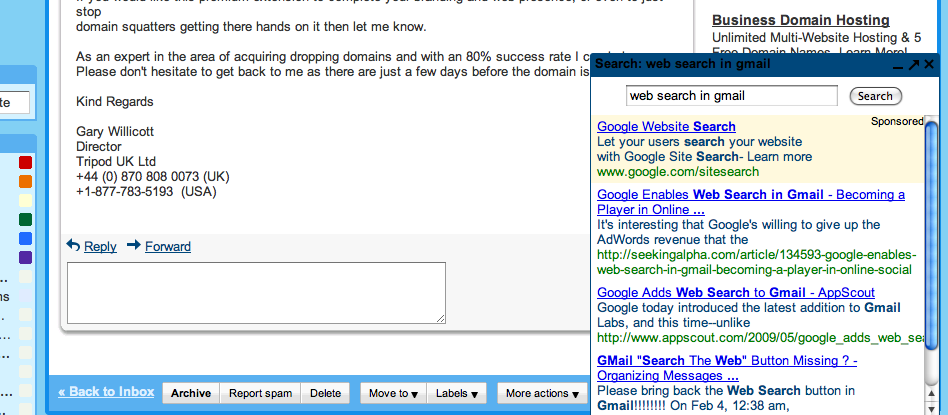
Searching the web while in Gmail up until now has required launching another browser window or leaving Gmail altogether.

Adam and Drew from Gmail Labs have solved this problem by making Google search available from within Gmail accounts.

Enable Google Search in Gmail

Enable Google Search in Gmail

About Google Search from Gmail Labs:

Displays Google search results inside your mail window, letting you quickly find things and use them when you’re writing an email.

Google Web Search in Gmail Browser

Google Web Search in Gmail Browser

With the addition of Google Search to Gmail, Gmail Labs continues to make Gmail an indispensable web mail app.

MyGofer.com: Research and Purchase Online, Pickup Offline

May 6, 2009

I read with interest yesterday a story in the Wall Street Journal about Sears Holdings Corporations annual shareholder meeting.

Chairman Edward S. Lampert Chairman said that while he expects most Sears sales to continue to occur in brick and mortar stores, he would increase investment in internet experiments.

According to the Wall Street Journal, Lampert’s goal is to capture the attention of shoppers at the crucial moment when they begin to discuss purchases with friends on social-media web sites and to research buying choices online.

Lampert said, “We want to make sure we don’t become completely irrelevant as people’s way of making decisions changes. The goal is not just survival, it’s progress.”

Toward that end, Lampert said the company may expand their MyGofer.com concept.
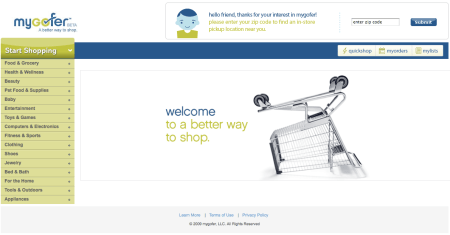
MyGofer.com

MyGofer.com

MyGofer turns some stores into pickup locations for online sales while trying to bridge the gap between online sales and traditional stores.

Sears owned Kmart unit also disclosed plans to let shoppers pick up merchandise at Kmart they have bought online.

From MyGofer site:

What is mygofer?

We believe shopping should be on your terms. That’s why we’ve created a simpler, more flexible, just plain better way to shop. We believe in giving you options. Lots of them. We believe you should be able to get whatever you want, how you want and when you want it. We’re designed to give you more choices to make shopping faster and more convenient.

We want to become your ultimate one-stop destination. We carry a broader assortment than the traditional retailer – including everything from groceries to clothing to electronics to appliances. Our assortment is designed for you, giving you everything you need in one convenient spot.

mygofer will evolve based on what you buy, and what you ask for. By listening to you, we will only get better.

What can I find at mygofer?

Pretty much everything. From toothpaste to tools to t-shirts, we have 1000’s of your favorite brands, all at one location.

Imagine Saturday morning errands taking minutes instead of hours. Imagine what you could do with all that extra time.

More choices, made easy- at competitive prices a broader assortment at your fingertips.

You did not find what you were looking for? mygofer is designed to give customers more options, but also designed to make sorting and shopping through more options easy to navigate with features like shopping lists and quick shop. Our expanded assortment gives us the opportunity to showcase great products designed to meet a variety of budget ranges. Given our expanded network, we will leverage opportunities for additional savings through special discounts, clearances and short-term price adjustments.

The correlation between researching online, buying online and buying offline have long been documented and discussed by the internet and search engine marketing community.

To truly make Sears relevant to buyers who have begun researching their buying options online, Sears Holdings Corp. ought to first consider expanding the keyword terms they bid on in Google.

Bidding just on branded terms like Kenmore and Craftsman while not bidding on appliance and power tools keyword strings like their competitors do by definition makes Sears less relevant than they could be.

Once Sears and Kmart get in the search paid and natural game, they should then have someone who knows what they are doing fix and optimize their websites.

SearsPortrait.com’s home page title tag says – you guessed it: Home!

SearsPortrait.com

SearsPortrait.com

Sears may not own the SearsPortrait.com site and business. For all I know it could be leased.

However, I am certain the new MyGofer.com site is owned by Sears Holding Corporation.

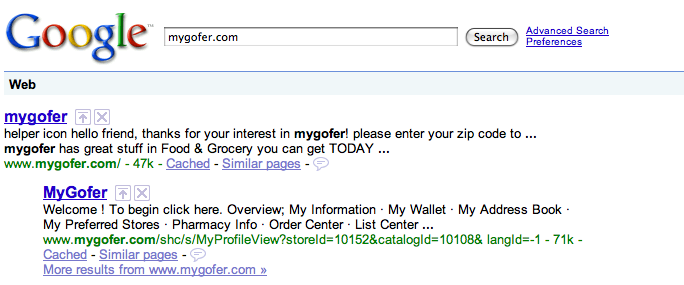
It too, can use some attention and optimization if it hopes the online audience will find the site while researching where to buy products online.
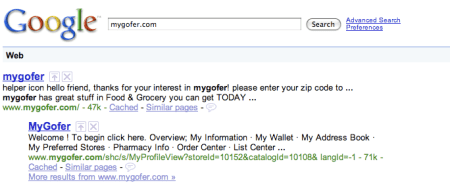
My Gofer Search Result
My Gofer Search Result

Tweetmeme: Twittersphere Buzzmeter

May 5, 2009

Curious which Tweets the Twitter audience has re-tweeted the most?

Tweetmeme aims to track and provide the most popular links generated on Twitter every five minutes.

Tweetmeme

Tweetmeme

Tweetmeme  lets visitors parse Tweets into lists of the “Most Recent”, “Top in 24 Hours” or “Top in 7 Days”.

Tweetmeme provides insight into both the popularity and reach of  Tweets within the Twitter audience.

The Future of Newspapers

May 4, 2009

From today’s Wall Street Journal, Warren Buffet owner of the Buffalo News and an investor in the Washington Post shared his outlook for the newspaper industry:

“For most newspapers in the United States, we would not buy them at any price They have the possibility of going to just unending losses.”

According to Buffet, as long as newspapers were essential to readers, they were essential to advertisers.

Indeed without a targeted audience, what media can hope to attract advertisers let alone monetize and profit from their content?

The newspaper industry has three strikes against it – a print cost structure, a shrinking audience and a contracting, transitory advertiser base.

Unfortunately, the future of newspapers no longer appears essential to either readers or advertisers.

Search Advertising Small Business Market Penetration

May 3, 2009

Australian small businesses are in line for some stimulus money from search companies Google and Yahoo.

According to the Australian, “Yahoo Search Marketing is offering businesses $150 in search inventory, while Google is giving away up to $75 per new customer.”

Why?

Its estimated ” just 2 per cent of the 1.9 million small businesses in Australia use paid search advertising. A key reason is that many businesses still do not have a website.”

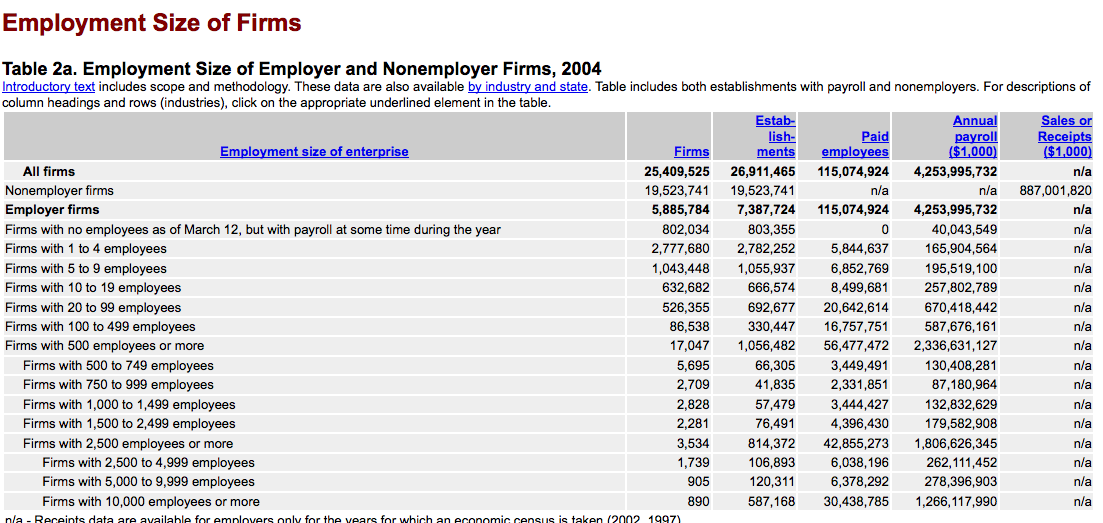
Search advertising small business penetration in the United States is surely higher isn’t it?

Number of Small Businesses in the United States

Number of Small Businesses in the United States

What percentage of small businesses in the United States buy search advertising?

What percentage of small businesses in the United States have a website?