Archive for May, 2009

Maximizing Your Google Adwords Return on Investment

May 31, 2009

The Inside Adwords blog team has posted six tactics for maximizing an Adwords Advertiser’s return on investment.

The six tactics Adwords suggests are:

1. Focus Adwords ads on low prices and savings.

Consumers care about prices more than ever, especially on day-to-day purchases. When someone searches on a particular product, you know they’re interested; by using your ad to tell them that you’ve got the highest quality and the best price, you’re more likely to earn their click. Update your ad text to focus on low prices, good values, and timely promotions.

Adwords Low Prices and Savings

Adwords Low Prices and Savings

2. Use value-related keywords.

It’s open season for bargain hunters. To reach these deal-conscious consumers, add appropriate price- and discount-related keywords. Try the AdWords Search-based Keyword Tool and Search Query Performance report to find and higher-performing keywords that people are actually searching on.

Value Related Keywords

Value Related Keywords

3. Make sure ad groups are targeted and relevant.

Ads perform best when their ad text reflects the ad group’s keywords; this makes ads more relevant to their intended audience. Make sure that both the text and the keywords in each ad group focus on a specific topic or product. For instance, an ad group about “tennis sneakers” will generally perform better than a broader ad group about “sneakers.”
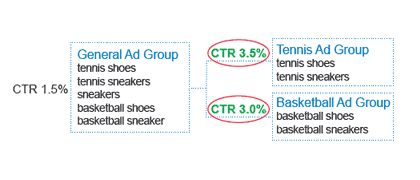
Targeted Relevant Ad Groups

Targeted Relevant Ad Groups

4. Don’t waste money on irrelevant clicks.

The wrong keywords can attract people who are looking for products you don’t offer. Use negative keywords to filter out traffic that’s not related to your offering. The Search Query Performance report can help you identify potential negative keywords by showing which queries have triggered your ads.

Irrelevant Clicks

Irrelevant Clicks

5. Make it easy for customers to buy.

Since people are spending more time comparing products and services online, make it easier for them to find what they’re looking for and buy from your site. Use the best Destination URL to send visitors directly to the page about the product or service promoted in your ad.

Make It Easy To Buy

Make It Easy To Buy

6. Focus budget on high-performers.

To get the most out of your campaigns, focus your time and resources on the keywords, ads, and ad groups that are driving the most value for your spend. To determine what’s performing best for you, consider Google’s free Conversion Tracking tool.

High Performing Keywords

High Performing Keywords

Google Wave and Natural Language Processing

May 30, 2009

Google has announced its new Google Wave product.

The following video explains how Google Wave processes natural language.

The Internet: Media’s Black Hole

May 29, 2009

With the ongoing destruction of traditional media’s business model, it occurred to me the internet is to the media what a black hole is to a galaxy.

Princeton Wordnet’s definition of black hole:

(n) black hole (a region of space resulting from the collapse of a star; extremely high gravitational field)

In media’s case; eventually few if any advertising dollars will have been able to escape the pull of the internet’s “extremely high gravitational field.”

What two forces gave birth to the extremely high gravitational field now sucking the life out of traditional media’s business model?

Attention and Economics.

Before a seller can ever make a sale, they first have to get the buyers attention.

Traditional media has long since lost its monopoly of consumer’s attention and along with it the dollars advertisers spent to get buyers attention.

Who Owns Your Tweets? You or Twitter?

May 28, 2009

There have been several posts in the last day or two about who owns a Twitter account – the employee or the employer.

I believe the Seo Writer blog answered the question the best in the following Q&A format:

Q: Who owns the Twitter account?
A: Twitter.

At which point I have commented: Yeah – and because Twitter owns all Twitter accounts don’t they also “own” all the content you have posted on it?

While Seo Writer’s answer appears to be the correct one, I think it also begs the question “Who Owns Your Tweets? You or Twitter?

Maybe someone over at Twitter could help answer this question if they haven’t already.

Flickr Images in Google Search Results

May 28, 2009

Today while scanning Google web search results, I happened upon a Flickr image result displayed in line with Google’s regular search results.

As far as I can recall, I don’t remember finding Flickr images anywhere in Google other than in Google Image search before today.

Flickr Images in Google Search Results

Flickr Images in Google Search Results

Clicking the icon to see all public photos and videos tagged with the keyword as suggested took me to the Flickr site.

Once on the Flickr page, I was informed there were a total of 40 photos tagged with the keyword I initially searched for.

Flickr Google Search Referral

Flickr Google Search Referral

Will Google expand distribution of Flickr images within its web results further for people specific search like the one above?

Or will Google display Flickr images within its web search results  for an broadening array of keywords?

My guess is the images will be confined to people related keyword searches for the time being.

Microsoft adCenter Spring Update

May 27, 2009

Microsoft adCenter has added several new features this spring to help advertisers: 1).  Save time managing their campaigns, 2). Give them more control over content ads distribution, and 3). Efficiently maintain their accounts to help improve performance.

Specifically the Microsoft adCenter Spring Upgrade gives advertisers the ability to:

•    Apply customer targets and incremental bids at the campaign level.

•    Generate new keywords with improved research and refinement tools.

•    Set and monitor bids with the improved default bid feature.

•    Exclude up to 500 websites where you do not want your content ads to appear.

Microsoft adCenter believes these new feature will help advertisers’ supercharge their ROI.

Digital Marketing Thought Leader Interviews @ DoubleClick

May 26, 2009

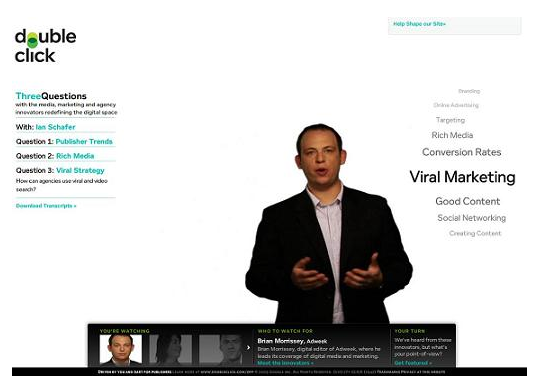
DoubleClick has launched a new video interview series called Three Questions for Innnovators.

DoubleClick’s video interviews cover the marketing and advertising industry’s most pressing themes and issues, including current trends and influencers, ad exchanges, social media, emerging media and the future.

Digital Marketing Thought Leaders

Digital Marketing Thought Leaders

To date, DoubleClick has interviewed twelve digital media thought leaders and innovators.

Transcripts of the interviews are also available.

To be expected, there are some simple yet profound insights in the interviews like the observation below from Esther Dyson:

“How can I get better viral marketing for my product? Have a better product!”

Twitter Search Errors… Again

May 25, 2009

Twitter search appears to be taking a vacation this Memorial Day 2009:

Twitter Search Error

Twitter Search Error

This isn’t the first time I have had difficulty accessing Twitter search.

Welcome Google User

May 24, 2009

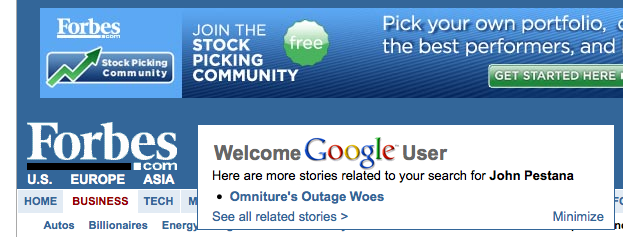
For all of the complaints coming from publishers about how Google siphons their content while offering nothing in exchange, I found this pop in ad on Forbes.com somewhat curious.

Welcome Google User

Welcome Google User

Had I not been searching on Google and had Forbes.com not had their content indexed by Google, I am highly certain I would not have visited Forbes.com at this particular time.

With the presence of their pop in ad, Forbes has at a minimum begun to accept a higher level of responsibility for how they serve their site visitors’ needs regardless of how the visitors arrived at any particular piece of content.

Business Management Reduced to Three Steps

May 23, 2009

In this Google webinar, Avinash Kaushik gives marketers a list of five things they can do to improve their business results.

The theme of Kaushik’s presentation “Aggregation of Marginal Gains: Little Changes, Large Results” stemmed from John Carlzon’s quote: “You cannot improve one thing by 1000% but you can improve 1000 little things by 1%.”

In his Google webinar, Kaushik also brilliantly condensed the essence of business management into three simple steps:

1. Increase revenue

2. Decrease costs

3. Improve customer satisfaction and loyalty.