Hitwise has an interesting post on year over year search referrals for 15 industry categories.
From Hitwise:
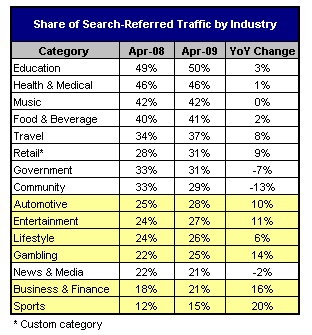
For the majority of categories measured at Hitwise, search is the top source of traffic referrals and the share has increased year-over-year. Overall, search is increasing as a traffic driver. Among the parent categories that received less than 25% of traffic from search in April 2008, all except News & Media received a higher share of search referrals last month.
2008 Search Referred Traffic vs. 2009 by Industry
Share of Search Referred Traffic by Industry
Hitwise Search Analyst Heather Dougherty suggests the data indicates growth opportunities remain in industries were search hasn’t yet been exploited fully as a referral tool.
According to Dougherty, laggard categories who have yet to capitalize on search referrals are the Automotive, Entertainment, Lifestyle, Gambling, News & Media, Business & Finance and Sports industries.
Could it be the businesses who haven’t yet capitalized on search as a referral mechanism haven’t clearly identified how an increased search engine presence will translate directly into increased revenues for their respective industries?
comScore’s Chairman Gian Fulgoni recently presented the “State of the U.S. Online Retail Economy through Q1 2009”.
Fulgoni’s presentation provided excellent insight into the online channel’s influence on both online and offline consumer behavior.
Because comScore gathers their data from a global panel of 2 Million Internet users, comScore research is required reading for every search behaviorist.
Of the material in comScore’s “State of the U.S. Online Retail Economy through Q1 2009”, I found the following slide one of the most provocative.
Research Onlne Buy Offline
The message is clear: whether a brand marketer or a one person shop – having an online presence is essential for reaching and connecting with buyers both online and off.
For several years I have been experimenting with domains and search engine results pages.
This particular domain SearchMarketingCommunications.com has been in both passive and active trials for several years.
Recently, I purchased the domain redirection option from WordPress for the blog address this domain publishes from cohn:wordpress.com.
Although it hasn’t yet been re-indexed by Google, the new domain is getting published by and distributed within both Yahoo and MSN search engine results pages (SERPs).
From the Official Google Blog about the outage many Google users experienced today:
Imagine if you were trying to fly from New York to San Francisco, but your plane was routed through an airport in Asia. And a bunch of other planes were sent that way too, so your flight was backed up and your journey took much longer than expected. That’s basically what happened to some of our users today for about an hour, starting at 7:48 am Pacific time.
An error in one of our systems caused us to direct some of our web traffic through Asia, which created a traffic jam. As a result, about 14% of our users experienced slow services or even interruptions. We’ve been working hard to make our services ultrafast and “always on,” so it’s especially embarrassing when a glitch like this one happens. We’re very sorry that it happened, and you can be sure that we’ll be working even harder to make sure that a similar problem won’t happen again. All planes are back on schedule now.
Luckily for the free world, Google is consistently more reliable than both the American Airlines trip I am now on or the AT&T Wifi service I am trying to upload this blog post from while stranded here in the Raleigh Durham, NC Airport.
WordPress has announced a new feature whereby bloggers can post to their blogs via email.
From the WordPress blog:
You can send email from any email client, whether in a browser, on your desktop, or from your cell phone, and as much formatting will be retained as possible.
Attachments are not left out, and your images will be included and automatically converted into thumbnails. If you include multiple images they’ll be converted into an attractive gallery. Now you can take photos anywhere and have them appear on your blog in moments.
I am not sure how to add tags or links to the post or how easily photos are embedded either.
More about the Post by Email feature from WordPress:
Google hosted their second Searchology event today to update its users, partners, and customers on the progress Google has made in search.
Google also uses the event to announce new search features.
Today Google announced a new set of features called Search Options, which are a collection of tools that let searchers slice and dice results and generate different views to find information faster and easier.
Two powerful new Google search options are the Wonder Wheel and Timeline.
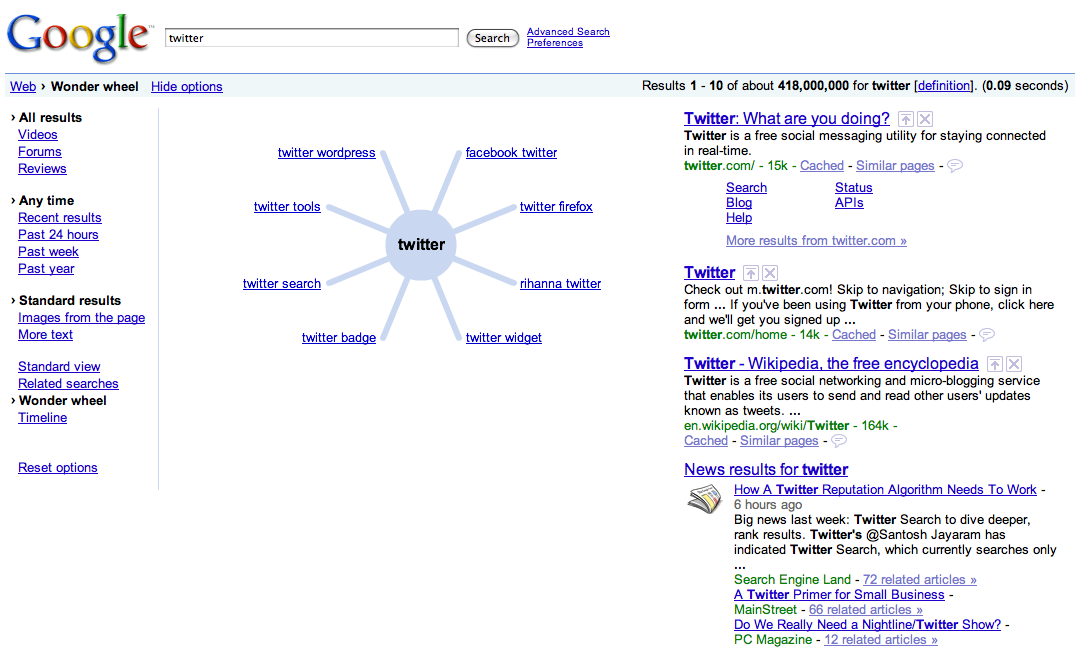
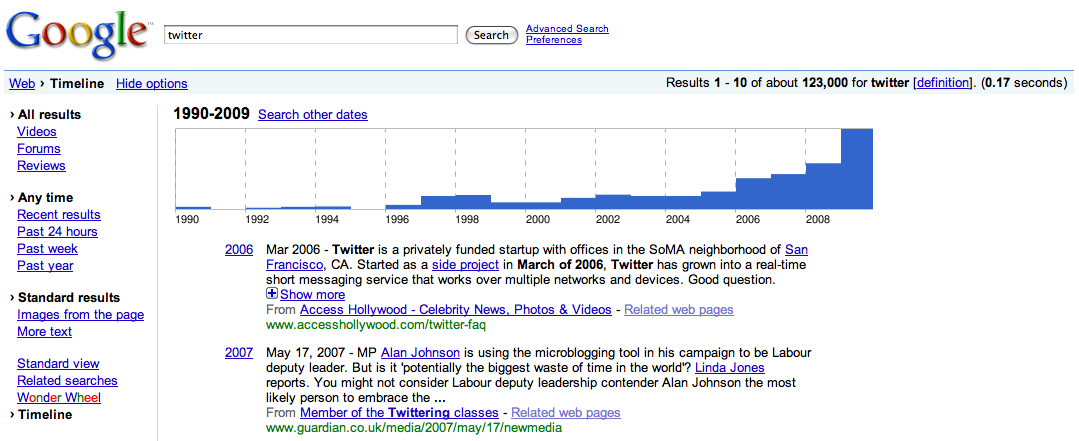
Wonder Wheel shows searchers other related terms most often used when searchers are searching for a particular topic while Timeline illustrates the search volume for a particular term within a specific time period.
Google Wonder Wheel: Twitter
Above, The Google Wonder Wheel shows terms related to searches for Twitter.
Below, the Google search options timeline shows how Twitter has become an increasingly more searched for term on Google over time.
Today while conducting research, I came across the following interesting forum post from Jay Dergaon:
I am conducting some research on behalf of the University of Phoenix. They are looking into specific blogging initiatives and out reach to bloggers, internally and externally.
If you know of any students or faculty from The University of Phoenix that have a blog please let me know. Also, if you’d be interested in writing or incorporating your blog into their new “aggregation of knowledge” initiative please let me know.
I wonder how many other higher education institutions in the U.S. include blogs or blogging in their curriculum?
Do any Universities in the United States teach blogging?
Can a student get a Bachelor of Science degree in Blogging yet?
Google commissioned OTX, an independent marketing research company, to conduct research to better understand the impact of search impressions on travel brands, specifically the Air, Hotel, Car Rental, Cruise and OTA Travel Categories.
The primary objectives of the OTX project were to determine:
1). Whether or not a search ad can impact key branding metrics.
2). Whether or not a search result’s placement matters.
The study was conducted in an online controlled “laboratory” format that mimicked a real search experience. Subjects were exposed to 1 of 12 search engine results pages (SERP) each of which showed the same search results and differed only where the test brand’s ad or organic listing appeared.
The results of Google’s Brand Value of Search study are available on YouTube.
Via Media Vox: Skycore, a mobile messaging service debuted mDAR (Mobile Delivery, Authentication and Redemption) at the Wireless Enterprise Symposium this week.
About mDar:
mDAR enables clients to build 2D barcodes, which some believe will ultimately wed the web to outdoor/print ads and make e-commerce mobile. When the barcodes are scanned, the information stored in them is decrypted. They can be used in grocery stores to give discounts, on print ads to provide more information on a given campaign, or to send users to a mobile subsite.
How mDar works:
When a barcode is created, it is uploaded to Cellyspace.com, then integrated and delivered to customers’ handsets. When a barcode-reading mobile phone scans the image, data goes back to Skycore servers and the clients, which can track the popularity of their respective codes.
According to Skycore Founder/CEO Rich Eicher “Our mDAR technology is a revolutionary service enabling virtually any business or organization to use mobile barcodes,” “[It] allows you to create and deploy redeemable tickets and coupons with complementary text and multimedia content and send it cross-carrier to your customers’ mobile handsets. Redeeming 2D barcodes is easier now, too, since users can choose smart phones or other 2D scanning devices.”




 Search Marketing Communications
You must be logged in to post a comment.