Archive for 2009

Oops, Bing: Just One Thing

June 5, 2009

As we all know by now, Microsoft has launched its highly hyped new search engine called Bing.

Instead of gushing about Bing the product’s attributes or shortcomings, I instead will concentrate on its one glaring strategic flaw – market positioning.

According to Search Engine Land, in developing its marketing and advertising campaign to position Bing as a “decision engine” among other things, Microsoft relied on its own limited perception of what searchers wanted from a search engine ie., Microsoft’s own limited internal search data.

Having a myopic self view of a market may work in segments where your products enjoy an effective monopoly like say desktop software.

However, extrapolating a markets wants and needs from a subset of the search audience can ultimately only produce an incremental increase in search market share at best.

Experienced search marketers understand the differences between the Google, Yahoo, Bing (Live) and even AOL search audiences.

Apparently the same can’t be said for the search technology team at Microsoft, I guess that’s why they work at Microsoft.
Google Adwords Recommendations By Email

June 4, 2009

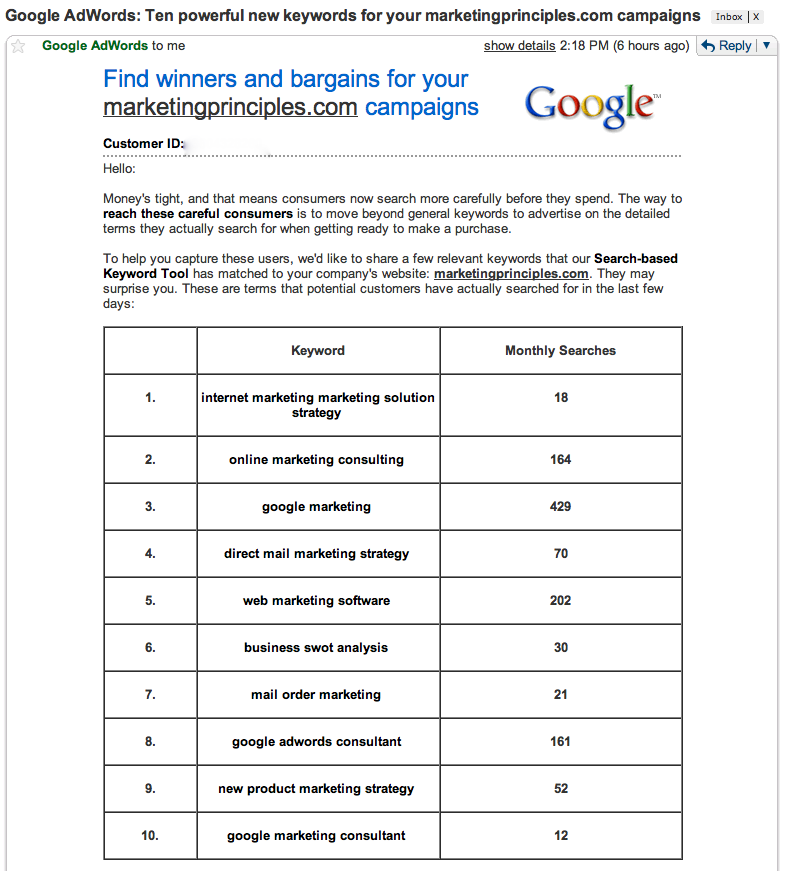
Today I receieved the first email from Google Adwords I can recall receiving suggesting keywords not already within my Adwords account I should consider using.

The email’s subject line captured my attention:

Google AdWords: Ten powerful new keywords for your marketingprinciples.com campaigns

Upon opening the email, I found the following message along with Google Adwords top ten keyword recommendations for my website marketingprinciples.com.

Google Adwords Recommendations

Google Adwords Recommendations

I wasn’t surprised with any of their keyword suggestions as much as I was with their having sent their search based keyword tool recommendations to me.

According to Adwords:

These are just the top 10 keywords. The Search-based Keyword Tool actually found 712 recently-searched keywords related to your site.

For each suggested keyword, the tool will also show you:

The average number of searches per month
The competitive bidding level for each term
The estimated bid to appear in the top three ad positions
The suggested landing page for each keyword

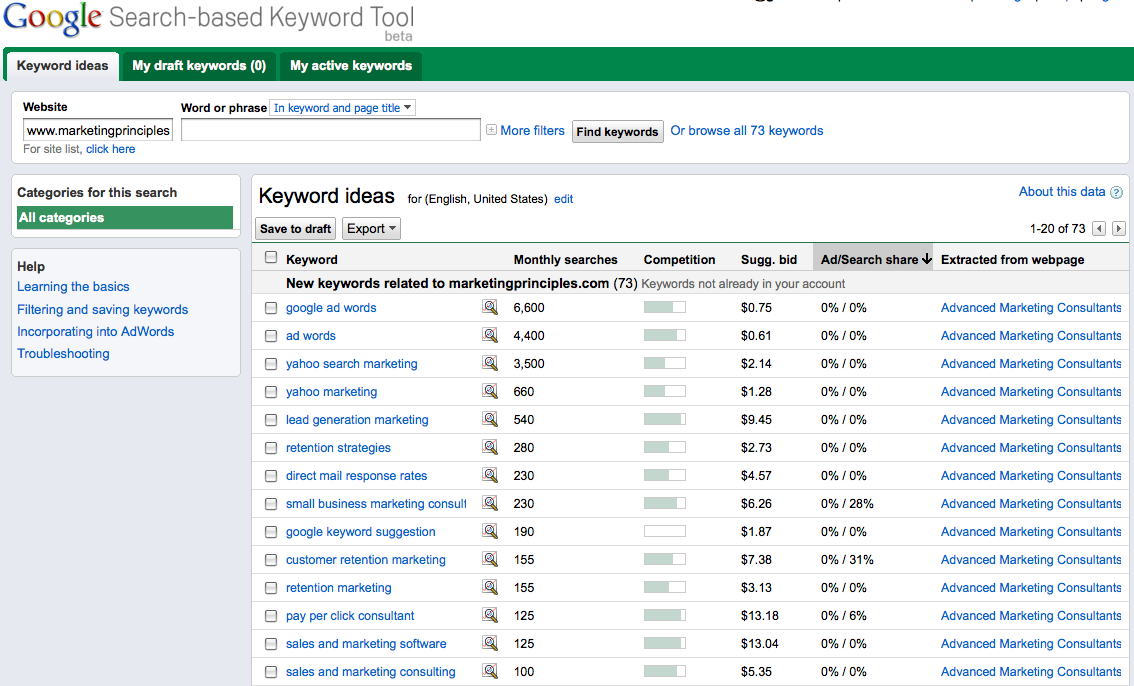
As suggested at the conclusion of their email, I logged into my Adwords account and ran the Search Based Keyword Tool to retrieve the “712 recently-searched keywords” related to my site.

However, the search-based keyword tool produced 73 keywords for marketingprinciples.com not 712.

Google Search Based Keyword Tool

Google Search Based Keyword Tool

Regardless, the search-based keyword list the tool provided for my site was relevant and specific to my business.

The recommended keyword list can be saved as a draft to an Adwords account or exported in a spreadsheet.

The tool’s most valuable feature is its matching of the new found keywords with their corresponding web page url.

For site’s with hundreds or thousands of pages, this feature can significantly reduce the amount of time needed to successfully program Adwords campaigns.

Google Local Business Center Dashboard Live

June 3, 2009

The Google Lat Long Blog has announced their roll out of the Local Business Center dashboard containing local listing and search data.

Initial data available in the Local Business Center:

Impressions: The number of times the business listing appeared as a result on a Google.com search or Google Maps search in a given period.

Actions: The number of times people interacted with the listing; for example, the number of times they clicked through to the business’ website or requested driving directions to the business.

Top search queries: Which queries led customers to the business listing; for example, are they finding the listing for a cafe by searching for “tea” or “coffee”?

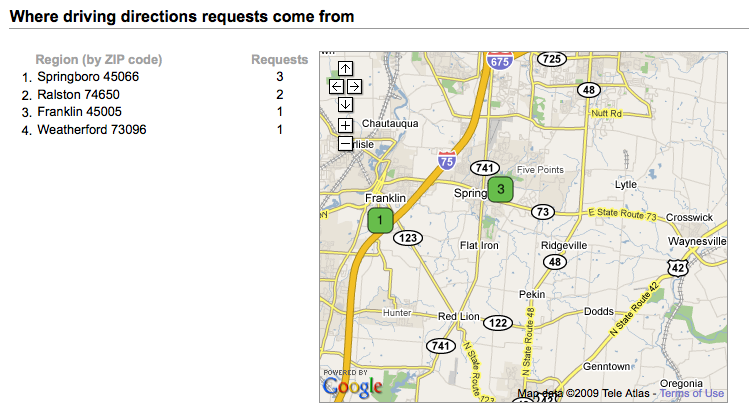
Zip codes where driving directions come from: Which zip codes customers are coming from when they request directions to your location.

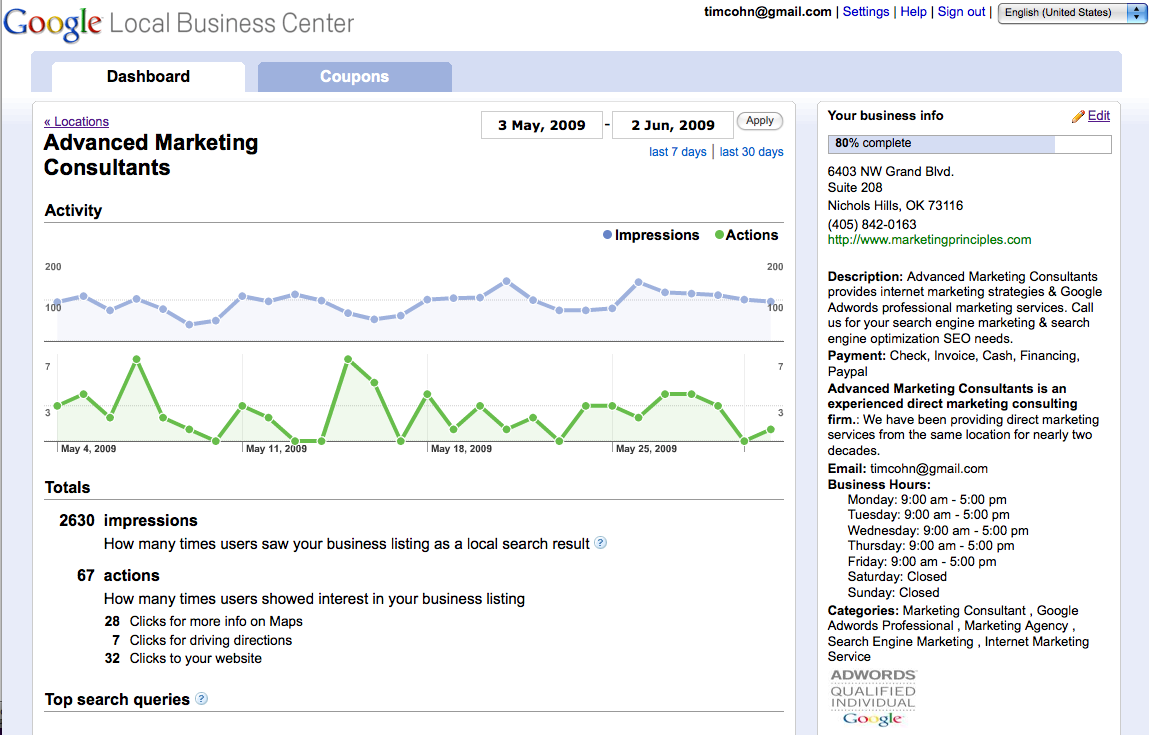
Indeed, when I logged into my Google Local Business Center account I found a scaled down Google Analytics type Dashboard waiting for me.

Google Local Business Center

Google Local Business Center

The top field on the Dashboard shows how many times users saw my particular business listing, how many clicks were for more information from Google Maps, how many clicks were for driving directions and how many clicks were delivered to my website.

The middle field on the Dashboard provide a top search queries bar graph.

Top Local Business Center Search Queries

Top Local Business Center Search Queries

The last field shows where driving directions came from.

Where Driving Directions Came From

Where Driving Directions Came From

The right rail shows all of the data I have provided to the Google Local Business Center and includes a link for editing my data.

Your Local Business Center Listing

Your Local Business Center Listing

Providing search data to businesses listed in the Google Local Business Center gives business owners yet another level of insight into how their business are performing online.

A Novel Bing Marketing Tactic: Buy Ads On Google

June 2, 2009

While checking my email today in Gmail I was somewhat surprised to see the following ad dsiplayed above my inbox:

Microsoft Bing Google Adwords Ad

Microsoft Bing Google Adwords Ad

Microsoft is also buying Google Adwords to promote their new Bing “decision engine” brand in Google search results.

Google Search Bing Ad

Google Search Bing Ad

Bing the brand is also being advertised in Google search results under “decision engine” as well as –

Decision Engine Ad

Decision Engine Ad

“search engine”.

Search Engine Ad

Search Engine Ad

I know its hard to believe but people still search Google.com for “search engine” and “search engines”.

In fact, according to Google – over 5,000,000 people worldwide search for either the single or plural version of the phrase each month.

Search Engine Demand

Search Engine Demand

However, a considerably smaller number of people search for the single or plural version of decision engine.

Decision Engine Search Demand

Decision Engine Search Demand

Roughly 5,000 times fewer searches in fact.

Microsoft Bing Live

June 1, 2009

I noticed search referrals coming from Bing today in my WordPress logs.

At first glance, it seemed like Bing was sending an inordinate amount of referrals for a Beta product.

After further investigation, it appears Bing is now Live worldwide.

Microsoft Bing Live

Microsoft Bing Live

With Microsoft’s official launch of Bing, MSFT also began an attempt to reposition the search process as something more than search by calling Bing a “decision engine”. Microsoft then directed all initial interest in Bing to DecisionEngine.com.

DecisionEngine.com has a video demonstration of Bing features while Live.com now redirects to Bing.com.

MSN.com is also showing a Bing preview box on its home page.

Bing Preview

Bing Preview

Maximizing Your Google Adwords Return on Investment

May 31, 2009

The Inside Adwords blog team has posted six tactics for maximizing an Adwords Advertiser’s return on investment.

The six tactics Adwords suggests are:

1. Focus Adwords ads on low prices and savings.

Consumers care about prices more than ever, especially on day-to-day purchases. When someone searches on a particular product, you know they’re interested; by using your ad to tell them that you’ve got the highest quality and the best price, you’re more likely to earn their click. Update your ad text to focus on low prices, good values, and timely promotions.

Adwords Low Prices and Savings

Adwords Low Prices and Savings

2. Use value-related keywords.

It’s open season for bargain hunters. To reach these deal-conscious consumers, add appropriate price- and discount-related keywords. Try the AdWords Search-based Keyword Tool and Search Query Performance report to find and higher-performing keywords that people are actually searching on.

Value Related Keywords

Value Related Keywords

3. Make sure ad groups are targeted and relevant.

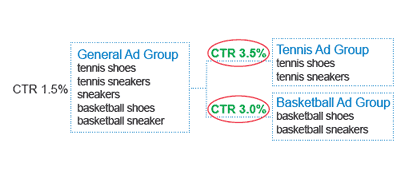
Ads perform best when their ad text reflects the ad group’s keywords; this makes ads more relevant to their intended audience. Make sure that both the text and the keywords in each ad group focus on a specific topic or product. For instance, an ad group about “tennis sneakers” will generally perform better than a broader ad group about “sneakers.”

Targeted Relevant Ad Groups

Targeted Relevant Ad Groups

4. Don’t waste money on irrelevant clicks.

The wrong keywords can attract people who are looking for products you don’t offer. Use negative keywords to filter out traffic that’s not related to your offering. The Search Query Performance report can help you identify potential negative keywords by showing which queries have triggered your ads.

Irrelevant Clicks

Irrelevant Clicks

5. Make it easy for customers to buy.

Since people are spending more time comparing products and services online, make it easier for them to find what they’re looking for and buy from your site. Use the best Destination URL to send visitors directly to the page about the product or service promoted in your ad.

Make It Easy To Buy

Make It Easy To Buy

6. Focus budget on high-performers.

To get the most out of your campaigns, focus your time and resources on the keywords, ads, and ad groups that are driving the most value for your spend. To determine what’s performing best for you, consider Google’s free Conversion Tracking tool.

High Performing Keywords

High Performing Keywords

Google Wave and Natural Language Processing

May 30, 2009

Google has announced its new Google Wave product.

The following video explains how Google Wave processes natural language.

The Internet: Media’s Black Hole

May 29, 2009

With the ongoing destruction of traditional media’s business model, it occurred to me the internet is to the media what a black hole is to a galaxy.

Princeton Wordnet’s definition of black hole:

(n) black hole (a region of space resulting from the collapse of a star; extremely high gravitational field)

In media’s case; eventually few if any advertising dollars will have been able to escape the pull of the internet’s “extremely high gravitational field.”

What two forces gave birth to the extremely high gravitational field now sucking the life out of traditional media’s business model?

Attention and Economics.

Before a seller can ever make a sale, they first have to get the buyers attention.

Traditional media has long since lost its monopoly of consumer’s attention and along with it the dollars advertisers spent to get buyers attention.

Who Owns Your Tweets? You or Twitter?

May 28, 2009

There have been several posts in the last day or two about who owns a Twitter account – the employee or the employer.

I believe the Seo Writer blog answered the question the best in the following Q&A format:

Q: Who owns the Twitter account?
A: Twitter.

At which point I have commented: Yeah – and because Twitter owns all Twitter accounts don’t they also “own” all the content you have posted on it?

While Seo Writer’s answer appears to be the correct one, I think it also begs the question “Who Owns Your Tweets? You or Twitter?

Maybe someone over at Twitter could help answer this question if they haven’t already.

Flickr Images in Google Search Results

May 28, 2009

Today while scanning Google web search results, I happened upon a Flickr image result displayed in line with Google’s regular search results.

As far as I can recall, I don’t remember finding Flickr images anywhere in Google other than in Google Image search before today.

Flickr Images in Google Search Results

Flickr Images in Google Search Results

Clicking the icon to see all public photos and videos tagged with the keyword as suggested took me to the Flickr site.

Once on the Flickr page, I was informed there were a total of 40 photos tagged with the keyword I initially searched for.

Flickr Google Search Referral

Flickr Google Search Referral

Will Google expand distribution of Flickr images within its web results further for people specific search like the one above?

Or will Google display Flickr images within its web search results  for an broadening array of keywords?

My guess is the images will be confined to people related keyword searches for the time being.