As a Google Advertising Professional, I use the Google Adwords keyword suggestion tool daily.
Here is my Google Adwords video showing how to use keyword suggestion tool and a link to the Google Adwords external keyword suggestion tool.
As a Google Advertising Professional, I use the Google Adwords keyword suggestion tool daily.
Here is my Google Adwords video showing how to use keyword suggestion tool and a link to the Google Adwords external keyword suggestion tool.
97.5 million viewers on average watched Super Bowl XLII.
Advertisers paid $2,700,000 for a 30 second spot. The advertisers effectively paid .027 per impression to reach the second largest television audience ever recorded.
Only large brands or smaller ones betting the company can afford Super Bowl commercials.
An important question for any business contemplating making such a large one-time purchase is – what percentage of the audience is inactive? What percentage of the audience is unreceptive to my company and its offer?
80% inactive audience?
90% inactive audience?
99.99% inactive audience?
100% inactive audience?
More importantly, what percentage of the television audience is an active audience? An audience who will at some point now or in the future be interested in what I am selling let alone buy it?
100% active audience?
10% active audience?
1% active audience?
0% active audience?
It would be an interesting case study to see what amount – if any – Salesgenie.com recoups from its Super Bowl XLII brand messaging and offer investment.
Alternatively with the same $2,700,000, Salesgenie.com could have bought 2,700,000 active audience members @ $1.00 clicks through a Google Advertising Professional.
Even bidding and paying $5.00 a click, SaleGenie.com could have reached and connected with 540,000 American salesmen looking for leads.
I wonder how many sales people acted on their Super Bowl ad? 5 million? I doubt it. There probably aren’t 5 million sales leads buyers in the United States.
What are the odds they reached, fielded let alone converted 540,000 leads (.0055 of the entire Super Bowl audience) from their Super Bowl XLII ad?
Did SalesGenie.com advertising gamble beat the odds or get beaten by them?
As I mentioned in my last post, Google has begun taking additional steps to bridge the gap between web search traffic and their advertiser’s foot traffic.
In researching the different types of Local OneBox results found both here in the United States and abroad, I found an Adwords ad format I hadn’t yet seen – an Adwords Ad with a Google Maps icon embedded within the Google Adwords advertiser’s ad.
By adding Google Maps images to local advertisers ads, Google has simplified and reduced the searching online to visiting off line and in person to three steps.
Step 1. The search for local products or services : Oklahoma City Web Design
The search for “Oklahoma City Web Design” produced the usual sponsored links both those above the new 10 OneBox results and those found along the right rail. However, after closer inspection I noticed the second listing had a maps icon embedded in the ad.
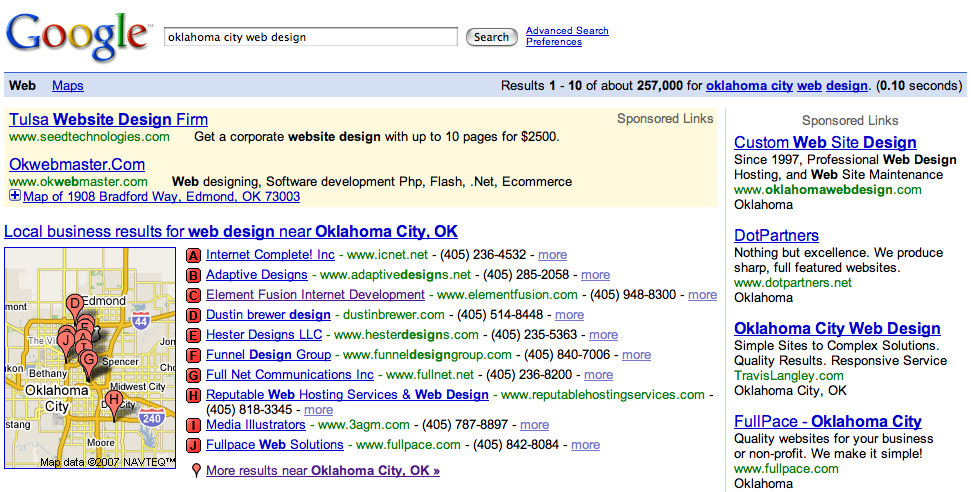
Step 2. Local product or service providers advertisement selected. Selection factors could include brands or services offered and their convenience to the searcher.

Step 3. After placing a call to the advertiser to verify their products availability and price, the searcher can then complete the three step process from searching online to buying off line by then getting directions to the advertisers location through Google Maps.
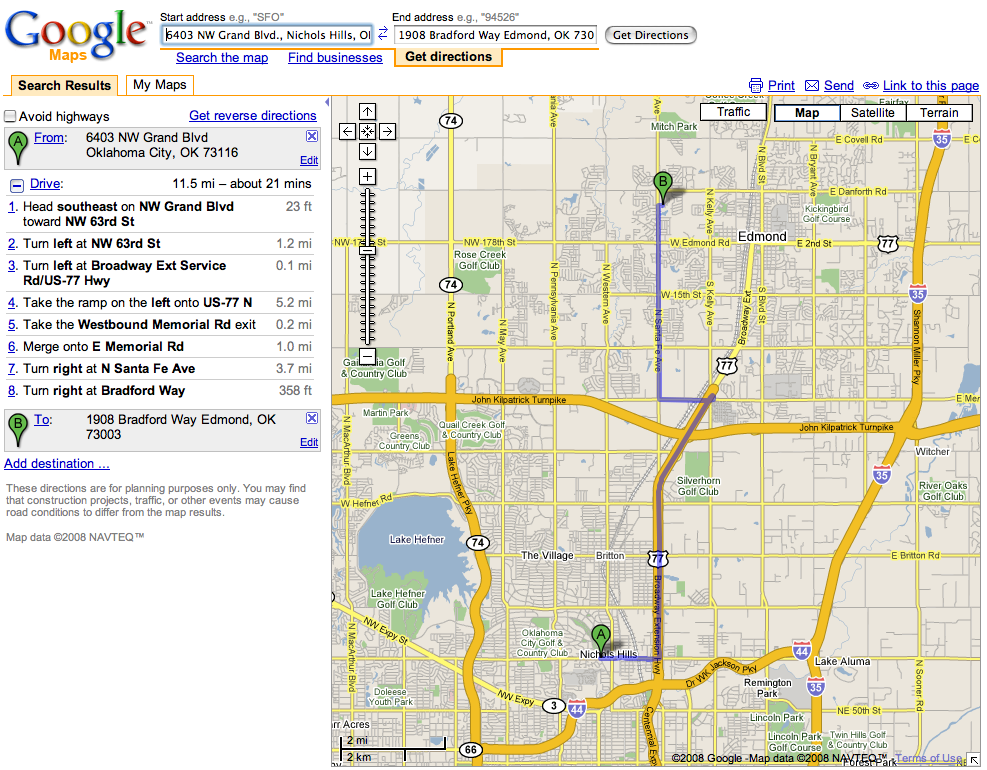
By adding the Google Maps feature to local Google Adwords advertisers ads, Google has bridged the gap between web search traffic and foot traffic in a fresh, unique and beneficial way.
Google’s First Step…
As reported and since confirmed by Greg Sterling, Google is now showing up to 10 local business results for geographic specific queries.
Google told Greg the reason it’s showing more links is because usability testing revealed that many people didn’t realize there was additional local content available beyond the three listings, despite the “more results . . .” prompt. Accordingly, Google said that with the 10 links it is hoping to signal people that there is much more local content a click away.
Google also said that it wouldn’t always show 10 results; it might still show three sometimes or one if the query is very specific.
As Mike Blumenthal has noted, it has been nearly a year since Google last upgraded their Local OneBox. At the time it led to a significant increase in Google Maps usage.
It will be interesting to see if and how Google’s worldwide roll out of their new Local OneBox increases Google Maps usage like it did after implementing their last Local Business OneBox changes.
In my previous post about Google’s local business results being expanded, I wrote about how the listings appeared locally and some of the factors I thought contributed to the listings.
Sterling reported the ten results are based on a range of factors, including the “query, proximity, availability of ratings/reviews and their quality and several other variables.”
Since Google doesn’t publish exactly what factors influence their list, all we can do is study what they publish and draw our own conclusions as to which variables may matter the most.
The following are examples of searches I have ran, Google’s Local OneBox business results and my analysis of what variables I think generated the list.
Google Local Business Results: Internet Marketing Oklahoma City –

This query for a service (internet marketing) followed by the location (Oklahoma City) produced a “top of page” 10 listings OneBox result. I also found some Google Adwords ads displaying the recently discovered business address on the fourth line of the Adwords ad.
Google Local Business Results: Oklahoma City Internet Marketing –
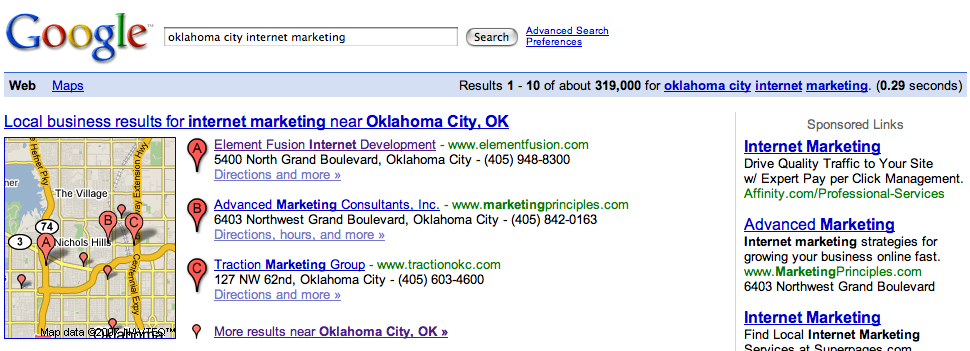
Searching for the same terms in a different order; placing the location first (Oklahoma City) and the service (internet marketing) last, produced a OneBox result with only three business listings. Some local Adwords advertisements still appeared with their specific address on the fourth line, which as mentioned previously only displayed a city or state.
Google Local Business Results: Business Marketing Oklahoma City –
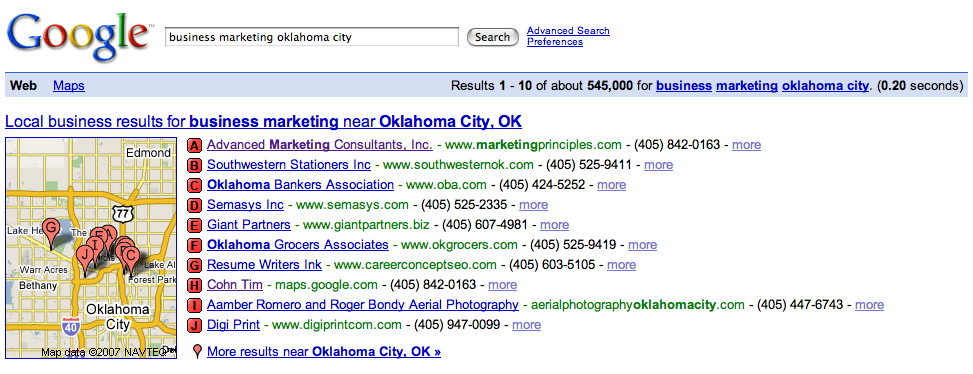
A slightly different search for a similar business category yields a new clue to at least one of the factors Google uses to generate its OneBox 10 local business listings.
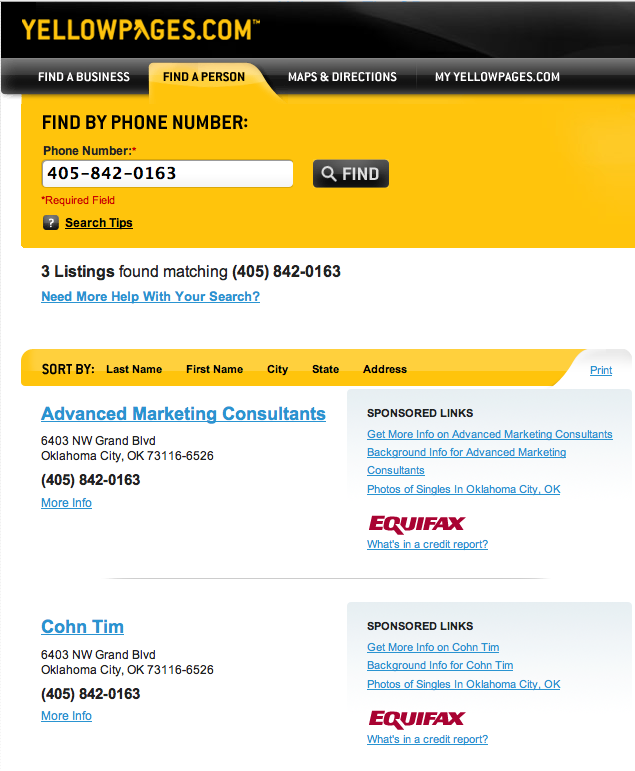
A search for the service (business marketing) and the location (Oklahoma City) produces a different yet seemingly innocuous list of businesses. However, in this particular query and in addition to the expected listing for my business “Advanced Marketing Consultants” appearing, “Cohn, Tim” also appears as one of the results.
Cohn, Tim is one of my business phone listings in my local Bell telephone directory. The phone company apparently can’t sort and digitally publish business listings with an individual’s name like they can an individual’s residential phone data.
A search in YellowPages.com produces “Cohn, Tim” for my business phone number –
Yet, a search in Google for “Tim Cohn Oklahoma” produces both of my residential phone numbers and listings in correct order: Tim (first name) and then Cohn (last name) –

I haven’t investigated whether the phone company automatically reverses residential phone records before they are published to the web or whether Google reverses the data before they publish it.
Regardless, it looks like the business listing for “Tim Cohn” will remain forever memorialized in the vast telephone company data and its Internet counterpart as the business listing: “Cohn, Tim”.
Having accepted the fact that the telephone company seemed incapable of changing their listing results years ago, I decided to turn this particular piece of flawed data into my “control”.
When Cohn, Tim appears in print – whether online or off – its source is always local phone company data.
Thus at least a portion of this particular Google local OneBox list origins lies in business telephone directory data.
To its credit, Google has become proactive in allowing users to modify incorrect Google data as Barry Schwartz recently reported.
And unlike my attempts to get the phone company to correct how my business phone listing appears both in print and online, I am sure Google will let me append my business listing in their Google Local Business Center, but that will have to be the subject of another post.
Google Local Business Results: Chevy Oklahoma City –

Unlike with an old fashioned yellow pages search for listings with “Chevy Oklahoma City” keywords whether in the yellow pages or through directory assistance, Google can return results most likely relevant and matched to the searchers or callers intent.
Whereas, a yellow pages search or directory assistance call would take a couple of “passes” to yield the similarly accurate and desired result – businesses listings most likely to be known as “Chevy Oklahoma City”.
Brilliant!
If the telephone company can’t arrange and organize my single business listing correctly in their digital directories, how will they ever be able to compete with Google’s ability to anticipate and even provide multiple possible answers to each searchers question?
Google Local Business Results: Double Glazers Chelsea London (England) –

Google’s local business results aren’t just appearing in the US. A search for “double glazers” in the Chelsea section of London produces a list of double glazers midway down the search engine results page. I am not sure why some OneBox results appear at the top of the page and why others appear in the middle of the page but I believe it too must be based on Google’s understanding of the searchers intent.
Google Local Business Results: Travel Agents Sydney (Australia) –
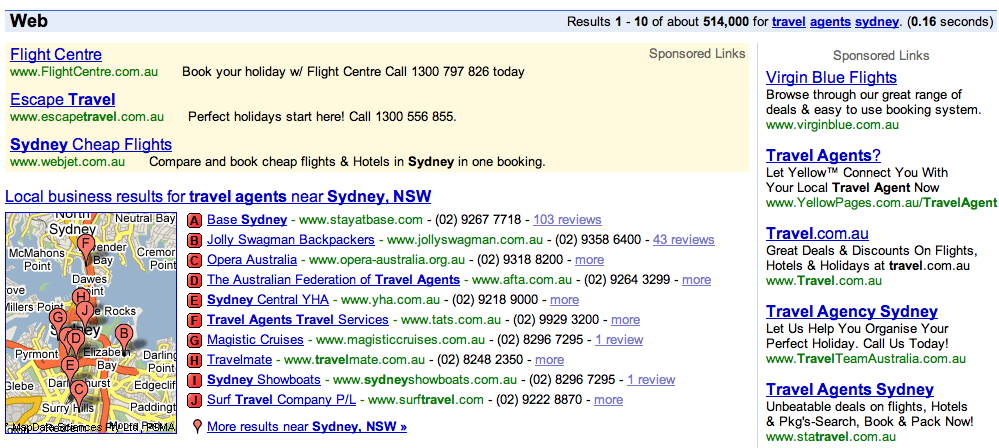
This search in Sydney, Australia for travel agents also produces a OneBox result. Here the OneBox appears again at the top of the page above the organic results.
In my next post, I will show how Google’s local business results have taken a second step closer to bridging the gap between paid web search traffic and foot traffic…
The Inside Adwords Blog has announced Google Adwords Demographic Bidding Beta.

Search Engine Watch provides a link to the Beta sign up page, however when I tried to get to it I got a “problem loading page” error.

By adding Demographic Bidding, Google Adwords will help brand managers and their advertising agencies reach more of their target audience.
Since Wikipedia is the 8th most visited web site according to comScore, I thought I would provide the following sources and definitions for”wiki” I found while searching Google.
* A website or similar online resource which allows users to add and edit content collectively.
Multiplatform Glossary
* A collection of web pages that can be edited by a group.
Cornell University
* This is a website that includes the collaboration of work from many different authors. A wiki site allows anyone to edit, delete, or modify the content on the web. (The first wiki creator named the site after a chain of buses in Hawaii; Wiki means “quick” in Hawaiian.)
Technology Initiative Grants
* A generic name for a web-page which anyone can edit quickly without having to learn HTML. Wikibooks
* A wiki (IPA: or ) is a website that allows visitors to add, remove, edit and change content, typically without the need for registration. It also allows for linking among any number of pages. This ease of interaction and operation makes a wiki an effective tool for mass collaborative authoring.
Wikipedia.org
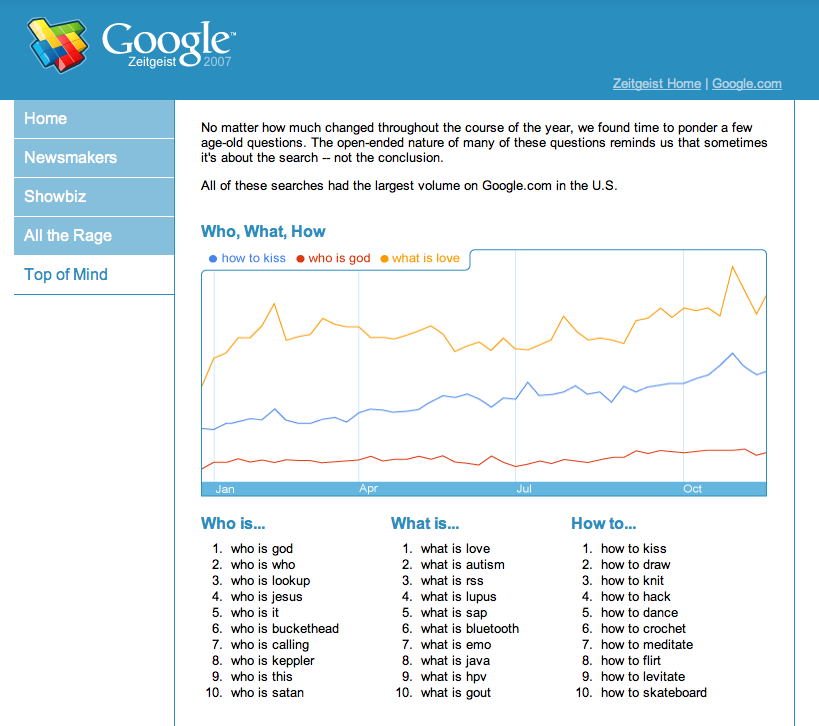
Google has posted its annual Zeitgeist recapping the most searched subjects of 2007.
Zeitgeist’s definition according to Princeton University’s Wordnet lexical database is:
(the spirit of the time; the spirit characteristic of an age or generation)
Google’s “Top of Mind” chart reveals the eternal nature of questions and the essence of all search engine queries – mankind’s ongoing search for answers and meaning.
The top searches from the “What”, “How” and “Who” categories coincidentally are questions about some form of “Love”.
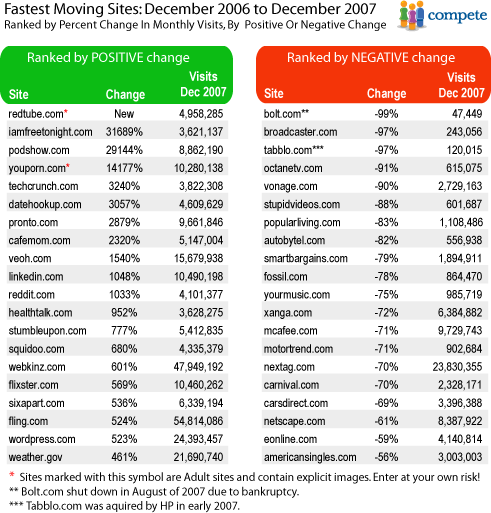
Compete.com has released their December 2006 – December 2007 list of websites their data shows have had the greatest percentage change in monthly visits.
The niche socialization and peer centric categories continue to increase their penetration and share of the internet audience.
Who would have guessed “user generated adult video content” sites like R e d T u b e and Y o u P o r n would top their list?
It will be interesting to see – what if any – new website categories appear and break out over the course of 2008.
Or will social, peer and user generated content websites continue to command the market’s attention?
The Winners are:
R e d t u b e. c o m
IAmFreeTonight.com
PodShow.com
YouPorn.com
TechCrunch.com
DateHookup.com
Pronto.com
CafeMom.com
Veoh.com
LinkedIn.com
Reddit.com
HealthTalk.com
StumbleUpon.com
Squidoo.com
WebKinz.com
Flixster.com
SixApart.com
Fling.com
WordPress.com
Weather.com
Google is now showing ten results for businesses under city, retail and service related queries instead of three.
This does two things:
1. It provides local businesses more exposure in local related searches. This in turn may aid Google’s efforts to generate more locally targeted advertising from retail and service businesses.
2. It reveals the lack of forethought shown by most businesses when it comes to choosing their free yellow pages category when ordering their phone line. If I had not spent years studying potential yellow pages categories for both mine and my client’s businesses, I too probably wouldn’t have given it much thought either. The data displayed under each query is only as informed as the person who placed the original order with the phone company.
In the following example under a Google search for “marketing oklahoma city” you can see about half of the businesses listed are probably not in the business of providing “marketing” services in Oklahoma City.
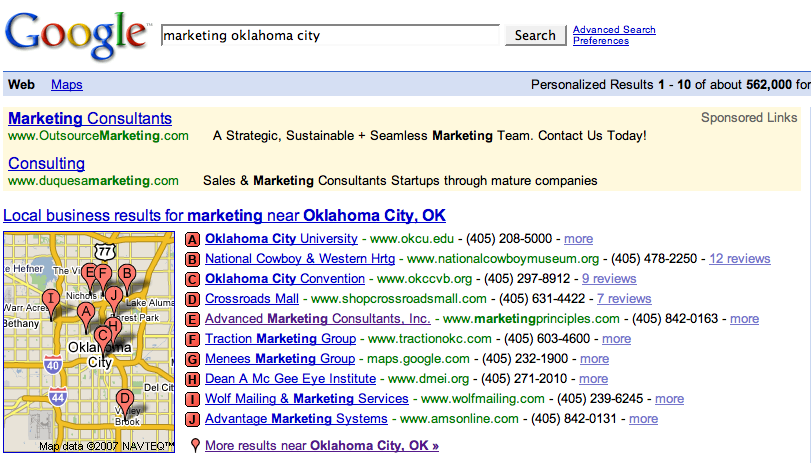
However, in a search for “marketing consultant oklahoma city” you can see nearly all of the businesses listed likely provide marketing consultant services in Oklahoma City.

Fortunately my business listing – Advanced Marketing Consultants – appears within both searches today.
Yes, every business with a phone line will probably now appear in a local search result.
One question remains – will their listing be shown to the right audience?
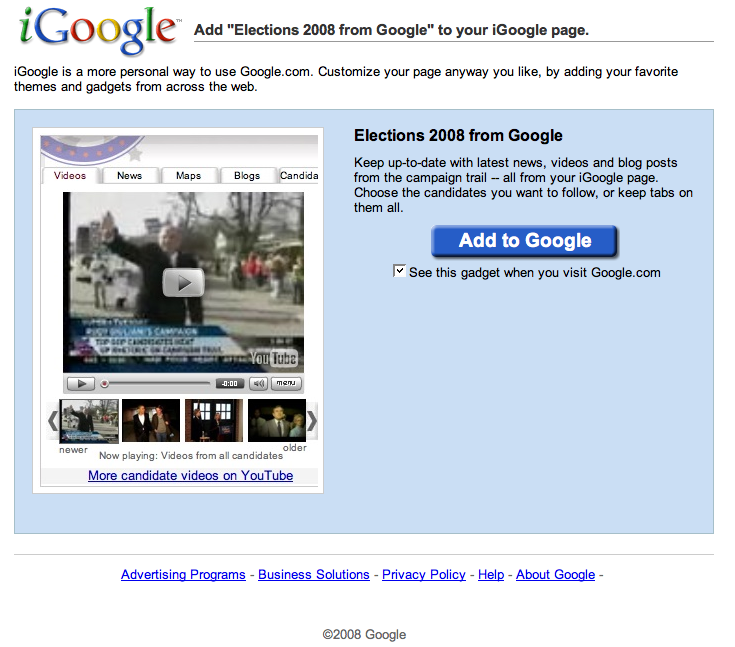
Google News has added a new gadget to track several forms of 2008 Presidential political media activity.
The gadget grabs political videos, news, maps and blogs of candidates from both parties.
You can pick one or all of the past and present Presidential candidates you want to follow.
The candidates with feeds available are:
Democrats:
Joe Biden
Hillary Clinton
Christopher Dodd
John Edwards
Mike Gravel
Dennis Kucinich
Barack Obama
Bill Richardson
Republicans:
Rudolph Giuliani
Mike Huckabee
Duncan Hunter
John McCain
Ron Paul
Mitt Romney
Tom Tancredo
Fred Thompson
I set this new Google political news gadget up under its own tab titled “2008 Presidential Race” in iGoogle to reduce its information footprint and reduce the overload that can occur when I try to digest the Google News home page.

 Search Marketing Communications
