My Google Advertising Professional certification is up for renewal September 21, 2009.
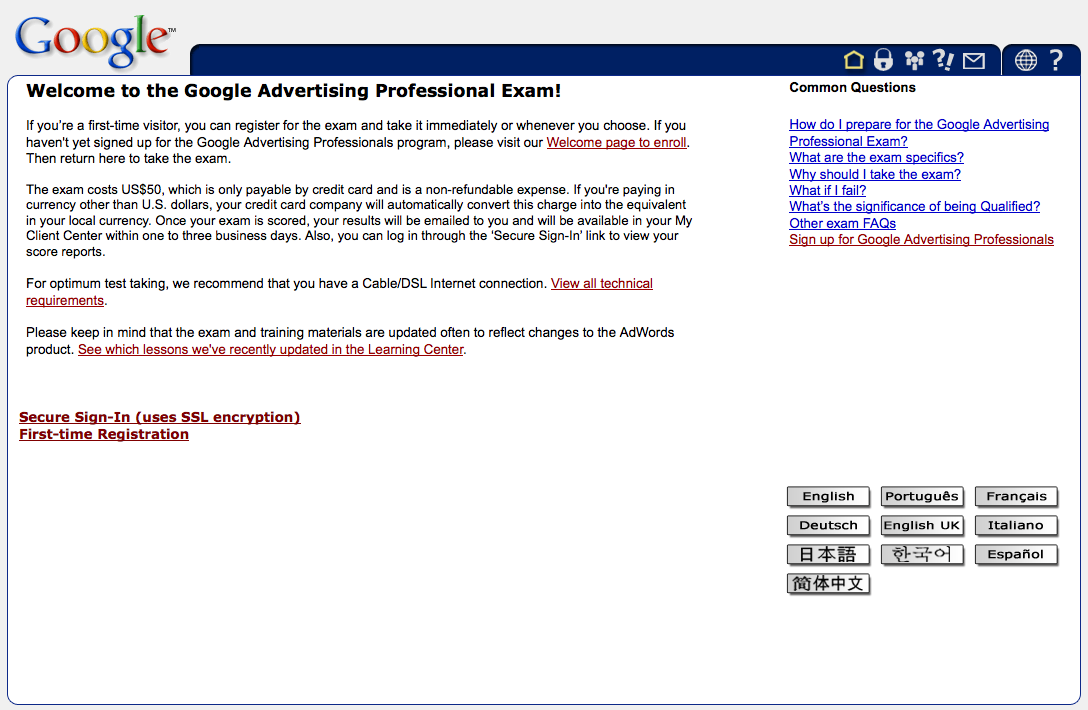
Google Advertising Professional Exam
I am reviewing the materials and plan to take the test tomorrow.
My Google Advertising Professional certification is up for renewal September 21, 2009.
Google Advertising Professional Exam
I am reviewing the materials and plan to take the test tomorrow.
Over the last week or so, Facebook seems to have ratcheted up its pay per click advertising program’s marketing while also suggesting anecdotally Facebook social network advertising can rival the performance of Google pay per click advertising.
Anyone in the search advertising business who has ever run a content network advertising campaign that reached comparable social networking sites like MySpace would beg to differ – myself included.
How can Facebook’s audience composition or intent be any different than MySpace’s audience?
More importantly, regardless of either audience’s size or marketing potential each social network’s group attention is focused internally on themselves and their friends not externally focused on finding information or buying products – which is a common trait every one in Google’s audience shares.
Both Myspace and Facebook marketers must understand this fact because they both use Google pay per click search advertising to try and reach and convince potential social network advertising advertisers of their respective company’s advertising’s promise.

Facebook MySpace Google Pay Per Click Ads
I guess neither Myspace or Facebook have been able to find the new advertisers they need to grow their businesses from within own their network’s hundreds of millions of accounts.
For growing their advertiser base, both Myspace and Facebook appear to trust Google pay per click advertising to help them get the job done.
I found this video homage to Apple quite instructive for individuals and companies looking for ways to create, market and sell their new products more successfully.
(via Rex Hammock)
Quite possibly an oversimplification of the complicated new product development, marketing and sales process, however Apple’s approach to packaging and selling new ideas is something every company should think about.
Google Labs has introduced the Google Fast Flip, an experiment in online content delivery.
Fast Flip lets browsers flip sequentially through bundles of recent news, headlines and popular topics, as well as feeds from individual top publishers in one location.
About Google’s Fast Flip:
Flipping through content is very fast, so you can quickly look through a lot of pages until you find something interesting. At the same time, we provide aggregation and search over many top newspapers and magazines, and the ability to share content with your friends and community. Fast Flip also personalizes the experience for you, by taking cues from selections you make to show you more content from sources, topics and journalists that you seem to like. In short, you get fast browsing, natural magazine-style navigation, recommendations from friends and other members of the community and a selection of content that is serendipitous and personalized.
Fast Flip provides five tabs for navigating top level general content on the Fast Flip site: Popular, Recent, Most Viewed, Recommended and Headlines.
The current list of sources for Google’s Fast Flip are: BBC News, FRONTLINE, Newsweek, TechCrunch, Billboard, Fast Company, Popular Mechanics, Technology Review, Business Week, Foreign Policy, ProPublica, Teen, Center for Investigative Reporting, Good Housekeeping, Quick & Simple, The Atlantic, Center for Public Integrity, Harper’s Bazaar, Redbook, The Daily Beast, Christian Science Monitor, House Beautiful, SPIN, The Daily Green, CosmoGirl, Marie Claire, Salon, Us Magazine, Cosmopolitan, Men’s Journal, Seventeen, Veranda, ELLE, National Review Online, Slate, Washington Post, Esquire, New York Times and the Smithsonian.

Google Fast Flip Recent
The Recent tab produces images of the most recently uploaded content while the Most Viewed tab shows viewers what other Google Fast Flip users found and viewed most often.

Google Fast Flip Most Viewed
The Recommended tab shows images or articles Google Fast Flip recommends.
I am not sure how Google determines which articles I would have an interest in unless of course Google Fast Flip is also an experiment in behavioral targeting.

Google Fast Flip Recommended
Google Fast Flip consolidates a lot of great news sources and makes finding what they have to offer much easier than going to each respective publishers site.
If Google Fast Flip made the images they provide available in the present size and two additional sizes – one 50% and the other 100% larger, I think they would be able to attract and engage a larger news audience.
Google’s Chief Economist Hal Varian has created a video tutorial to show marketers how to use data from Google’s recently launched Adwords Bid Simulator to help advertisers maximize profits earned from their marketing investment.
On the Official Google Blog, Varian summarizes Google’s advertising auction process:
In general, when you increase your maximum CPC bid for keywords on search you are able to generate more clicks to your site. This may be because your new bid qualifies you to appear higher up in the Sponsored Links on the search results page, or because your higher bid qualifies your ad to appear in new, more expensive auctions. The goal for you as an advertiser is to decide whether or not these additional clicks come at a cost that is still profitable for you.
To make this decision, you need to compare your expected value per click to your incremental cost per click. Your value per click is how much a click for a particular keyword is worth to you, on average. Your incremental cost per click is how much extra you are paying, on average, for the extra clicks you are getting from your higher bid. When your value per click is higher than your incremental cost per click it makes sense to increase your bid. On the other hand, if your value per click is lower than your incremental cost per click, you probably want to decrease your bid.
Watch Varian’s video to understand how to estimate how keyword bids impact both an Adwords campaigns value per click and incremental cost per click.
Yesterday, Microsoft announced plans for new visual search feature additions to their Bing search engine.
Bing plans to roll out image based searches later this year via Bing’s Visual Search Galleries.
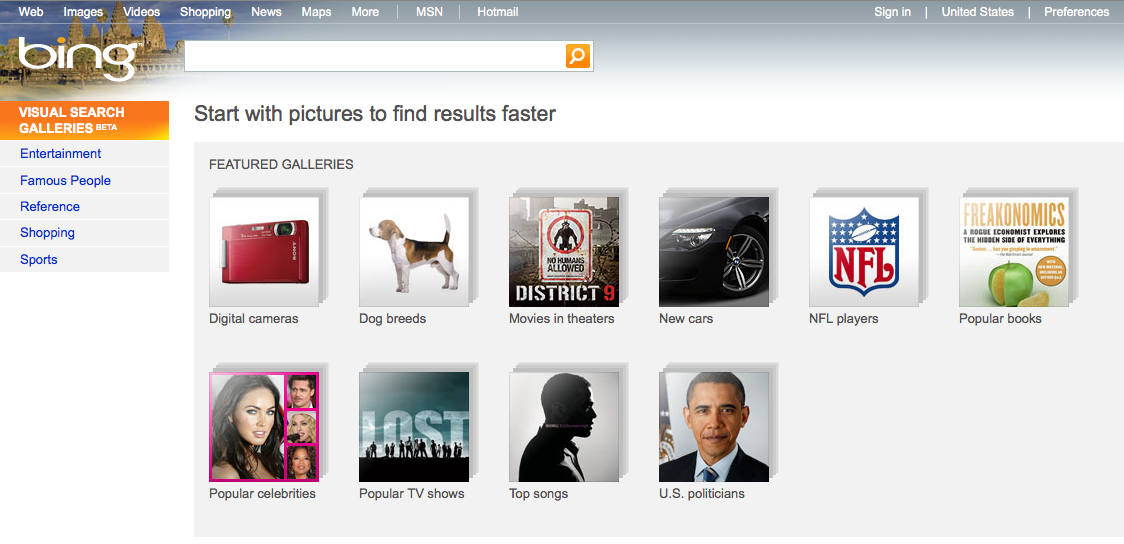
Bing Visual Search Galleries
Microsoft’s visual search promise comes with one seemingly large caveat, prospective Bing visual search users must first install Silverlight before they can view Bing’s visual search results.
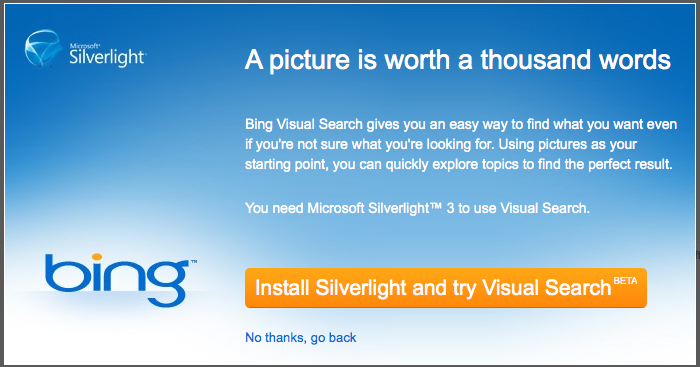
Install Silverlight
If having to install an application before searchers can get a search product to work isn’t a friction generating barrier – I don’t know what is.
I noticed in one of my Google Adwords accounts, their new Max CPC Bid Simulator doesn’t provide data on every keyword in an Ad Group.

Max CPC Bid Simulator
I asked several Adwords Experts if they knew whether this was until more history data became available within the account or whether the tool didn’t have network level data to draw upon.
Any ideas why the Adwords Max CPC Bid Simulator doesn’t provide data for each keyword in an Ad Group?
Today, my Twitter account briefly reached 1,000 Twitter Followers.

1000 Twitter Followers
Having reached 1,000 Twitter “audience members” presents an obvious question: which is more valuable – a 1,000 person social media audience or 1,000 person search audience?
The Google Finance blog has announced a new set of tools for analyzing search volumes called Google Domestic Trends on Google Finance.
How Google Domestic Trends works:
Google Domestic Trends tracks Google search traffic across specific sectors of the economy. The changes in the search volume of a given sector on google.com may provide useful economic insight. We have created 23 indexes that track the major economic sectors, such as retail, auto and unemployment. Each index value is baselined at 1.0 on January 1, 2004 and is calculated and displayed on the Google Finance charts as a 7-day moving average. You can easily compare actual stocks and market indexes to these Google Trends on the charts.
The 23 categories available in Google’s Domestic Trends tool are: Advertising & marketing, Air travel, Auto buyers, Auto financing, Automotive, Banking & personal finance, Business, Computers & electronics, Construction, Credit & lending, Durable goods, Finance & Insurance, Furniture, Industries, Investing, Jobs, Luxury goods, Mortgage, Real estate, Rental, Retail trade, Travel and Unemployment.
The Google Advertising and Marketing Trends Index which tracks queries related to “marketing, do not call, advertising, signs, logo, commercials” etc. illustrates both the marketing industry’s peaks and troughs since 2004.
Interestingly, the lowest point in the index was reached in January of this year while the highest point since early 2005 was reached September 4 of this year.
The Advertising and Marketing Trends Index probably peaked as a result of increased advertising and marketing spending by the auto industry on the cash for clunkers program.
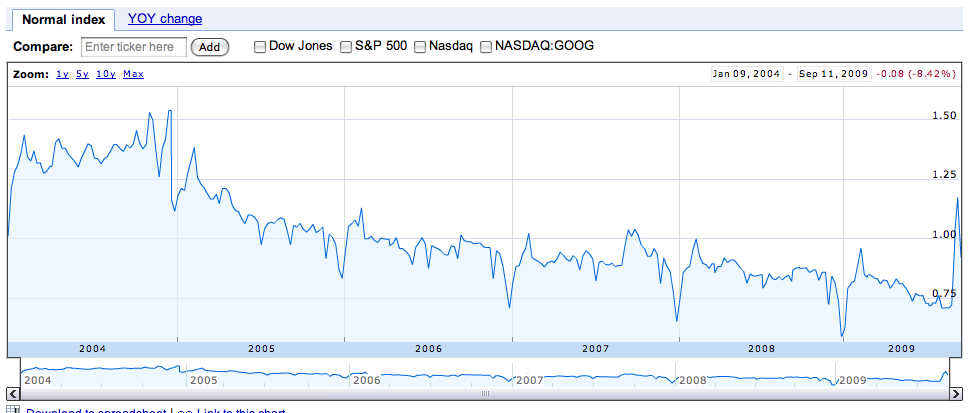
Google Advertising & Marketing Index
Google’s index data can be compared with actual stocks, the Dow Jones, or Nasdaq by entering the respective tickers in the Compare box.
Below, I have generated a Google Advertising and Marketing Trends chart comparing the performance of the Dow Jones, S&P 500, Nasdaq, Google (GOOG) and the New York Times (NYT).

Google Advertising Marketing Index Stocks Comparison
While the indexes have remained in a relatively narrow trading range, Google and the New York Times stock have not. Google stock has climbed 350% while the New York Times Company stock has fallen 79% over the same time period.
Evidently, now is not the time to be in the content creation business.
Google Insights for Search provides more detailed information about the ten search categories that compose the Google Domestic Trends Index on a country by country or worldwide basis.

Google Insights for Search US Advertising & Marketing Index
Additionally, Insights for Search now also provides a forecast for each of the 23 Domestic Trends.
In the case of the Advertising and Marketing Index, Google forecasts a 47% drop in US Advertising and Marketing activity for December 2009 compared to December 2004.

Google Insights for Search Worldwide Advertising Marketing Index
Google forecasts a 43% drop in Worldwide Advertising and Marketing activity for December 2009 compared to December 2004.

 Search Marketing Communications
You must be logged in to post a comment.