Archive for the ‘Microsoft’ Category

Interview with Dr. Qi Lu; President, Microsoft Online Services Group

December 11, 2008

Microsoft’s PressPass recently interviewed Dr. Qi Lu, the new President of Microsoft’s Online Service Group about his plans for taking Microsoft’s search products to the next level.

Microsoft Dr. Qi Lu

Microsoft Dr. Qi Lu

Source – Microsoft PressPass

Prior to joining Microsoft, Dr. Lu was executive vice president of Engineering for the Search and Advertising Technology Group at Yahoo. Prior to his 10 years at Yahoo, Lu was a Research Staff Member at IBM’s Almaden Research Center. He also has worked at Carnegie Mellon University as a Research Associate and at Fudan University in China as a faculty member. Lu holds 20 U.S. patents, and received his Bachelor of Science and Master of Science in computer science from Fudan University in Shanghai, and his Ph.D. in computer science from Carnegie Mellon University in Pittsburgh, Pa.

Excerpts from Microsoft’s PressPass interview with Dr. Lu:

PressPass: Where do you see the opportunities for Microsoft in the search and online space?

Lu: First, I think there is a genuine opportunity to take our search products to the next level. I see that Microsoft’s search product quality is improving at a very, very fast rate, that there are great foundations there. And with the technology base, the talent base, the computing infrastructures, I’m confident that we will be in a position to produce a differentiated and compelling search experience.

The second opportunity is to continue building a very powerful advertising platform. Microsoft has made a series of strategic acquisitions, and also built a bunch of internal technologies and products. The key is to put all those assets together to build powerful, highly scalable advertising platforms. The advertising we see today will be very different in the future because of new platforms for it. Ads will be truly relevant and useful, and the experience will be compelling.

PressPass: Whenever anyone talks about competition in search, the target always is Google. Are they catchable?

Lu: Well, we’re here to win, and my view on this is that to win in the search space, fundamentally you build on the strengths of your product. And we know what it takes to build a compelling user experience and winning product, which is to have a powerful infrastructure, great talent and put great processes in place so that we can out-develop, out-market, out-innovate our competitors.

But make no mistake; I think Google is a very, very powerful company. They are definitely ahead in the search space. There are a lot of challenges ahead. We’ve got our work cut out for us.

It will be interesting to see in which direction Microsoft heads with ex-Yahoo Dr. Lu at the Microsoft search helm.

Will Microsoft resume talks to acquire Yahoo’s search business?

Will Microsoft continue developing their own search product?

Or – will Microsoft now attempt to accomplish both (buy Yahoo’s search business and migrate Yahoo search advertisers to adCenter while attempting to improve Microsoft’s search and advertising products) in their quest to catch Google?

and Microsoft Wanted To Buy Yahoo’s Search Business…

November 13, 2008

I have recently had some issues with a client’s account in Microsoft’s adCenter.

When Microsoft first launched adCenter – their search advertising system, I signed up and called in for some reason and realized at the time “customer support” was being handled by a call center.

During my call, I asked the CSR if they were an employee of Microsoft and she replied she wasn’t.

I thought maybe they had outsourced customer support initially because they were just launching their service.

I hadn’t called them since.

Yesterday I called in to investigate why my client’s ads were not being displayed under search queries for their brand name.

After a series of questions about the account from the adCenter customer support representative, I told her all I did was load two new text ads – over a week ago.

The entire account hasn’t generated any impressions let alone clicks since.

I then heard some additional voices on my call at which point I asked “is this call being monitored?”

She said “all calls may be monitored.”

I then asked are you in a call center offsite? Yes.

Are you a Microsoft employee? No.

If you have some free time on your hands, call adCenter’s customer support telephone number to discuss the nuances of pay per click advertising with “Microsoft’s” “customer support” staff.

You might be glad Microsoft hasn’t bought Yahoo’s search marketing business.

Microsoft adCenter Customer Support Telephone Number

Microsoft adCenter Customer Support Telephone Number

adCenter Dynamic Keyword Insertion

October 26, 2008

Paid search ads with the search term in the ad have been proven to receive higher click through rates (CTR) over search engine ads without the searched for term embedded in them.

From the Microsoft Adcenter blog:

“With adCenter, the easiest way to include the search term is through {keyword} insertion. This function allows you to drop the term from the search box straight into your ad.”

If inserting the keyword will likely take an ad over its 25 character limit for titles or the 70 character limit for descriptions – use default text in the ad.

Default text is then used in advertiser’s ads whenever their ads would otherwise exceed character limits.

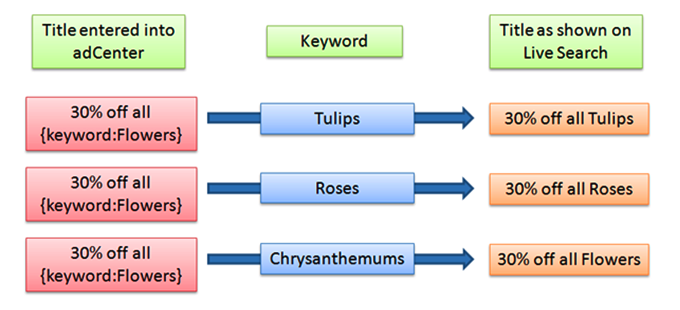
If an ad title is “30% off all {keyword} ” and one of the {keyword} variables is “Chrysanthemums,” the resulting ad title, “30% off all Chrysanthemums,” would exceed the character limit for ad titles and as a result, the ad would not be displayed.

However, by using default text in the ad title, advertisers can keep their ad text within the allowable character limit. If the ad title is “30% off all {keyword:Flowers} ” and someone searches by using the keyword “Chrysanthemums,” the ad title would be displayed as “30% off all Flowers”.

Adcenter Dynamic Keyword Insertion

Adcenter Dynamic Keyword Insertion

Use dynamic keyword insertion in conjuction with default text to increase ad relevance and increase paid search advertising click through rates.

Yahoo Workforce and Market De-Cap-itation

October 21, 2008

I have always found Yahoo related market news ironic when its front and center on the Yahoo Finance site – particularly when the news isn’t so good.

Yahoo Finance

Yahoo Finance

Like today’s news of Yahoo’s plans to fire 1,500 employees or 10% of their workforce just eight short months after receiving and then rejecting a $47.5 Billion dollar purchase offer from Microsoft.

At the close of business today, Yahoo’s stock market capitalization was $16.73 Billion – approximately one third Microsoft’s $47.5 Billion offer.

Yahoo Market Cap

Yahoo Market Cap

In either case, whether you were an employee who was fired – or you still own Yahoo stock – ouch!

Search Advertising Geo Targeting Options

October 3, 2008

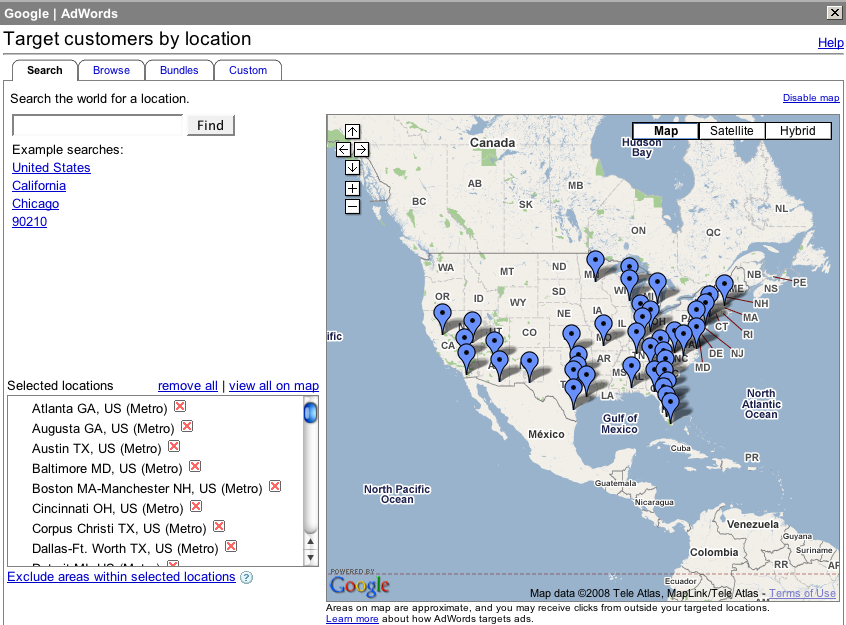
If targeting local and mobile search advertising is the future growth drivers for search advertising providers, then Google and its Adwords geo-targeting features are in the driver’s seat when compared to its three closest search advertising rivals Yahoo, Microsoft and Ask.com.

Below I outline each providers’ offerings not according to their search advertising market share but instead according to their level of geotargeted advertising product development.

Google’s advertising product and its geo-targeting capabilities have one distinct yet obvious feature the other’s lack:

An actual map for geo-targeting the location of your ads and where they will be shown!

Google Search Advertising Country Geotargeting

Google Search Advertising Country Geotargeting

With Google Adwords, advertisers can target their ads one country at a time through Google’s Country Geotargeting tab, or choose to bundle their ads for display in multiple countries at once with Adwords Bundle Geotargeting feature.

Google Search Advertising Bundle Geotargeting

Google Search Advertising Bundle Geotargeting

Google Search Advertising Bundle Geotargeting

Google Search Advertising Metro Geotargeting

Google Search Advertising Metro Geotargeting

Google Adwords advertisers who advertise in specific markets nationally or regionally can target their ads by metropolitan area or by city.

Although not referenced, Google’s metropolitan area targeting looks slightly similar to the Designated Market Area system developed by Nielsen Media Research which incorporates Nielsen’s broadcast media markets and distribution scheme.

For its City geotargeting option, Google surrounds the target city with a square.

Google Search Advertising Custom Geotargeting

Google Search Advertising Custom Geotargeting

Google custom geotargeting by far provides the highest level of geotargeting available from any search advertising provider.

Custom geotargeting lets advertisers create their own custom advertising distribution area within any market.

Google search advertisers can simply point and click three or more points on their advertising map and Google does the rest for them – creating a custom advertising distribution area through latitude and longitude coordinates.

How do the other search advertising providers’ geo-targeting features stack up compared with Google’s?

Yahoo and Ask both offer advertising geo-targeting options but both to a lesser degree.

Yahoo Search Advertising Geotargeting

Yahoo Search Advertising Geotargeting

Yahoo offers geotargeting to it advertisers by account market area and specific regions. Account market area is established by the advertising account holder when the open their account. Both account market area and specific region areas are organized by country, state, province or territory.

The Yahoo specific region feature geotargets its advertising through the Designated Market Areas system licensed from Nielsen Media Research.

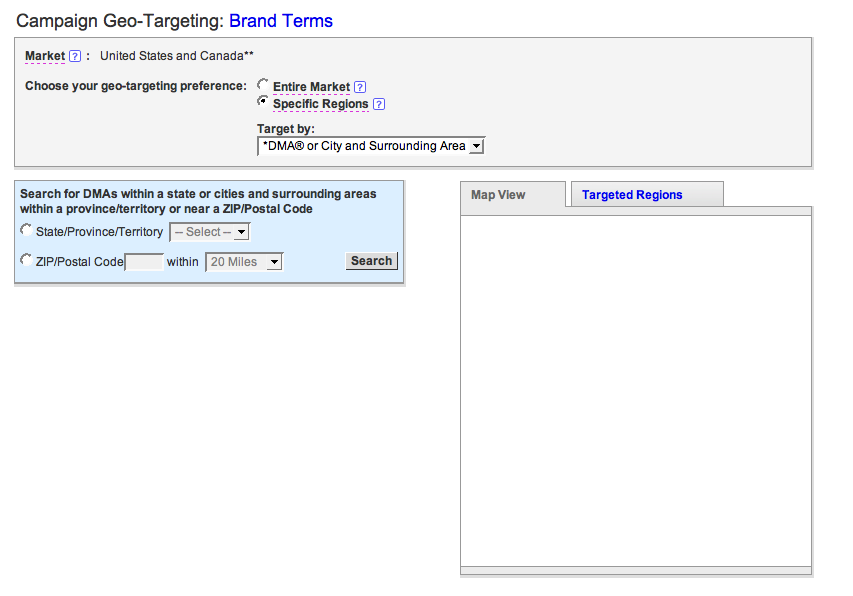
Yahoo Search Advertising Geotargeting Mapview

Yahoo Search Advertising Geotargeting Mapview

Where is the Yahoo Search Advertising Geotargeting Map?

Yahoo offers a Map View tab of specific regions geotargeted by its advertisers yet I haven’t ever been able to view an actual Yahoo map showing where my advertising has been geo-targeted and placed.

I can’t imagine why Yahoo search marketing would place a “Map View” tab in their Campaign settings geo-targeting page yet not actually provide a map view.

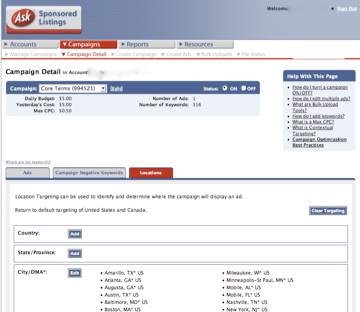
Ask Search Advertising Geotargeting

Ask Search Advertising Geotargeting

Ask provides its advertisers with Location targeting which is also based on Nielsen’s Designated Market Area system.

Ask doesn’t provide a map showing advertisers locations of their geo-targeted advertising.

However, and to its credit – Ask does provide a geotargeting feature direct marketers like myself would like to see from other search advertising providers like Google Adwords – Postal Code targeting.

Postal Code Targeting or Zip Code targeting here in the US would allow direct marketers and brands alike another level of advertising targeting, delivery and thus control.
At this point you may be wondering why I chose to cover Microsoft’s adCenter search advertising geotargeting product last even though it has a larger share of the search market than Ask.

Why have I listed Microsoft’s advertising geotargeting product development last?

Because Microsoft’s search advertising product does not offer its advertisers geotargeting options let alone any other kind of geographic ad targeting.

Microsoft Search Advertising Geotargeting

Microsoft Search Advertising Geotargeting

Will Microsoft ever offer advertising geo-targeting features to its advertisers?

If not, why?

Top Search and Web Properties Query Share

September 20, 2008

comScore has released its August 2008 qSearch analysis of the the U.S. search marketplace.

According to comScore, Google core search sites continued to lead the U.S. core search market in August with 63% of the searches conducted, up from 61.9% in July.

Yahoo core search sites had the second largest amount of search traffic with 19.6%, followed by Microsoft with 8.3%, the Ask Network with 4.8% and AOL LLC with 4.3% of searches conducted.

At the top web properties where search is observed, Google web properties led with 10.2 billion searches followed by Yahoo web properties with 2.4 billion searches, Microsoft web properties with 1 billion searches and AOL LLC and it search sites with 839 million search queries.

What I found most interesting in the comScore top web properties search data was Fox Interactive’s web sites – including MySpace.com – conducted 593 millions searches compared to Ask Network’s properties 572 million searches.

July August 2008 comScore Site Search Share

July August 2008 comScore Site Search Shar

Also, according to comScore data and to my surprise, MySpace.com has even surpassed AOL’s Search Network – not including MapQuest – fielding 117 million more search queries per month than AOL search.

Even with MySpace network’s growth slowing, at some point won’t its user base and growth cause it to generate an equal and then ever increasing number of search queries per month?

At its present size and barring any significant search market disruptions, will MySpace.com eventually generate more searches per month than AOL?

Ultimately, will MySpace.com generate more search queries per month than even Microsoft’s web properties?

Microsoft adCenter: No Cost Per Conversion Data

September 15, 2008

Is there a particular reason why the Microsoft adCenter doesn’t provide a cost per conversion column for its advertisers?

Microsoft adCenter Cost Per Conversion

Microsoft adCenter Cost Per Conversion

The Microsoft adCenter dashboard displays ad group name, ad group start date, ad group end date, status, spend, impressions, clicks, ctr %, average position, conversions, average cpc and negative keywords.

adCenter data does show number of conversions – just not their cost. This unnecessarily creates an extra level of interpretation and work for advertisers.

Why?

If an advertiser wants to manage and understand their advertising campaign’s effectiveness through cost per conversion data – Microsoft through its omission of this metric – leaves advertisers to make their own calculations… or not.

Is this a lack of transparency in Microsoft’s adCenter?

If it is, Microsoft’s not providing its advertisers with acquisition cost data makes calculating their return on investment more difficult.

Both Google and Yahoo supply this type of data.

Surely this is just an oversight on Microsoft’s part.

If it is an oversight, adding cost per conversion data in the Microsoft adCenter dashboard would help Microsoft’s advertisers understand more about their campaigns acquisition costs and in turn their return on investment from advertising with Microsoft.

Surely providing this data in column form would be in the best interest of both Microsoft and its advertisers.

Live Search xRank and Barack Obama

August 29, 2008

Microsoft has re-launched Live Search along with its xRank features.

Today I was surprised to find the following picture embedded in Microsoft’s Live Search home page.

Or is it the other way around?

I was surprised to find the Microsoft Live Search box embedded in a picture of Barack Obama.

Live Search Barack Obama

Live Search Barack Obam

I am not sure but I think this is a first.

Embed your search home page in images from the day’s headlines?

If your search appliance isn’t gaining search traffic market share from its competition piggy back your product on news and images known to produce search traffic by bolting your search box onto the backs of the day’s top headlines?

Yahoo already does this to some degree but Live Search has taken its editorial to a new level.

If search was previously defined by it’s transparency and absence of bias, Microsoft Live Search has now flip flopped with its decision to make its editorial choice the cover of their Live Search home page.

It will be interesting to see if this decision increases Microsoft’s Live Search traffic volume and market share or if it puts off both its otherwise loyal search users while dissuading potential additional search audience members from visiting the Live Search site.

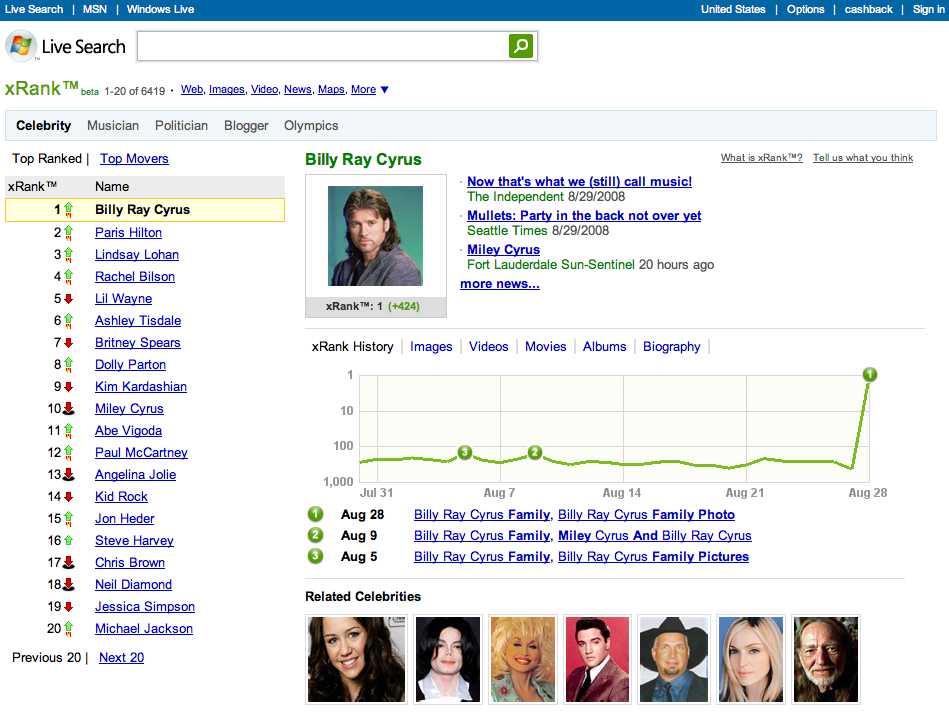
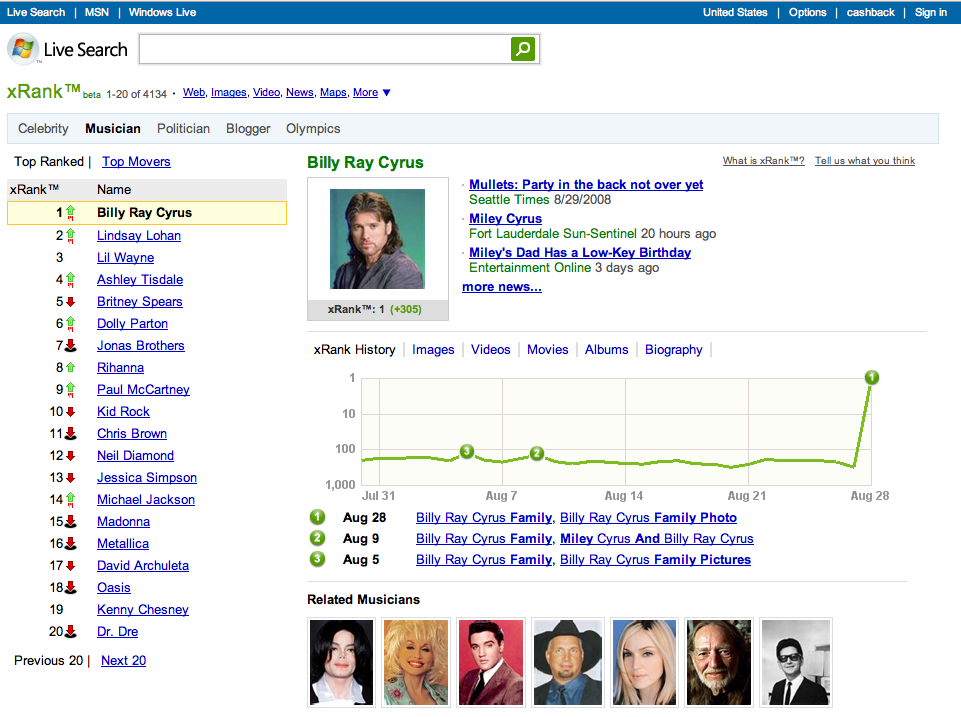
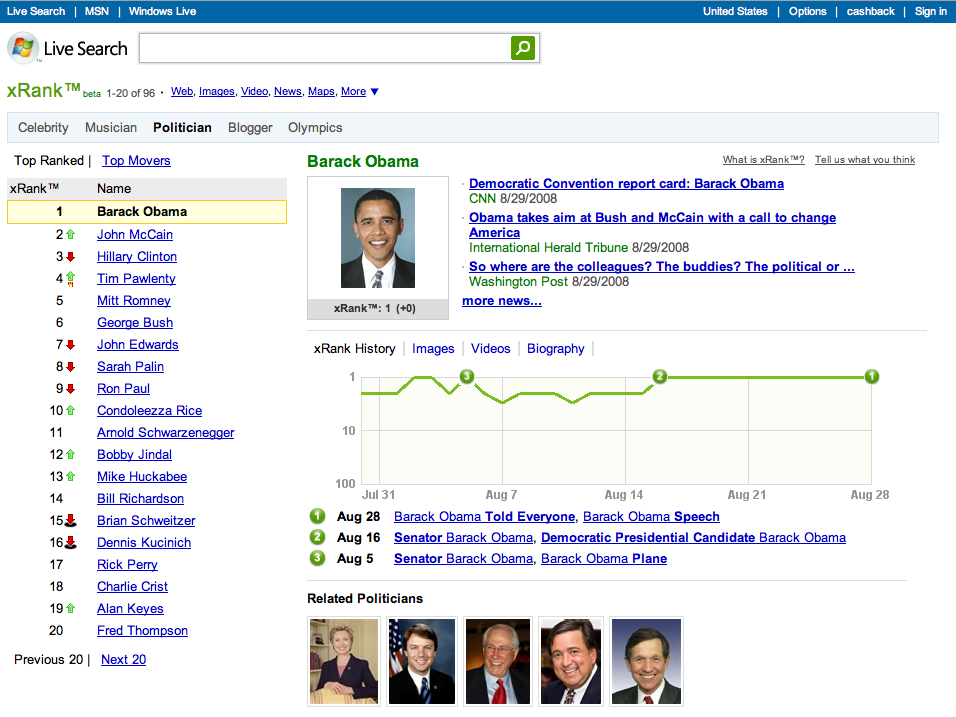
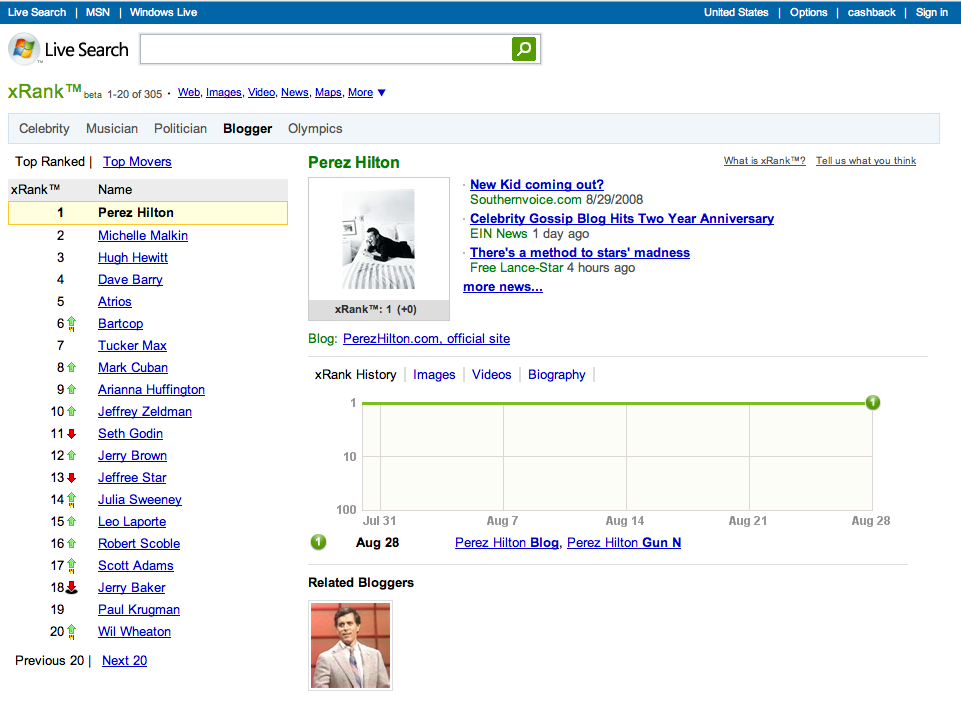
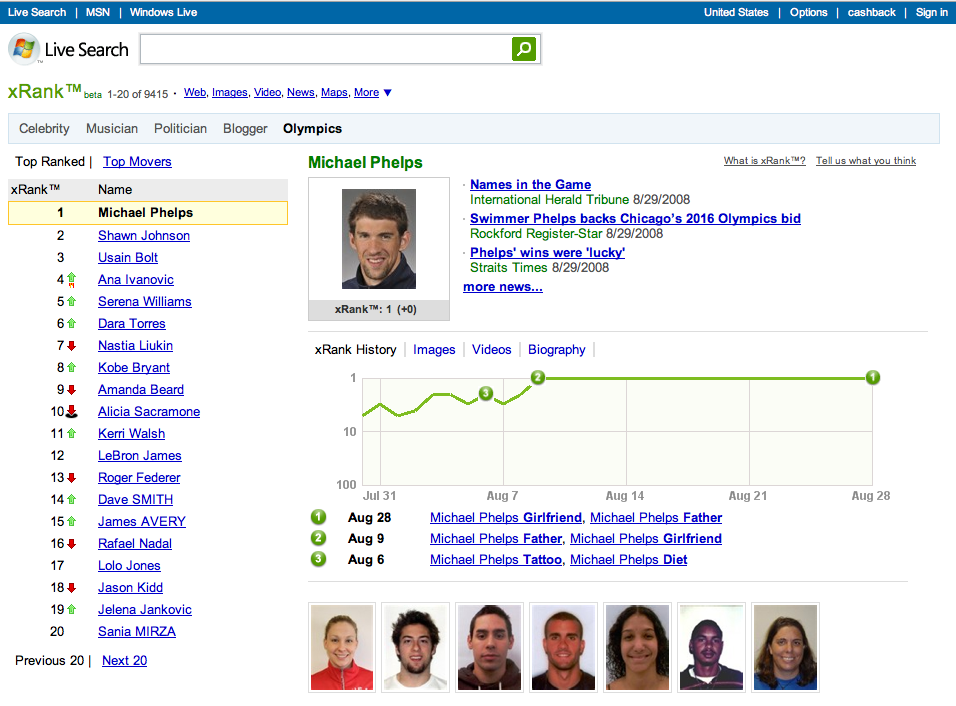
Drilling down from the home page Live Search provides five categories of Live Search xRank results: Celebrity, Musician, Politician, Blogger and Olympics.

I assume as news cycles ebb and flow, so will their xRank editorial categories selections.

By optimizing its home page for maximum search audience traffic through co-opting the day’s headlines, Live Search has literally given new meaning to the terms search engine optimization and SEO.

Live Search xRank Celebrity

Live Search xRank Celebrity

Live Search Celebrity xRank

Live Search xRank Musician

Live Search xRank Musician

Live Search Musician xRank

Live Search xRank Politician

Live Search xRank Politician

Live Search Politician xRank

Live Search xRank Blogger

Live Search xRank Blogger

Live Search Blogger xRank

Live Search xRank Olympics

Live Search xRank Olympics

Live Search Olympics xRank

Steve Ballmer Egged On Literally

May 19, 2008

From CNET News:

No not like Mr. Ballmer needs any additional encouragement leading Microsoft the world’s largest software company.

He was quite literally egged; as in “eggs thrown at” during a speech at a Hungarian University.

Europeans… first a pie in Bill Gates face and now eggs hurled at Steve Ballmer.

What will they think of next?

Vodpod videos no longer available. from index.hu posted with vodpod

Microhoo Boo

May 1, 2008

According to today’s online edition of the Wall Street Journal, Microsoft’s Chief Executive Office Steve Ballmer and it board remain undecided about whether or not they will raise their bid to acquire Yahoo and its internet display advertising and search audience business.

As I previously wrote in a post on Greg Sterling’s blog, Microsoft’s proposed acquisition of Yahoo is really about Microsoft’s need to retain, preserve and grow their existing audience and keystrokes before Google has completed their quarterback sneak through Microsoft’s desktop.

Without Yahoo and its internet audience, Microsoft will face accelerating short and long term audience losses to Google.

The question Microsoft hasn’t yet been able to answer for itself remains: “How much cash do we have to spend today to save and protect the future of our desktop franchise and its cash flow?

Apparently the price is one Microsoft has yet to come to grips with or let go of.