Yahoo Groups Spam?

February 19, 2008

I don’t know whether thus was a bulk request or not but every email addressed “Hi Friend” is guilty until proven innocent.

Yahoo! Groups


This invitation expires in 30 days. Monday, 18 February 2008 – 3:48 PM UTC


    “spamber_hawkins”@yahoo.com has invited you to join the perfect-homebizness group!    


    Hi Friend,Would you like to earn an extra $250 every day?, for just 30 minutes work? You could quit your job and make double the money at home working for yourself. Companies are currently looking for data entry workers worldwide to enter data online. Rates of pay are excellent from $250 a day and up.

We have over 8000 current members earning extra money from their own home. This is not the usual get-rich-quick scheme programs you’ve tried before, and we can guarantee an income of $250 a day or your money back! If you want to earn from home for entering data, please keep reading:

Click the Link Below:

http://zapurl.com/3svfw

Spamber Hawkins

Note:

This is a one time real opportunity job on the net
and you will not receive email from us..


Yahoo! Groups is a free service that allows you to stay in touch with friends and family or meet new people who share your interests. Yahoo! Groups values your privacy. It is a violation of our service rules for members to abuse this invitation feature. If you feel this has happened, please notify us. You may also change your email preferences to stop receiving group invitations in the future. Your use of Yahoo! Groups is subject to our Terms of Service.

Whypark.com Not!

February 19, 2008

I recently had approximately 1,000 of my warehoused and indexed domains along with their accompanying websites deleted from Google. Google also stopped delivering Adsense ads units on all of my sites that were hosted at WhyPark.com.

I don’t know whether WhyPark.com’s new customers will initially have the same experience I did, but I imagine they too will end up experiencing the same results I did – sooner or later.

Normally, I like to Beta test software or services for an extended period of time before I roll it out across my network. I tested several sites at WhyPark.com for nearly ten months with no adverse effects. Doing so still didn’t stop what have now become obvious and painful results.

And I thought I was already a dubious buyer of nearly all purported “time” and “money” saving internet software and services prior to buying software services from WhyPark.com…


AdSense Delivering Blank Results on Some Sites


As many of you have noticed, AdSense ads started appearing as blank spaces last weekend for some sites. Many sites have not been affected and continue to show AdSense without issue. Google’s response is that they have started to stop serving ads on selected sites where content is largely the same as other sites in their AdSense network. This is not just an issue that has affected WhyPark, but also other networks and individual sites. We haven’t been able to determine what makes them pick one site over another.If any of your sites have been affected, we would recommend adding code from another network to your pages temporarily. When you login to WhyPark, click on the Earn Revenue tab. We’ve updated this page with some of the popular advertising networks.We have been diligently working this week to address these changes. We were able to sign contracts with several ad networks to start integrating ads directly into WhyPark sites. This will provide us with several enhancements including the ability to have more control over the layout and placement of ads within pages. We’ll also begin split testing networks across sites and categories to determine which networks will provide the highest revenue to you based on each site’s theme and category. We’ll keep you posted as these networks are integrated and how it will all work. The option will be yours to choose WhyPark network ads, or continue to use your own advertising network’s code.


We’ve contracted with ClickForensics to ensure that all clicks originating from WhyPark sites to our new ad partners are of the highest quality. This will ultimately earn WhyPark customers higher revenue per click and maintain our credibility for advertisers.


Since our last email, the following new features have been added:1. New Templates including images. You can also use the new placeholder to bring category-specific images into your templates. Be sure that you have selected the category that best matches your site’s theme to bring in the most relevant images.2. Community Tab in the Domain Manager: We’re looking to truly create a close relationship with our customers. The community tab is just the beginning of a number of features that are in development to enhance our communication with you, get answers to questions back more effectively and develop a tight community of WhyPark users.The first two additions under the Community tab are Update Posts and User Suggestions. The Update Posts link shows what new features are available with the newest feature being shown on the Domain Manager’s home page. User Suggestions is a place where you can suggest features that you’d like to see at WhyPark. You can also vote on suggestions that have been made. We’ll then develop the most popular suggestions as new features.


The past few weeks have been busier than ever at WhyPark. While we’re sorry to see these changes with AdSense, we’re excited by the doors that have been opened. We feel strongly that our new features and integrated ad network will provide tremendous value to our WhyPark community. I could ramble on for hours about all of the positive things happening and in the works at WhyPark, but we’ll continue to keep you posted as updates occur.


Microsoft & Yahoo Vs. Google: The Battle for Local Audience and Mobile Keystrokes

February 9, 2008

Let’s look at two areas where search will play a role in winning new audience and their keystrokes: Local and Mobile search.

Here are how Microsoft, Yahoo and Google web property’s search are performing today.

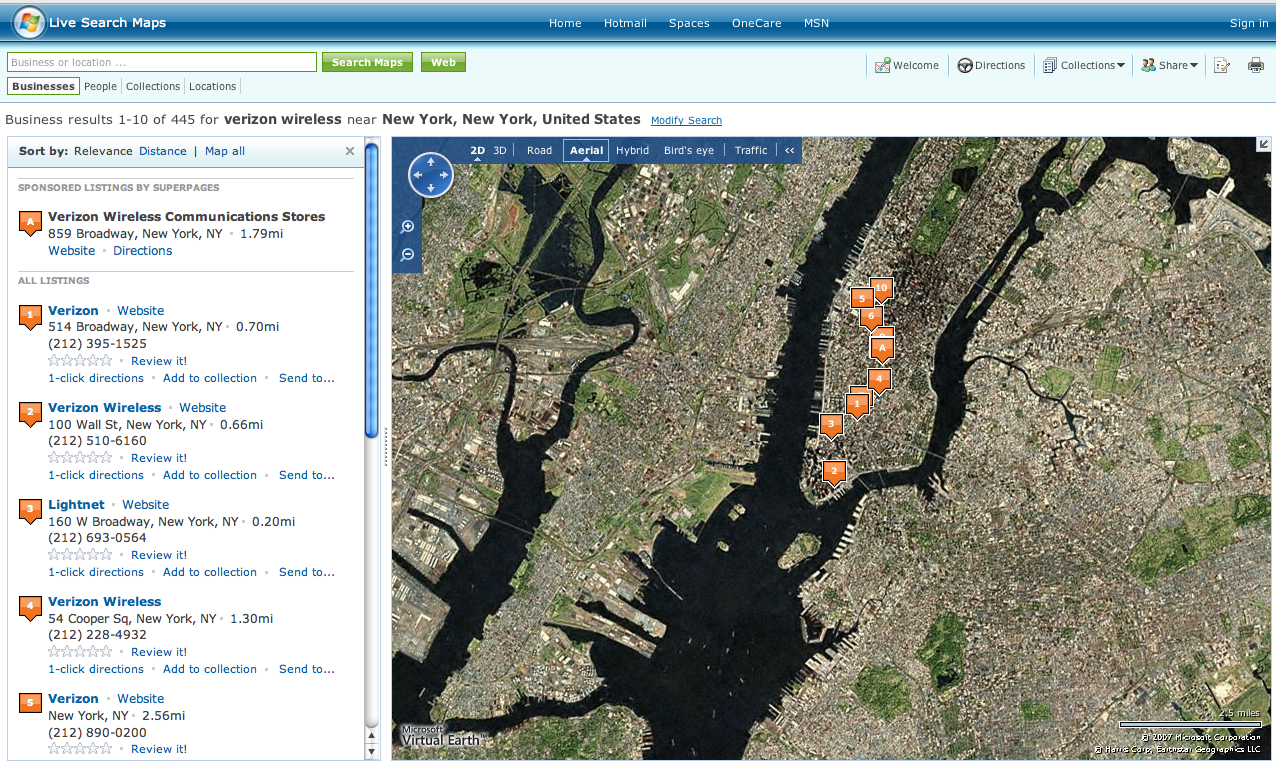
Its been reported nearly 50% of searches are local in nature. Let’s see how Microsoft’s Live handles a local brand search for Verizon Wireless in New York, NY.

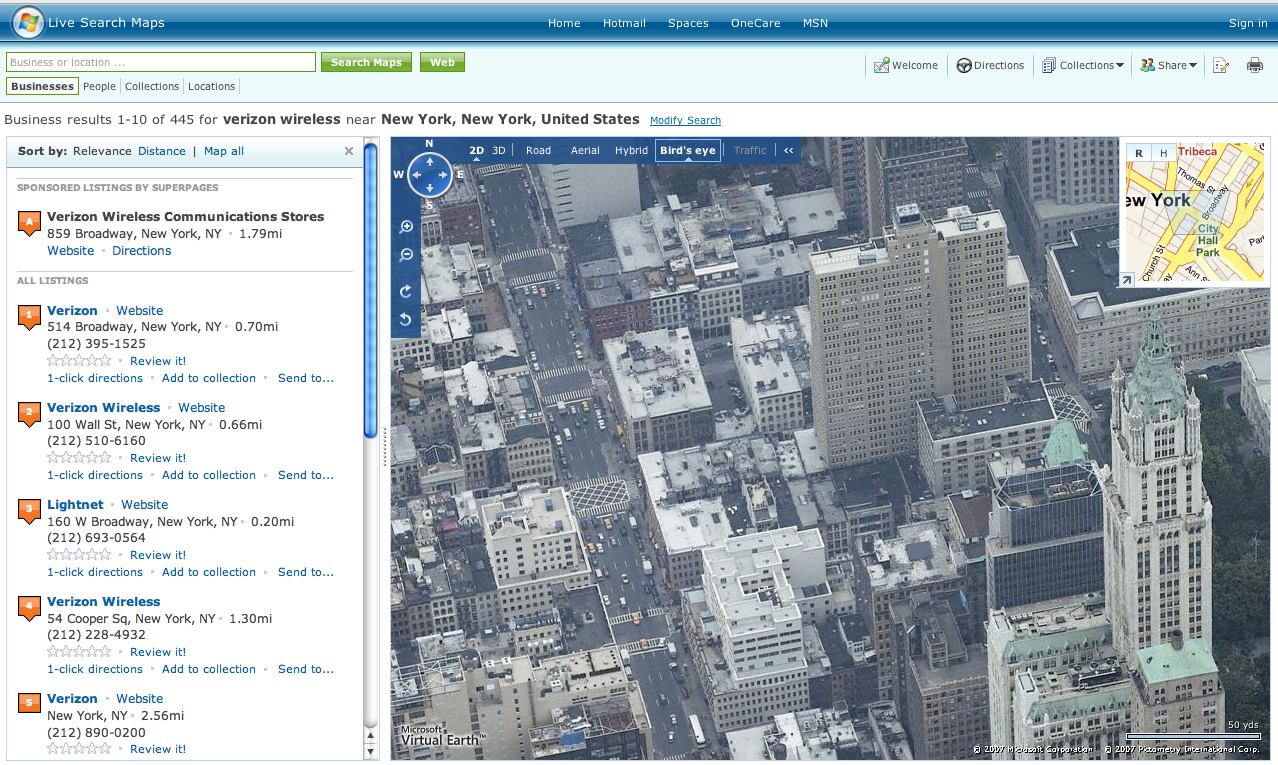
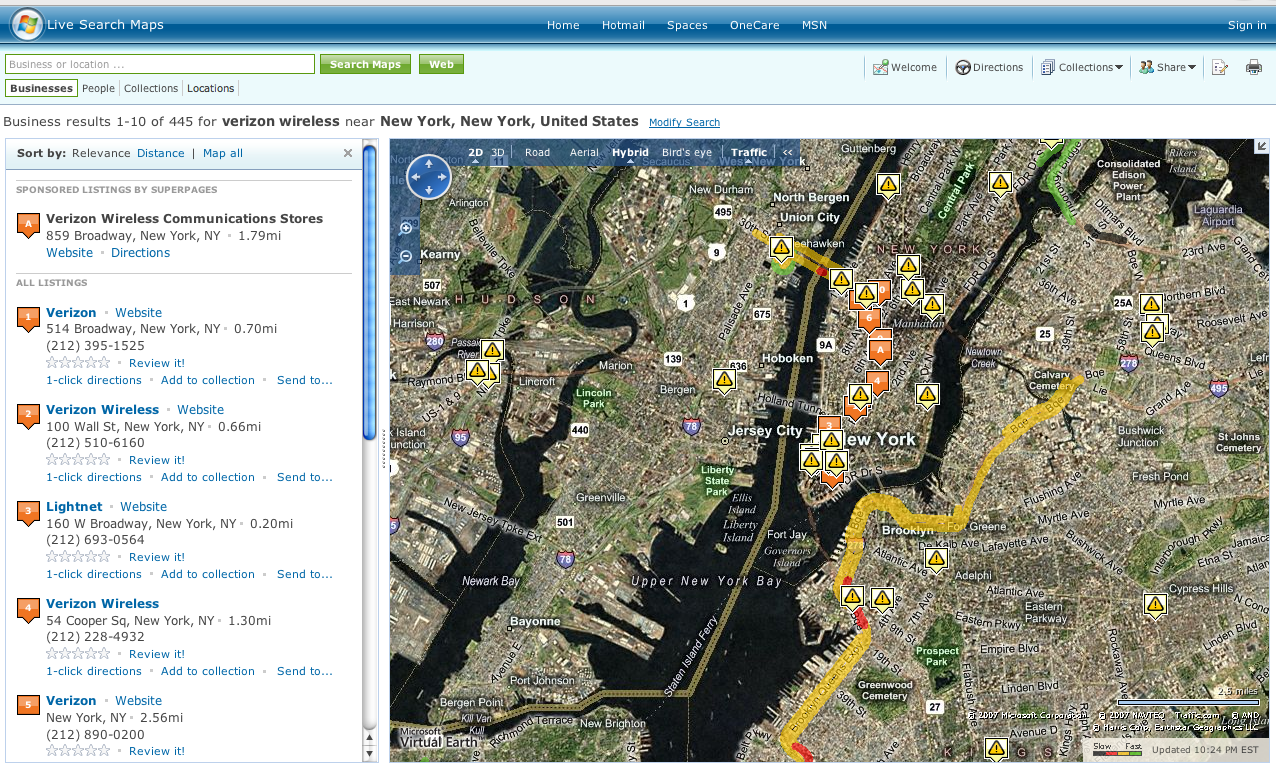
Live is able to locate Verizon Wireless stores in New York and provides five viewing options: Road, Aerial, Hybrid, Bird’s Eye and Traffic. Are their results relevant? Yes. Could we make our way to Verizon Wireless store or reach them by phone with the information Live provides? Yes.

With the Bird’s Eye view we may even be able to see what our destination looks like. Pretty cool.

Microsoft (US) Brand Search: Verizon Wireless New York, NY

Microsoft Live Verizon Wireless NY Road Map

Microsoft Verizon Wireless NY Road

Microsoft Live Verizon Wireless NY Aerial Map
Microsoft Verizon Wireless NY Aerial

Microsoft Live Verizon Wireless NY Hybrid Map

Microsoft Verizon Wireless NY Hybrid

Microsoft Live Verizon Wireless NY Bird’s Eye Map

Microsoft Verizon Wireless NY Bird’s Eye

Microsoft Live Verizon Wireless NY Traffic Map

Microsoft Verizon Wireless NY Traffic

How does Live perform outside the United States? A search for HSBC in London yields similar results. This particular brand search result is for a location near Trafalgar Square. If you aren’t going to be able to stop by a bank branch in London today, you can still take in the sights.

Microsoft (UK) Brand Search: HSBC London, England

Microsoft HSBC London UK Bird’s Eye Map

Microsoft HSBC London Bird’s Eye

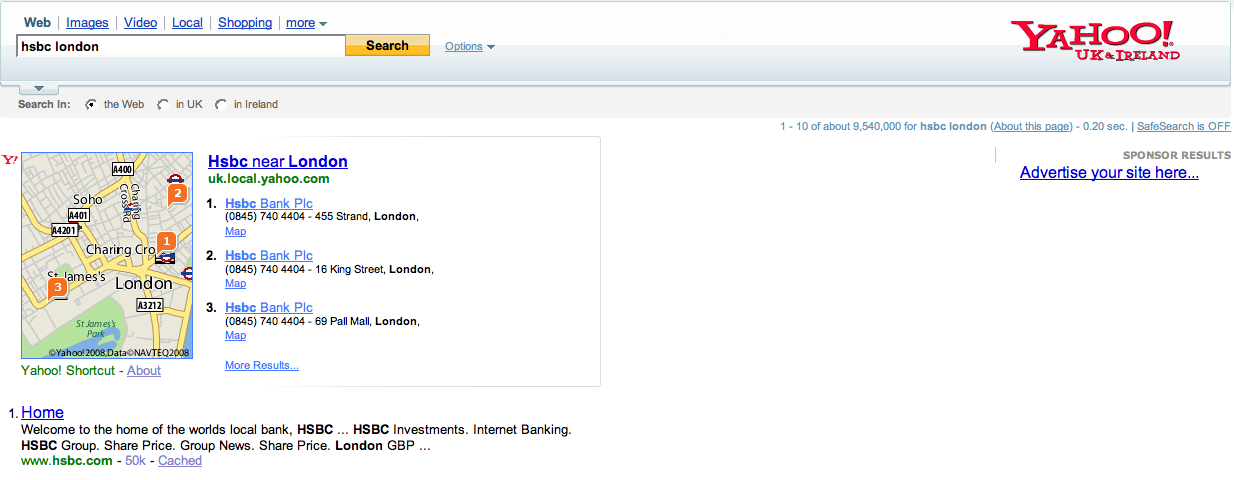
Now let’s try the same searches in Yahoo. Yahoo offers similar results. The look and feel isn’t too much different from those we received from Microsoft.

Initially though, I had difficulty locating the results I was hoping to find. Eventually I did find them – must have been my error.

Our options for connecting with one of the stores include: Getting directions, Save for later, Send to phone and Write a review.

Yahoo (US) Brand Search: Verizon Wireless, New York, NY

Yahoo Verizon Wireless NY “Find a Business”

Yahoo Verizon Wireless Find A Business

Yahoo Verizon Wireless New York

Yahoo Verizon Wireless New York

I can get the same type of UK map results from Yahoo however; I have to pull Yahoo’s UK web property up to get London results whereas with Microsoft I was able to get results from their US site.

Yahoo (UK) Brand Search: HSBC London, England

Yahoo HSBC UK Brand US Search

Yahoo HSBC UK US Search

Yahoo HSBC UK London UK Search

Yahoo (UK) Brand Search: HSBC London, England

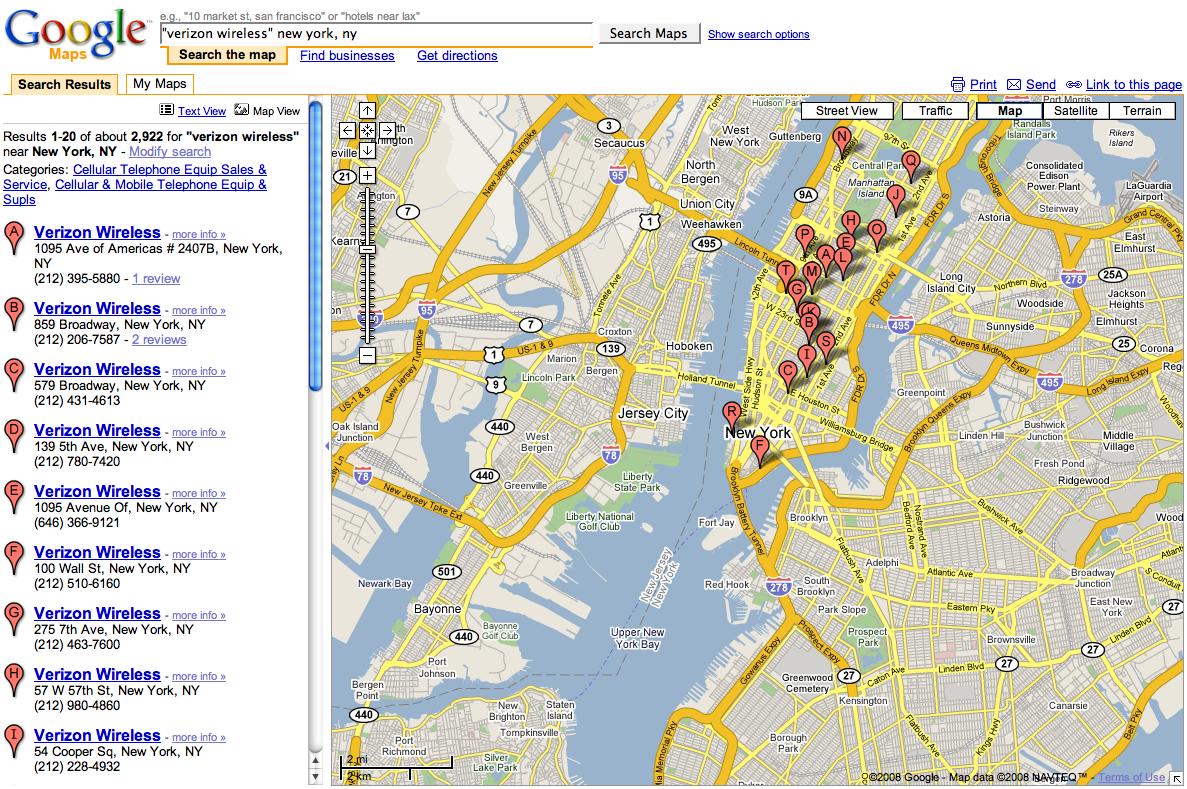
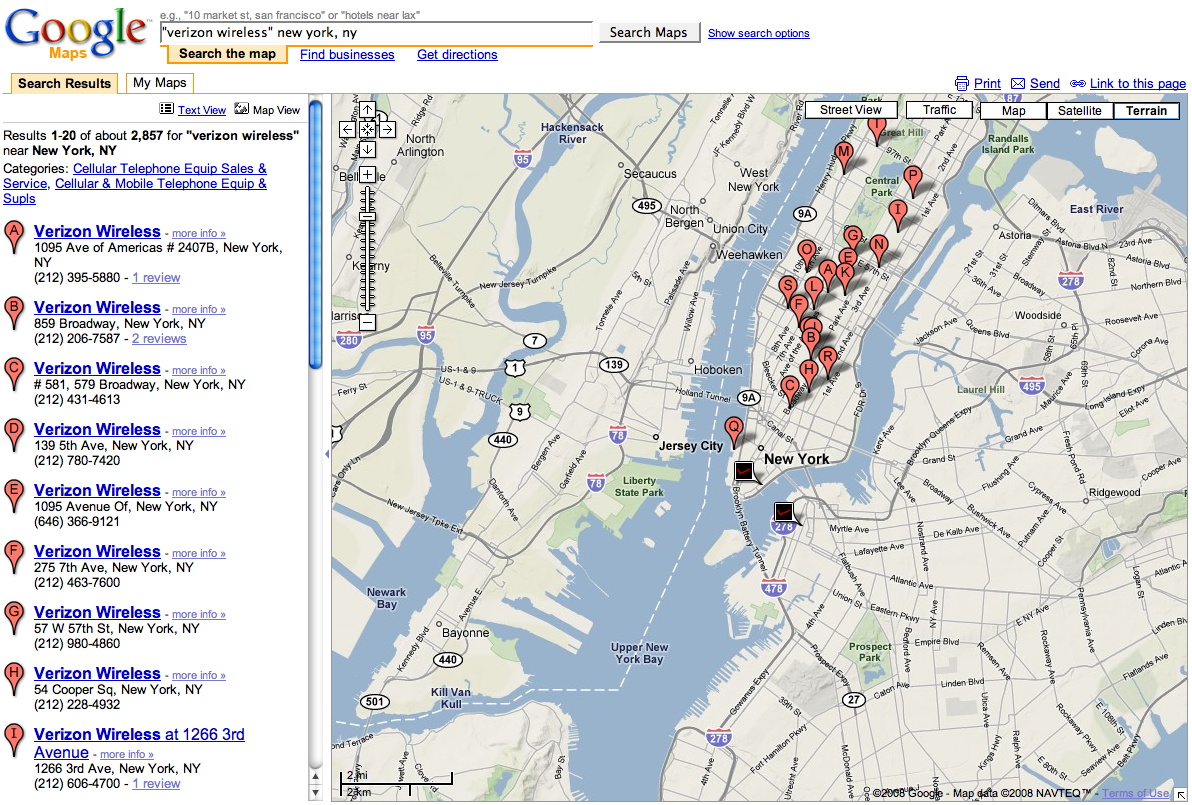
Now, let’s run searches for the same terms in Google. Like Microsoft, Google returns five types of views albeit under different button terms: Map, Street, Traffic, Satellite and Terrain Views.

The look and feel of Google’s views seem more visually pleasing than both the Microsoft and Yahoo products, however my appraisal is subjective.

Microsoft’s search and map features seem to be evenly matched with Googles’ and beyond those of Yahoo’s. Microsoft’s “Bird’s Eye” view does appear to ahead of its counterpart – Google’s satellite view.

Google (US) Brand Search: Verizon Wireless New York, NY

Google Verizon Wireless NY Map View

Google Verizon Wireless Map View

Google Verizon Wireless NY Street View

Verizon Street View

Google Verizon Wireless Traffic View

Google Verizon NY Traffic View

Google Verizon Wireless NY Satellite View

Google Verizon Wireless Satellite View

Google Verizon Wireless Terrain View

Google Verizon NY Terrain View

Google offers only three viewing options in the UK at this time compared to Microsoft’s five, yet I can fetch the results from Google’s US property unlike with Yahoo.

Google (UK) Brand Search: HSBC, London England

Google US HSBC Brand Search London UK Map View

Google (UK) Brand Search: HSBC, London England

Overall Microsoft, Google and Yahoo each offer their version of both business and brand rich search results.

From what I can tell, businesses and brands have yet to scratch the surface so to speak when it comes to reaching their potential customers in this new geographically rich and fertile target marketing environment.

Mobile Search and Reverse Business Telephone Number Lookup, a Visual 411

February 8, 2008

As local information requests are being keyed in from mobile devices, 411 and driving directions are becoming more visually rich and available via search.

Case in point: The business telephone number reverse lookup.

How does Microsoft’s Live render a reverse lookup for Microsoft’s own telephone number? Microsoft delivers the correct result along with the five previously mentioned view options: Road, Aerial, Hybrid, Bird’s Eye and Traffic. The map view does however default to Chicago, IL even though Microsoft is located in Bellevue, WA.

I can find the Microsoft campus on the map after scrolling over a couple thousand miles. I ran several more queries with each defaulting to the same Chicago starting point. I am not logged into a Microsoft account so I wouldn’t think it was based on my computers cookies or IP address which by the way is still several hundred miles south.

Evidently, Microsoft, Yahoo and Google all seem to generate their map results based on your past location specific searches.

Microsoft’s reverse lookup offers: 1 Click Directions, Add to collection, Send to Email, Mobile and GPS and Reviews. The send to GPS requires MSN Direct compatible navigation systems.

Reverse Business Lookup– 425-882-8080 Microsoft

Microsoft 425-882-8080

Microsoft 425-882-8080

A reverse lookup for Yahoo’s telephone number in Yahoo produces two results both of which are Yahoo locations. The map provides the same functionality found in their standard searches: Get Directions, Save for later, Send to phone and Write a review. If a web address is associated with the location it will be displayed too.

Reverse Business Lookup– 408-349-3300 Yahoo

Yahoo 408-349-3300

Yahoo 408-349-3300

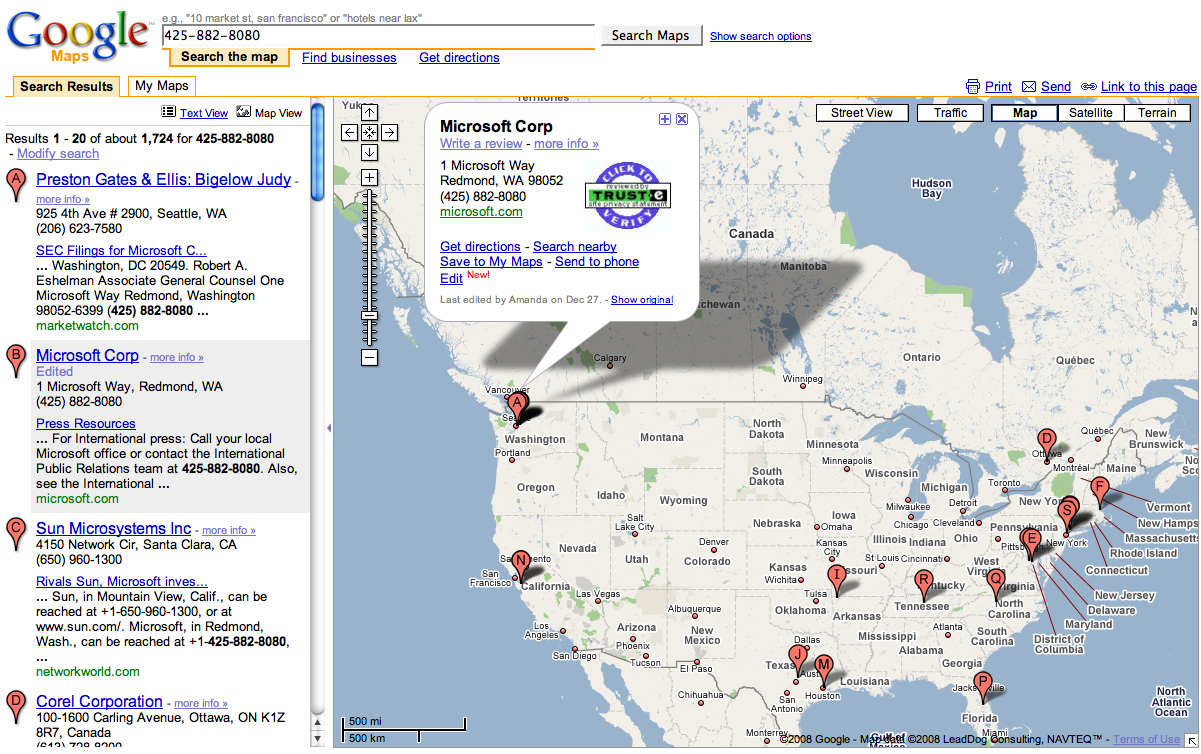
A search for Google’s telephone number yields the same five view options: Map, Street, Traffic, Satellite and Terrain Views as with the brand or business category search before. Additionally, Google provides a dialogue box with more options.

Searchers options are: Get directions, Search nearby, Street view, Save to My Maps, Send to phone and Edit. More information about the business and reviews are also one click away.

With “Search nearby” a searcher can locate additional businesses and services like finding Chinese takeout from their hotel.

Where Microsoft’s Bird’s Eye view appears to have bested Google’s satellite view, Google’s “street view” takes visualization to the next level.

With Google’s street view, Google provides eye level images of locations. It’s not available in every area yet. Coordination with volunteer picture geotagging projects may eventually speed the population of their street level image file.

Google’s new Edit feature lets anybody correct the location of a business. It also prompts business owners to “claim” their business in Google’s Local Business Center. These two options should eventually help them improve their data.

Reverse Business Lookup – 650-253-0000 Google

Google 650-253-0000

Google 650-253-0000

Google Street View

Google Street View

Edit Map Feature

Reverse Lookup Edit

By pushing more information out to users third screen (mobiles), Google, Microsoft and Yahoo regardless of their corporate status, have greater potential to attract ever-larger audiences and their keystrokes – a situation where all consumers ultimately win.

Before and After Picture: Local Search Engine Optimization in Oklahoma City

February 8, 2008

The following email came from a client who received a “targeted” search engine optimization services pitch from a search engine optimization salesman who was prospecting for clients.

I changed the search engine optimization company and client names.

This is after my optimization of their old website started “miraculously” producing over 4,000 web visitors per month and new business – telephone calls, online and in store sales – where none had came from before.

Clients amaze me!

Hi Tim-

What do you think about this e-mail? I thought this was what your website optimization was supposed to accomplish. Help?

[Preferred Client]

—–Original Message—–
From: [ABC SEO Company]

Sent: Wednesday, February 06, 2008 3:14 PM
To: Website owner
Subject: Attn: [Jane Doe] Regarding [preferredclient.com]

Hello [Jane],

I was recently looking through [ABC Consumer] magazine and saw your advertisement. I took a look at your website and found it very appealing. I decided to do a little research on Google to see if your website was on the first page.

I searched for “[general product term] Oklahoma City” and your site did not come up in the natural search results on Google. I then tried “[another general product term] Oklahoma City” and even “[and even another general product term] Oklahoma City” again with no results. Potential customers are currently using keyword phrases similar to these to search for a company like yours. [PreferredClient.com] could and should be on the first page of major search engines like Google, Yahoo and MSN.

I work for ABC SEO Company, a search engine marketing firm. We help position websites on multiple search engines so you will come up for targeted keywords. It is surprising how many more customers you can attract with online marketing. If you have a couple minutes I would be happy to give you some information on how our services could benefit your business.

Please let me know if you have a few minutes to talk.

Best Regards,

ABC SEO Salesman

Research and Development
ABC SEO Salesman

PH: xxx-xxx-xxxx
Fax: xxx-xxx-xxxx

My response:

Hi [Preferred Client],

Well, my work sent 4,127 visitors from 11 different search engines between January 6, 2008 and February 5, 2008 via 1,528 keywords whereas prior to my work your site received 0 visitors monthly via 0 search engines.

During the same time period the visitors who came to your site via the 11 search engines on average viewed 13.46 pages each and spent 3:48 of their time on your site.

84.01% of the 4,127 visitors who arrived at your site via search engines had never been to the [PreferredClient.com] website before.

Search Engine Optimization

I don’t know whether the progression from 0 searches to 1, 2, 3 searches etc. is considered arithmetic, geometric or quadratic but I think the difference is quantifiable.

I also don’t know how many searches he thinks his recommendations would yield daily, weekly, monthly or yearly but I would definitely ask him for his estimate.

I think all you can do when you receive these type of emails is ask the sender what kind of search traffic they estimate their recommendations will deliver and then weigh their response with what your before and after search experience has been and is now.

I think only then would you have the necessary information needed for deciding whether pursuing their recommendations or not would be in the best interest of your business.

Wouldn’t you agree?

Let me know if there is anything else I can do for you.

Thanks and all the best,

Tim Cohn

Microsoft and Yahoo vs. Google: The Battle for Audience and Keystrokes

February 7, 2008

The Redmond giant has sprung to its feet from its long and comfortable slumber.

Much like the browser business before it, Microsoft has realized it had better get into the search advertising business before its too late.

I think we all know who won the browser war. We also know how they did it.

Even with its proposed acquisition of Yahoo!, Microsoft may have already overslept and thus lost this battle.

On the surface this acquisition looks like a grab for a piece of the search advertising business.

However, just below the surface lie its real targets: the Internet audience and their keystrokes.

Internet Audience?

Keystrokes?

Both beachheads Microsoft has or has had control of nearly since their inception, keystrokes via the personal computer desktop and the Internet audience via browsers – not from birth but before the web’s infancy ended.

Like their importance to Microsoft’s franchise before, both have an equally and even greater importance going forward. Audience begets keystrokes and vice versa. However, It’s hard to control one if you don’t control the other.

Microsoft’s $44 billion offer to acquire Yahoo and its audience is an admission by Microsoft that if they aren’t able to augment their present audience now with an acquisition the size of Yahoo, they won’t ever be able to stem the audience gains being made by Google and their control of the largest and most valuable part of the internet audience – the search audience.

At this point, Microsoft’s not getting control of Yahoo’s audience is the single greatest risk facing their business – hence their offer price and the need to get the deal done. Maybe not today or tomorrow, but let unabated Microsoft faces continued losses in both audience and keystrokes.

Its not a market position Microsoft is familiar with or comfortable.

Why search is the most valuable audience on the Internet.

There are two types of audiences on the Internet. The old and familiar audience type, which is the one served and supported by display advertising.

Advertisers buy ads to reach an audience based on what content a publisher assembles to attract a particular audience. Ads are then priced and sold based on the desirability advertisers have in reaching that particular audience.

At any one time, a large percentage of the publisher’s audience is inactive – not interested in what the advertiser is selling.

Advertisers still have to pay to reach the publishers entire audience regardless of how many people may or may not be interested in the advertiser’s ads or products. Because display advertising is inefficient i.e., reaches more disinterested audience than audience of potential buyers – it sells for less and thus generates less income for publishers.

The other type of audience available to advertisers on the web is search advertising.

Unlike display advertising, search advertising reaches only an active audience – people who have explicitly requested advertisers information about their products or services – by their clicking on ads.

Search advertisers only incur costs to reach their audience when consumers click on their ads. Thus search advertising is significantly more efficient in delivering advertising messages to the exclusively active segment of the Internet audience – people who are actively searching for information.

By definition, search advertising only delivers advertisements to people actively seeking what the advertiser is advertising and selling. Because of this efficiency in targeting and delivery, search advertisers are able to reach more qualified prospects for less than through traditional media.

In turn, search advertising providers like Google are able to charge advertisers commensurate with the value the advertisers receive from reaching a efficiently targeted and active audience.

The result?

By my calculations, Google’s annualized gross revenue from advertising per visitor is roughly twice that of Yahoo’s and nearly four times Microsoft’s (gross advertising revenues divided by web property visits)

At a minimum, a search driven visit is worth at least twice – up to four times more than a non-search driven visit.

This is why Microsoft desperately needs Yahoo’s audience.

Although there are wide discrepancies over what percentage of search each company gets, Google receives between four to twenty times more search traffic than Microsoft and three to five times more search traffic than Yahoo, combined and assuming no market disruption – the two companies would still only generate one fourth to one half the search business of Google.

This acquisition also assumes Yahoo’s ad platform can continue to harvest one half the value Google does whether through Yahoo! or Microsoft’s search product without cultural distraction or interruption from the merger.

Even with their proposed clean room assembly, Microsoft’s acquisition of Yahoo! does not answer how they will make up difference (search volume + gross revenue per visitor).

By doubling their performance (revenue per visit) post merger to meet Google’s present level of performance, a MicroHoo search advertising business gross revenues per visitor would be half of Google’s.

In order for Microsoft to retain Yahoo’s audience, publishers and advertisers- the combined company will also need to produce:

Highly relevant search results for its audience, a functional ad platform for its advertisers, profitable ad distribution for its publishing partners and most importantly: a greater return on its advertisers’ investments.

Without which any new ad platform and search product may grab the attention of a larger audience and gain its keystrokes only to see it lost after they are unable to deliver what the internet audience has already come to expect, find and get from Google.

Of course, this also assumes Microsoft is somehow precluded from using its expanded platform and footprint to reroute ancillary chunks of audience to its new web properties acquired through the proposed acquisition along with their accompanying keystrokes.

In the absence thereof, there may be no stopping Google’s march.

Google Advertising Professional Video

February 6, 2008

As a Google Advertising Professional, I use the Google Adwords keyword suggestion tool daily.

Here is my Google Adwords video showing how to use  keyword suggestion tool and a link to the Google Adwords external keyword suggestion tool.

SalesGenie.com Super Bowl Ad

February 5, 2008

97.5 million viewers on average watched Super Bowl XLII.

Advertisers paid $2,700,000 for a 30 second spot. The advertisers effectively paid .027 per impression to reach the second largest television audience ever recorded.

Only large brands or smaller ones betting the company can afford Super Bowl commercials.

An important question for any business contemplating making such a large one-time purchase is – what percentage of the audience is inactive? What percentage of the audience is unreceptive to my company and its offer?

80% inactive audience?

90% inactive audience?

99.99% inactive audience?

100% inactive audience?

More importantly, what percentage of the television audience is an active audience? An audience who will at some point now or in the future be interested in what I am selling let alone buy it?

100% active audience?

10% active audience?

1% active audience?

0% active audience?

It would be an interesting case study to see what amount – if any – Salesgenie.com recoups from its Super Bowl XLII brand messaging and offer investment.

Alternatively with the same $2,700,000, Salesgenie.com could have bought 2,700,000 active audience members @ $1.00 clicks through a Google Advertising Professional.

Even bidding and paying $5.00 a click, SaleGenie.com could have reached and connected with 540,000 American salesmen looking for leads.

I wonder how many sales people acted on their Super Bowl ad? 5 million? I doubt it. There probably aren’t 5 million sales leads buyers in the United States.

What are the odds they reached, fielded let alone converted 540,000 leads (.0055 of the entire Super Bowl audience) from their Super Bowl XLII ad?

Did SalesGenie.com advertising gamble beat the odds or get beaten by them?

Google’s Local Advertising Embedded with Google Maps

January 29, 2008

As I mentioned in my last post, Google has begun taking additional steps to bridge the gap between web search traffic and their advertiser’s foot traffic.

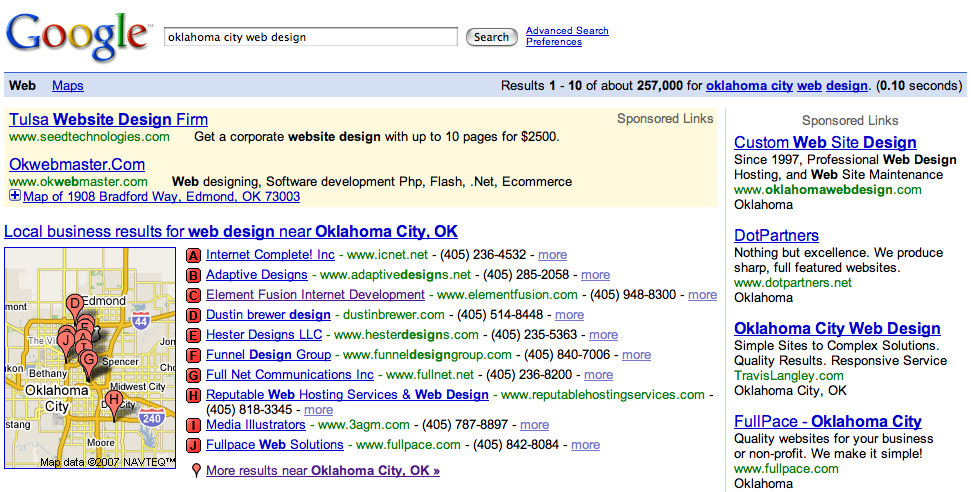
In researching the different types of Local OneBox results found both here in the United States and abroad, I found an Adwords ad format I hadn’t yet seen – an Adwords Ad with a Google Maps icon embedded within the Google Adwords advertiser’s ad.

By adding Google Maps images to local advertisers ads, Google has simplified and reduced the searching online to visiting off line and in person to three steps.

Step 1. The search for local products or services : Oklahoma City Web Design

The search for “Oklahoma City Web Design” produced the usual sponsored links both those above the new 10 OneBox results and those found along the right rail. However, after closer inspection I noticed the second listing had a maps icon embedded in the ad.

Google Local Adwords Ad + Google Maps

Step 2. Local product or service providers advertisement selected. Selection factors could include brands or services offered and their convenience to the searcher.

Google Local Adwords Ad + Google Maps Expansion

Step 3. After placing a call to the advertiser to verify their products availability and price, the searcher can then complete the three step process from searching online to buying off line by then getting directions to the advertisers location through Google Maps.

Google Local Adwords Ad + Google Maps Expansion + Directions

By adding the Google Maps feature to local Google Adwords advertisers ads, Google has bridged the gap between web search traffic and foot traffic in a fresh, unique and beneficial way.

Google Local Business Results and the Last Mile: Search Takes Two Steps Closer to Bridging the Gap Between Web and Foot Traffic

January 28, 2008

Google’s First Step…

As reported and since confirmed by Greg Sterling, Google is now showing up to 10 local business results for geographic specific queries.

Google told Greg the reason it’s showing more links is because usability testing revealed that many people didn’t realize there was additional local content available beyond the three listings, despite the “more results . . .” prompt. Accordingly, Google said that with the 10 links it is hoping to signal people that there is much more local content a click away.

Google also said that it wouldn’t always show 10 results; it might still show three sometimes or one if the query is very specific.

As Mike Blumenthal has noted, it has been nearly a year since Google last upgraded their Local OneBox. At the time it led to a significant increase in Google Maps usage.

It will be interesting to see if and how Google’s worldwide roll out of their new Local OneBox increases Google Maps usage like it did after implementing their last Local Business OneBox changes.

In my previous post about Google’s local business results being expanded, I wrote about how the listings appeared locally and some of the factors I thought contributed to the listings.

Sterling reported the ten results are based on a range of factors, including the “query, proximity, availability of ratings/reviews and their quality and several other variables.”

Since Google doesn’t publish exactly what factors influence their list, all we can do is study what they publish and draw our own conclusions as to which variables may matter the most.

The following are examples of searches I have ran, Google’s Local OneBox business results and my analysis of what variables I think generated the list.

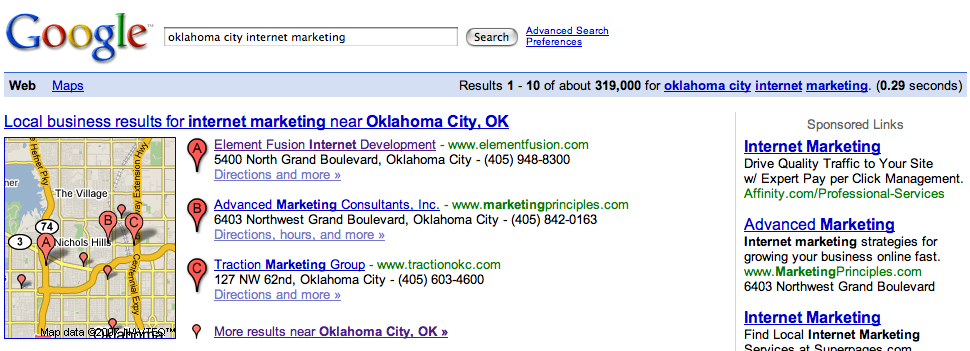
Google Local Business Results: Internet Marketing Oklahoma City –

Google Local Internet Marketing Oklahoma City

This query for a service (internet marketing) followed by the location (Oklahoma City) produced a “top of page” 10 listings OneBox result. I also found some Google Adwords ads displaying the recently discovered business address on the fourth line of the Adwords ad.

Google Local Business Results: Oklahoma City Internet Marketing –
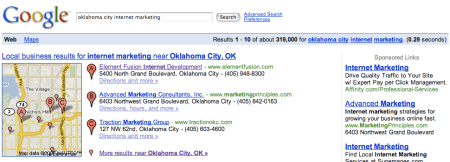
Google Local Oklahoma City Internet Marketing

Searching for the same terms in a different order; placing the location first (Oklahoma City) and the service (internet marketing) last, produced a OneBox result with only three business listings. Some local Adwords advertisements still appeared with their specific address on the fourth line, which as mentioned previously only displayed a city or state.

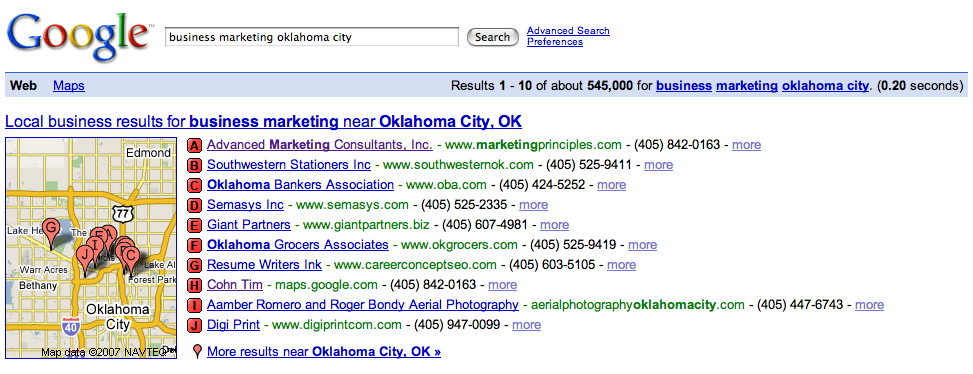
Google Local Business Results: Business Marketing Oklahoma City –

Google Local Business Marketing Oklahoma City

A slightly different search for a similar business category yields a new clue to at least one of the factors Google uses to generate its OneBox 10 local business listings.

A search for the service (business marketing) and the location (Oklahoma City) produces a different yet seemingly innocuous list of businesses. However, in this particular query and in addition to the expected listing for my business “Advanced Marketing Consultants” appearing, “Cohn, Tim” also appears as one of the results.

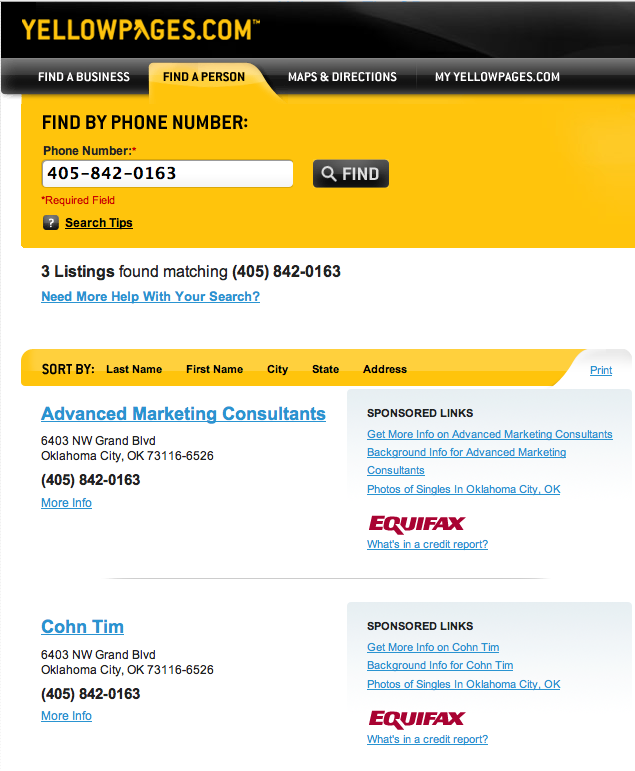
Cohn, Tim is one of my business phone listings in my local Bell telephone directory. The phone company apparently can’t sort and digitally publish business listings with an individual’s name like they can an individual’s residential phone data.

A search in YellowPages.com produces “Cohn, Tim” for my business phone number –

YellowPages.com

Yet, a search in Google for “Tim Cohn Oklahoma” produces both of my residential phone numbers and listings in correct order: Tim (first name) and then Cohn (last name) –

Tim Cohn Oklahoma

I haven’t investigated whether the phone company automatically reverses residential phone records before they are published to the web or whether Google reverses the data before they publish it.

Regardless, it looks like the business listing for “Tim Cohn” will remain forever memorialized in the vast telephone company data and its Internet counterpart as the business listing: “Cohn, Tim”.

Having accepted the fact that the telephone company seemed incapable of changing their listing results years ago, I decided to turn this particular piece of flawed data into my “control”.

When Cohn, Tim appears in print – whether online or off – its source is always local phone company data.

Thus at least a portion of this particular Google local OneBox list origins lies in business telephone directory data.

To its credit, Google has become proactive in allowing users to modify incorrect Google data as Barry Schwartz recently reported.

And unlike my attempts to get the phone company to correct how my business phone listing appears both in print and online, I am sure Google will let me append my business listing in their Google Local Business Center, but that will have to be the subject of another post.

Google Local Business Results: Chevy Oklahoma City –

Google Local Chevy Oklahoma City

Unlike with an old fashioned yellow pages search for listings with “Chevy Oklahoma City” keywords whether in the yellow pages or through directory assistance, Google can return results most likely relevant and matched to the searchers or callers intent.

Whereas, a yellow pages search or directory assistance call would take a couple of “passes” to yield the similarly accurate and desired result – businesses listings most likely to be known as “Chevy Oklahoma City”.

Brilliant!

If the telephone company can’t arrange and organize my single business listing correctly in their digital directories, how will they ever be able to compete with Google’s ability to anticipate and even provide multiple possible answers to each searchers question?

Google Local Business Results: Double Glazers Chelsea London (England) –

Google Local London

Google’s local business results aren’t just appearing in the US. A search for “double glazers” in the Chelsea section of London produces a list of double glazers midway down the search engine results page. I am not sure why some OneBox results appear at the top of the page and why others appear in the middle of the page but I believe it too must be based on Google’s understanding of the searchers intent.

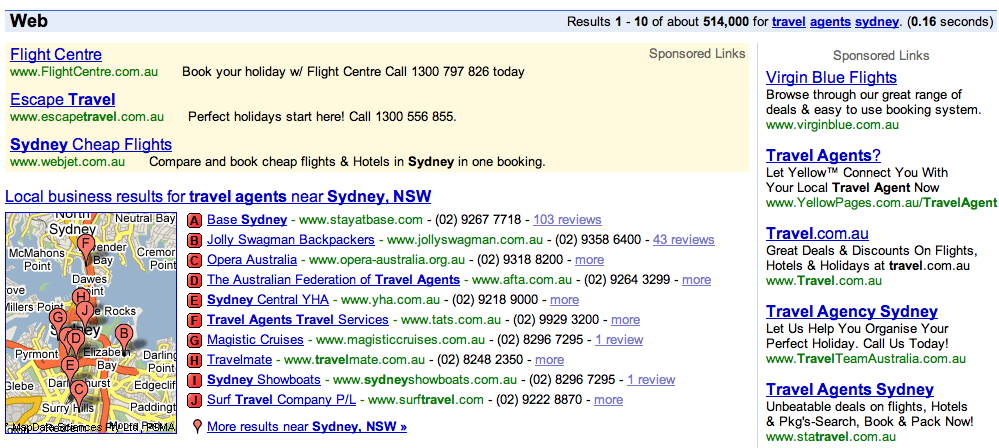
Google Local Business Results: Travel Agents Sydney (Australia) –

Google Local Sydney

This search in Sydney, Australia for travel agents also produces a OneBox result. Here the OneBox appears again at the top of the page above the organic results.

In my next post, I will show how Google’s local business results have taken a second step closer to bridging the gap between paid web search traffic and foot traffic…