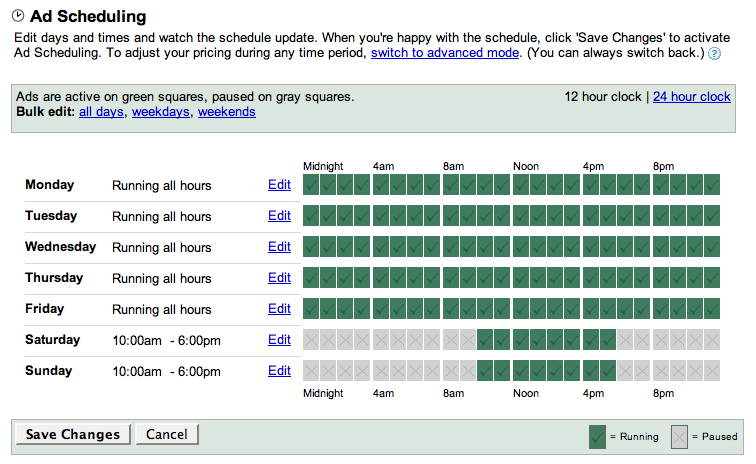
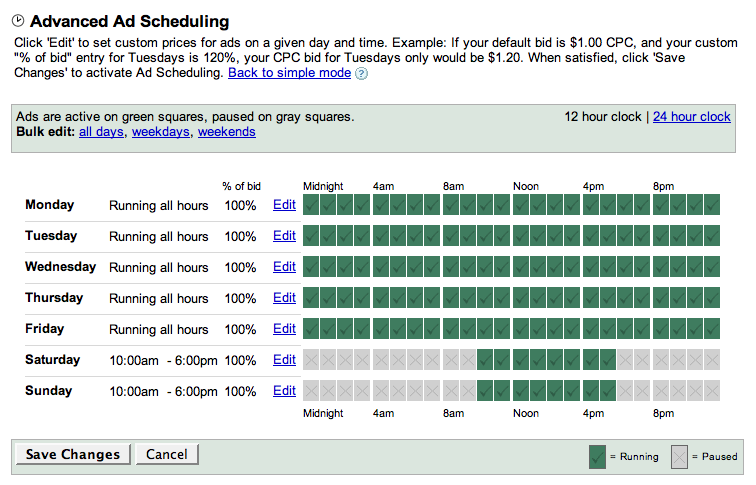
In case you can’t get the Ziggs.com website to load, here is a screen shot of their home page:
Their server must not have been ready for prime time, because the “Service Unavailable” message continues appears.
Keep trying. Better luck next time.
So much for trying to book an in store appointment online through Apple’s website.
I have been trying to schedule a time to take my MacBook Pro in to get its battery replaced for twenty minutes.
This is my second Mac laptop to need a replacement battery.
Apparently, when Apple bench tests their Mac laptops they don’t run them everyday all day for several months.
If they did, they too would learn their laptop batteries begin to warp and eventually “outgrow” their slot under the laptop rendering the laptop a desktop because it then requires an AC power connection to function.
I guess I should take a picture of it and post it here which I will have to do later because…
Apple’s technical support guy just hung up on me after he confirmed “Apple’s online concierge” wasn’t working on his end either.
I wasn’t willing to dial the local store directly because every time I have called the local Apple Store I have gotten an endless voice messaging tree which never resulted in a human connection.
To their credit, Apple’s technical representative offered me a special telephone number to reach my local Apple Store and a person who could help me schedule an appointment.
However, when I asked why Apple didn’t just publish the telephone number that reached store personnel on their website instead of my having to call to get the special telephone number – he hung up.
Update: 12:59 PM same day:
Apple’s Concierge site came back up after my call to tech support.
I booked an appointment online to get tech help from the local Genius Bar at 12:00.
I arrived at the store and checked in.
My name was called. I then met with the tech help and explained my battery problem.
The Apple tech helper said they had a few problems with some MacBook Pro batteries. He then said a replacement battery would be provided at no cost.
He installed the battery, I signed a work order and then packed up my Mac.
I was in and out of the Apple store in about fifteen minutes.
I don’t know what PC owners have to go through to get their machines repaired but I am sure its not half as quick or painless as getting an Apple computer repaired.
I’m still glad I am not a PC owner.
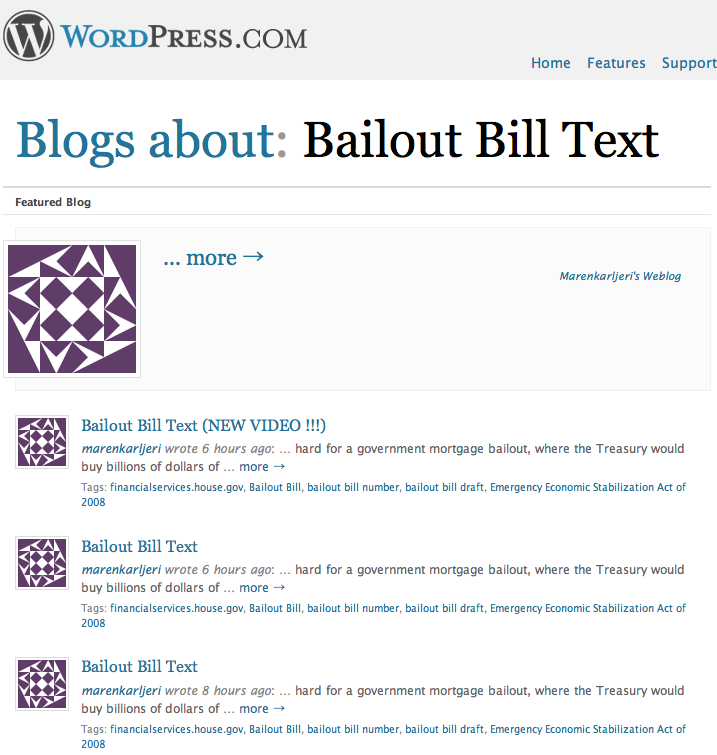
A search today for “Bailout Bill Text” produces a list of WordPress blogs which have purportedly written about the US government bailout of the mortgage industry.
Instead, the top four search results WordPress provides searchers who have clicked through to its site are from the same splog.
Clicking through to any of the results produces stolen content the splog has scraped into their post combined with an embedded and totally unrelated video.
I realize it may be difficult for WordPress to stop the proliferation of splogs and their ilk.
However, can’t WordPress at least identify and then filter Splogs from displaying their scraped content within their own search results?
Not doing so does both its publishers and the search audience a disservice.
Here is a copy of the Bailout Bill Text.
The U.S. House of Representatives Committee on Financial Services has drafted its financial markets bail out bill.
The Speaker of the House and the U.S House of Representative achieved their goal of providing the bail out bill text to the public before Asian markets opened Monday morning.
The bail out bill official title is:
“The Emergency Economic Stabilization Act of 2008”
Below is text from the Table of Contents which outlines the U.S. House of Representatives $700 billion Wall Street rescue plan.
[DISCUSSION DRAFT]
110TH CONGRESS
2D SESSION H. R. ll
To provide authority for the Federal Government to purchase and insure certain types of troubled assets for the purposes of providing stability to and preventing disruption in the economy and financial system and
protecting taxpayers, and for other purposes.
IN THE HOUSE OF REPRESENTATIVES
M__ – introduced the following bill; which was referred to the
Committee on ______________________________________
A BILL
To provide authority for the Federal Government to purchase and insure certain types of troubled assets for the purposes of providing stability to and preventing disruption in the economy and financial system and protecting taxpayers, and for other purposes.
Be it enacted by the Senate and House of Representatives of the United States of America in Congress assembled, SECTION 1. SHORT TITLE AND TABLE OF CONTENTS.
(a) SHORT TITLE.—This Act may be cited as the
‘‘Emergency Economic Stabilization Act of 2008’’.
(b) TABLE OF CONTENTS.—The table of contents for this Act is as follows:
Sec. 1. Short title and table of contents.
Sec. 2. Purposes.
Sec. 3. Definitions.
TITLE I—TROUBLED ASSETS RELIEF PROGRAM
Sec. 101. Purchases of troubled assets.
Sec. 102. Insurance of troubled assets.
Sec. 103. Considerations.
Sec. 104. Financial Stability Oversight Board.
Sec. 105. Reports.
Sec. 106. Rights; management; sale of troubled assets; revenues and sale proceeds.
Sec. 107. Contracting procedures.
Sec. 108. Conflicts of interest.
Sec. 109. Foreclosure mitigation efforts.
Sec. 110. Assistance to homeowners.
Sec. 111. Executive compensation and corporate governance.
Sec. 112. Coordination with foreign authorities and central banks.
Sec. 113. Minimization of long-term costs and maximization of benefits for taxpayers.
Sec. 114. Market transparency.
Sec. 115. Graduated authorization to purchase.
Sec. 116. Oversight and audits.
Sec. 117. Study and report on margin authority.
Sec. 118. Funding.
Sec. 119. Judicial review and related matters.
Sec. 120. Termination of authority.
Sec. 121. Special Inspector General for the Troubled Asset Relief Program.
Sec. 122. Increase in statutory limit on the public debt.
Sec. 123. Credit reform.
Sec. 124. HOPE for Homeowners amendments.
Sec. 125. Congressional Oversight Panel.
Sec. 126. FDIC authority.
Sec. 127. Cooperation with the FBI.
Sec. 128. Acceleration of effective date.
Sec. 129. Disclosures on exercise of loan authority.
Sec. 130. Technical corrections.
Sec. 131. Exchange Stabilization Fund reimbursement.
Sec. 132. Authority to suspend mark-to-market accounting.
Sec. 133. Study on mark-to-market accounting.
Sec. 134. Recoupment.
Sec. 135. Preservation of authority.
TITLE II—BUDGET-RELATED PROVISIONS
Sec. 201. Information for congressional support agencies.
Sec. 202. Reports by the Office of Management and Budget and the Congressional
Budget Office.
Sec. 203. Analysis in President’s Budget.
Sec. 204. Emergency treatment.
TITLE III—TAX PROVISIONS
Sec. 301. Gain or loss from sale or exchange of certain preferred stock.
Sec. 302. Special rules for tax treatment of executive compensation of employers
participating in the troubled assets relief program.
Sec. 303. Extension of exclusion of income from discharge of qualified principal
residence indebtedness.
The entire 110 page draft can be downloaded from the House Committee of Finanical Services web site.
Google provides “conversion code” to Adwords advertisers for tracking actions occurring after searchers have clicked on advertisers ads.
Five action types Adwords advertisers can track are:
1. “Other”
2. Purchase/Sale
3. Signup
4. Lead
5. View of a key page
Once the conversion code has been installed into the source code between the <body> and </body> tags of your action page, the advertiser needs to verify whether Google Adwords can track the conversion code correctly or not.
Google can track conversions on both secure and non secure sites.
Until recently, I hadn’t had any problems verifying or tracking actions from either type of site.
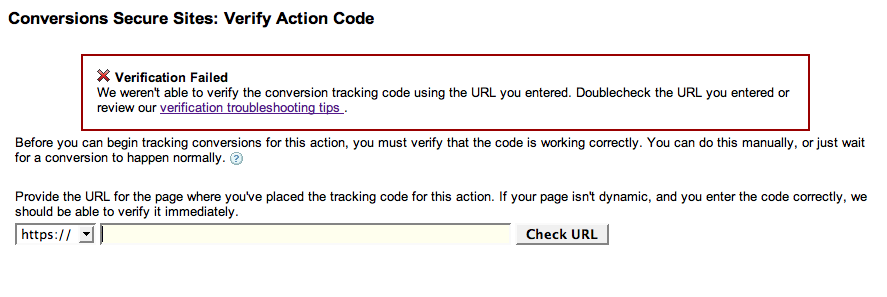
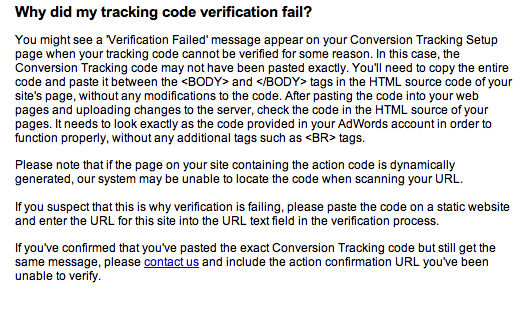
However, while trying to verify action code from dynamic pages within a secure site, I wasn’t able to generate a result other than “verification failed” when using Adwords test “verify action code” feature.
Conversion Code Verification Failure – sans url.
When verifying whether or not an action code is reporting correctly from a dynamic and secure site and provided the code has been installed correctly, advertisers may find clicking on one of their ads and then completing the action may provide the quickest and easiest answer to their question – “is the conversion code working or not?”
Otherwise, launching a campaign without verification and waiting for a conversion action to eventually occur may be the only other way to determine whether the conversion code actually reports or not.
There seems to be more activity in the domain aftermarket market for marketing related terms recently.
In a previous post, I wrote about owning marketingconsultants.org and being approached by a domain investor to buy his premium domain marketingconsultants.com.
I didn’t bid on his domain, but it reportedly sold for $9,200.00 according to the domain auctioneer Sedo.
An even more desirable premium domain: MarketingAgency.com is now at auction.
I received the following domain auction alert via email:
“Dear Marketing Executive,
We’re auctioning off the premium Internet Domain MarketingAgency.com in Moniker’s New York Traffic Conference Extended Online Auction.
For info to consider and/or instructions on bidding please visit the domain.
The Auction has started and ends on October 2nd. Why bid? Keyword based domains, especially ones that reflect terms with high PPC Ad rates fetch top dollar. There are so many different ways to monetize this domain. Check out a site that tracks aftermarket domain sales data, dnjournal.com
Please pass this auction info on to a decision maker or someone familiar with the value of Domains within your company, if this person is not you. I assure you it’s a once in a lifetime opportunity to secure a virtual asset that could pay dividends indefinitely.
Thanks in advance,
XXX “
I visited the site as suggested and found the following placeholder:
Next, I clicked through to the site as suggested to find the present top bid.
I was surprised to see one buyer has already offered $88,240.00 for MarketingAgency.com
The auction for MarketingAgency.com is certain to bring “five figures” to its owner.
Time will tell whether MarketingAgency.com is worth “six figures” or not.
With Google having added numeric quality scores ranging from 1 to 10 within all Adwords advertisers accounts, an entirely new level of performance data has become available to paid search managers.
Will Google Adwords Quality Score Management soon follow?
Presently, Adwords provides advertisers with ten different types of account performance reports.
The ten types of Google Adwords reports along with their attributes are:
1. Keyword Performance: Performance data for all keywords or those in selected campaigns.
2. Ad Performance: Performance data for each of your ads
3. URL Performance: Performance data for each of your Destination URLs.
4. Ad Group Performance: Ad group performance data for one or more of your campaigns.
5. Campaign Performance: Performance data for your campaigns.
6. Account Performance: Performance data for your entire account.
7. Demographic Performance: Performance data for sites by demographic.
8. Geographic Performance: Performance data by geographic origin.
9. Search Query Performance: Performance data for search queries which triggered your ad and received clicks.
10. Placement Performance: Performance data for placements where your ad was placed.
These ten types of Google Adwords reports provide valuable and actionable Adwords account performance data paid search managers require for making informed adverting purchasing decisions.
Reports are available in daily, weekly and monthly intervals.
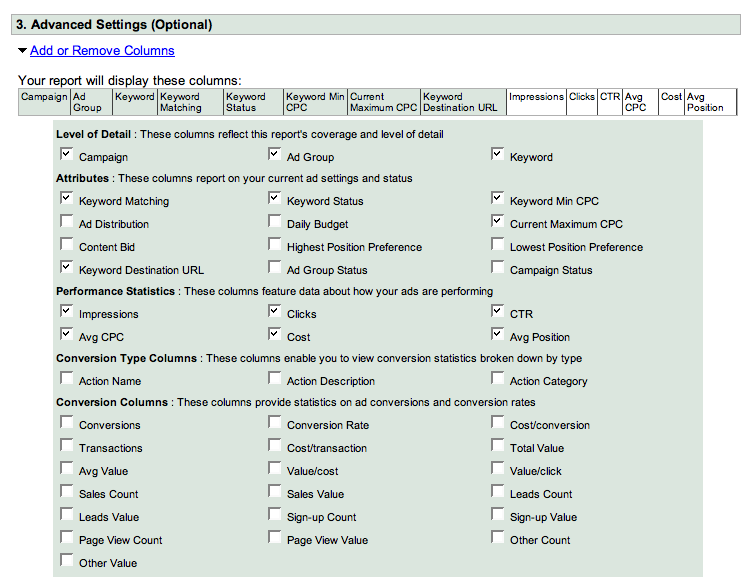
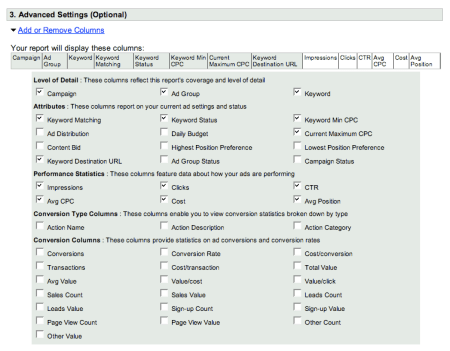
With the Adwords reports advanced settings option, advertisers can receive an even greater degree of account performance details.
Additional attributes available from the advanced settings reports include performance statistics, conversion types and detailed conversion data.
With the advent of their Adwords numeric quality score, Google has now denominated the level of advertising performance it requires from advertisers.
Additionally, Google has given their advertisers a new tool for further identifying, managing and improving ad and keyword performance.
In exchange for their new advertising quality measurement tool, Google will ultimately get improved advertising quality.
As far as I know, the numeric quality score is the first metric Google has made public to either its publisher or advertiser community that can be measured against and thus managed to.
The numeric quality score is yet another milestone on Google’s road to further transparency with its advertisers.
At some point, will Google provide Adwords Quality Score reporting options to its advertisers too?
By providing advertisers with Quality Score reporting, advertisers will then have an another set of important data for further managing and improving the performance of their ads and keywords.
By making Quality Scores available in Adwords reports, Google would initialize the Adwords Quality Score Management process.
To help celebrate its 10th birthday, Google has announced their latest iteration for crowdsourcing ideas with their Project 10^100.
Google’s Project 10^100 ( “ten to the hundredth”) aims to solicit and bankroll fresh ideas Google believes could have broad and beneficial impact on people’s lives.
Google Inc. plans to award a prize of up to $10 million to help make winning ideas a reality.
People are encouraged to submit their ideas, in any of 25 languages, on Project 10 to the 100th through October 20. Entrants must briefly describe their idea and answer six questions, including, “If your idea were to become a reality, who would benefit the most and how?”
CNN will be covering this Google project, including profiles of ideas and the people who submit them from around the world.
A Google spokeswoman was reluctant to set parameters for the submissions, although the project’s Web site suggests that successful ideas should address such issues as providing food and shelter, building communities, improving health, granting more access to education, sustaining the global ecosystem and promoting clean energy.
“We don’t want to limit it at all. We want a wide range of ideas,” said Bethany Poole, product marketing manager at Google, who announced the project live Wednesday morning on CNN along with Andy Berndt, managing director of Google’s Creative Lab. “We think great ideas come from anywhere.”
“These ideas can be big or small, technology-driven or brilliantly simple — but they need to have impact,” said Google in a press release. “We know there are countless brilliant ideas that need funding and support to come to fruition.”
Learn more about Project 10 to the 100th @ YouTube:
You must be logged in to post a comment.