Archive for the ‘Yahoo’ Category

Top 10 Internet Yellow Pages Searches

August 27, 2008

From the Yellow Pages Association:

According to research firm Knowledge Networks/SRI, the Top 10 category searches among 2007’s 3.8 billion total IYP (online) searches were:

1. Restaurants
2. Physicians & Surgeons
3. Hotels
4. Auto Repairing & Service
5. Florists-Retail
6. Auto Dealers-New & Used
7. Dentists
8. Auto Parts & Supplies – New & Used
9. Beauty Salons (tie)
10. Hospitals (tie)

According to Larry Small, research director at YPA: “It may come as a surprise to some but the top 10 IYP headings mirror the top 10 print Yellow Pages headings — typically because these headings drive so many on and offline queries. These differences can be attributed to differences in consumer’s local search needs for product vs. service-oriented information and long-term vs. short-term purchase plans.”

Their research profile of IYP users shows that:

— 63% are female
— 89% are aged 25-64
— 54% are college graduates
— 42% have lived at the same address for 10+ years

The top (Offline) 20 Yellow Pages Headings for 2007 in numeric order followed by their number of references were:
Rank / Heading / Classification (millions)

1. Restaurants-Fast Food-Other & Non Specific 1,288.4
2. Physician & Surgeons-Specialist & Non Specific 1,122.7
3. Automobile Parts-New & Used 485.2
Automobile Parts-New 312.2
Automobile Parts-Used 173.0
4. Automobile Repairing & Service 411.9
5. Pizza 317.7
6. Automobile Dealers-New & Used 266.0
Automobile Dealers-New 189.7
Automobile Dealers-Used 76.2
7. Attorneys/Lawyers 260.6
8. Dentists 246.7
9. Plumbing Contractors 228.6
10. Beauty Salons 203.7
11. Hospitals 199.8
12. Department Stores 195.5
13. Insurance 183.8
14. Veterinarians 171.4
15. Hardware-Retail 145.7
16. Tire Dealers 142.4
17. Pharmacies or Drug Stores 130.8
18. Theaters 126.2
19. Florists-Retail 120.5
20. Banks 115.5

New Email Addresses from Yahoo: Ymail and Rocketmail

August 18, 2008

Although Yahoo announced new email address availability under their Ymail and Rocketmail domains in June, Yahoo just now appears to be actively promoting them.

Upon logging into my Yahoo email account, I received this banner ad.

Ymail Rocketmail

Ymail Rocketmail

I can only guess Yahoo is creating these additional email addresses to retain their existing customers by offering them more email address alternatives than Yahoo’s original email addresses provided previously.

I set up a new Ymail account in just a few minutes and can switch between my new email account and my original Yahoo email account easily

Share of Searches by Search Engine

August 11, 2008

Via Hitwise: Google’s share of US searches exceeeds 70% for the first time.

“Google’s share of searches increased 10% over the same month last year and 2% over the previous month. Yahoo! Search, MSN Search (including Live.com), and Ask followed with 18.65%, 5.36%, and 3.53% share of searches, respectively.”

Combined with last month’s milestone which saw Google field 7 billion searches within a single month according to ComScore and in the absence of any new disruptive and innovative search appliance, Google looks to continue its arithmetic assault on Yahoo, MSN / Live and Ask’s share of US search traffic.

Search Engine Market Share

Search Engine Market Share

Microhoo Boo

May 1, 2008

According to today’s online edition of the Wall Street Journal, Microsoft’s Chief Executive Office Steve Ballmer and it board remain undecided about whether or not they will raise their bid to acquire Yahoo and its internet display advertising and search audience business.

As I previously wrote in a post on Greg Sterling’s blog, Microsoft’s proposed acquisition of Yahoo is really about Microsoft’s need to retain, preserve and grow their existing audience and keystrokes before Google has completed their quarterback sneak through Microsoft’s desktop.

Without Yahoo and its internet audience, Microsoft will face accelerating short and long term audience losses to Google.

The question Microsoft hasn’t yet been able to answer for itself remains: “How much cash do we have to spend today to save and protect the future of our desktop franchise and its cash flow?

Apparently the price is one Microsoft has yet to come to grips with or let go of.

MicroHoo Internet Yellow Pages Market Leader?

March 25, 2008

comScore has released its 2007 Internet Yellow Pages market share report showing YellowPages.com barely edging out SuperPages.com for the market leader position in the Internet Yellow Pages market.

The top eight Internet Yellow Pages (IYP) sites in the United States for 2007 and their market share were:

1. Yellowpages.com 20.2%

2. Superpages.com 20.0%

3. Yahoo Sites 17.9%

4. Google Sites 15.1%

5. Yellow Book Network 8.6%

6. Time Warner Network 6.1%

7. Microsoft Sites 4.8%

8. R. H. Donnelley 3.3%

Greg Sterling has also noted how YellowPages.com has entered into a new deal with Microsoft.

Something the comScore report didn’t point out is that by Microsoft acquiring Yahoo, Microhoo! will acquire a market leadership position in the Internet Yellow Pages market vaulting over both YellowPages.com and Superpages.com in one leap.

Provided the market share numbers don’t move much over the next several quarters, Microhoo will have a 22.7% share of the Internet Yellow Pages market.

By Microsoft switching to YellowPages.com, they are simply preparing to strengthen and flesh out their new market position in the Internet Yellow Pages market by further exploiting Yahoo’s existing relationship with AT&T and their ownership of Yellowpages.com

Google Ad Manager Service

March 13, 2008

While Microsoft is still trying to get its arms around Yahoo and its share of the online search and display advertising market, Google has taken one step to closer to consolidation of the online advertising market with the recent EU approval of their DoubleClick acquisition.

With its acquisition of DoubleClick and its roughly 60% share of the online display advertising market, Google has now created a dominant market share position in both the online display and search advertising markets.

Google’s challenge now remains vertical integration in both markets – greater penetration of search advertising sales within the online brand advertising market and deeper penetration within the small to medium size publishing segment within the online display advertising market.

To achieve its objectives in the online display advertising market, Google has announced its new service called the Google Ad Manager.

From the official Google Blog:

Google Ad Manager is a free, hosted ad and inventory management tool that can help publishers sell, schedule, deliver and measure their directly-sold and network-based ad inventory. It offers an intuitive and simple user experience with Google speed and a tagging process so publishers can spend more time working with their advertisers and less time on their ad management solution. And by providing detailed inventory forecasts and tracking at a very granular level, Ad Manager helps publishers maximize their inventory sell-through rates.”

The Google Ad Manager will both allow the small to medium size publisher to greater optimize its advertising inventory yield through access to advertising inventory tools previously only available through DoubleClick while also furthering Google’s pursuit to better serve its primary market – small to medium size businesses – now through the small to medium size publisher.

The Google Ad Manager Service:

Google Ad Manager

IBM + Yahoo! (IBMY!) An alternative to Microhoo?

February 25, 2008

Could Yahoo! find its White Knight in IBM?

IBM

Yahoo

Since it now seems highly unlikely a bolted together advertising partnership with Google, News Corp. or AOL will materialize and dissuade Microsoft from its proposed takeover of Yahoo!, shouldn’t Yahoo! be looking outside the search box for possible solutions?

An IBM+Yahoo! or IBMY! combination makes as much sense as a MicroHoo.

Short of something as crazy as Yahoo! partnering with IBM, Yahoo will soon be otherwise assimilated by Microsoft.

I am sure there are millions even billions of reasons why IBM shouldn’t even consider it, but there only has to be one “good enough” financial reason for Yahoo! to justify its seeking and getting either IBM’s defensive or offensive investment at this their defining and possibly Yahoo’s final moment in time.

I wonder which particular financial reason would be compelling enough for both IBM and Yahoo to seek each other’s company now – if there is any at all?

Microsoft & Yahoo Vs. Google: The Battle for Local Audience and Mobile Keystrokes

February 9, 2008

Let’s look at two areas where search will play a role in winning new audience and their keystrokes: Local and Mobile search.

Here are how Microsoft, Yahoo and Google web property’s search are performing today.

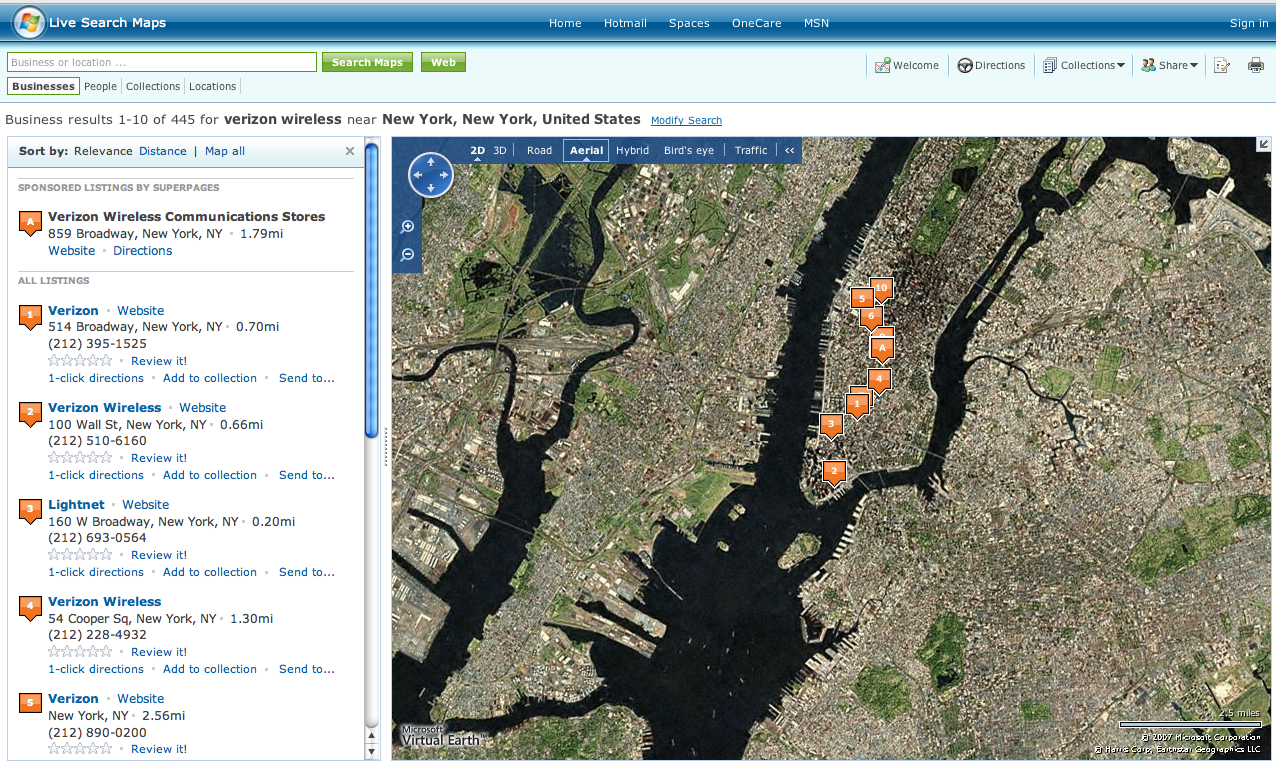
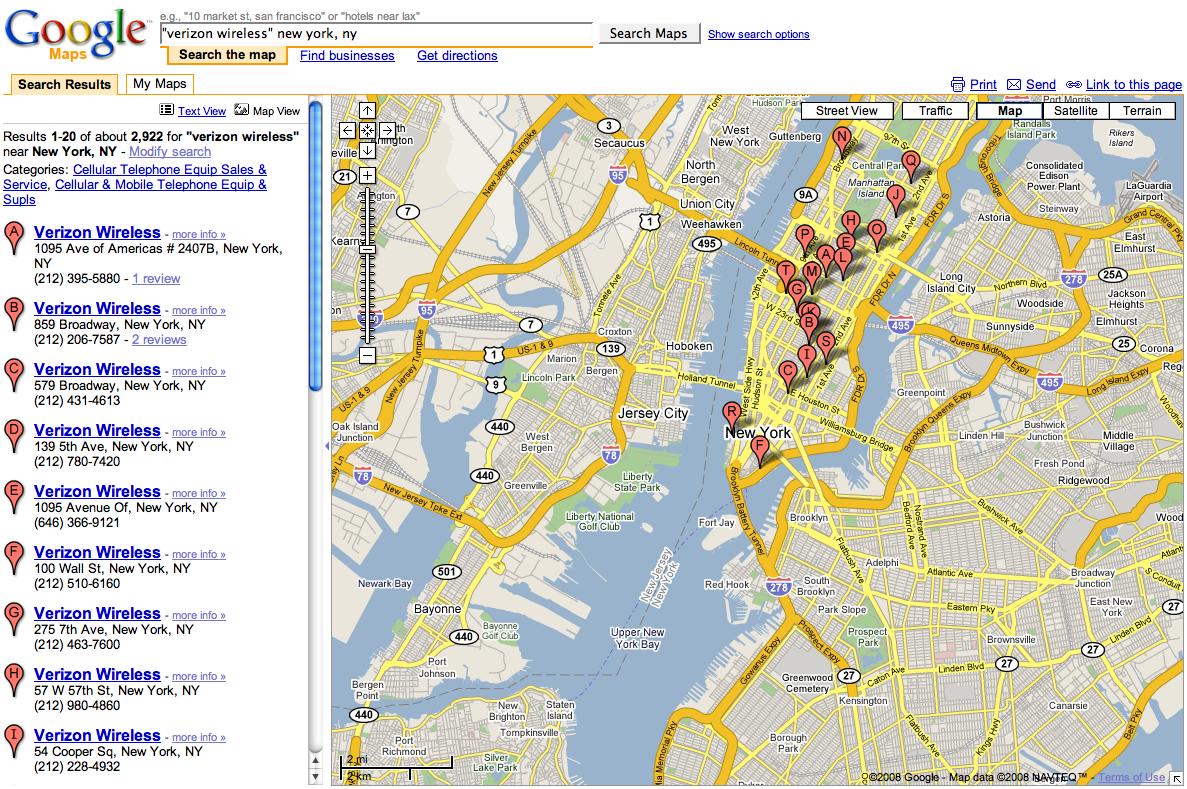
Its been reported nearly 50% of searches are local in nature. Let’s see how Microsoft’s Live handles a local brand search for Verizon Wireless in New York, NY.

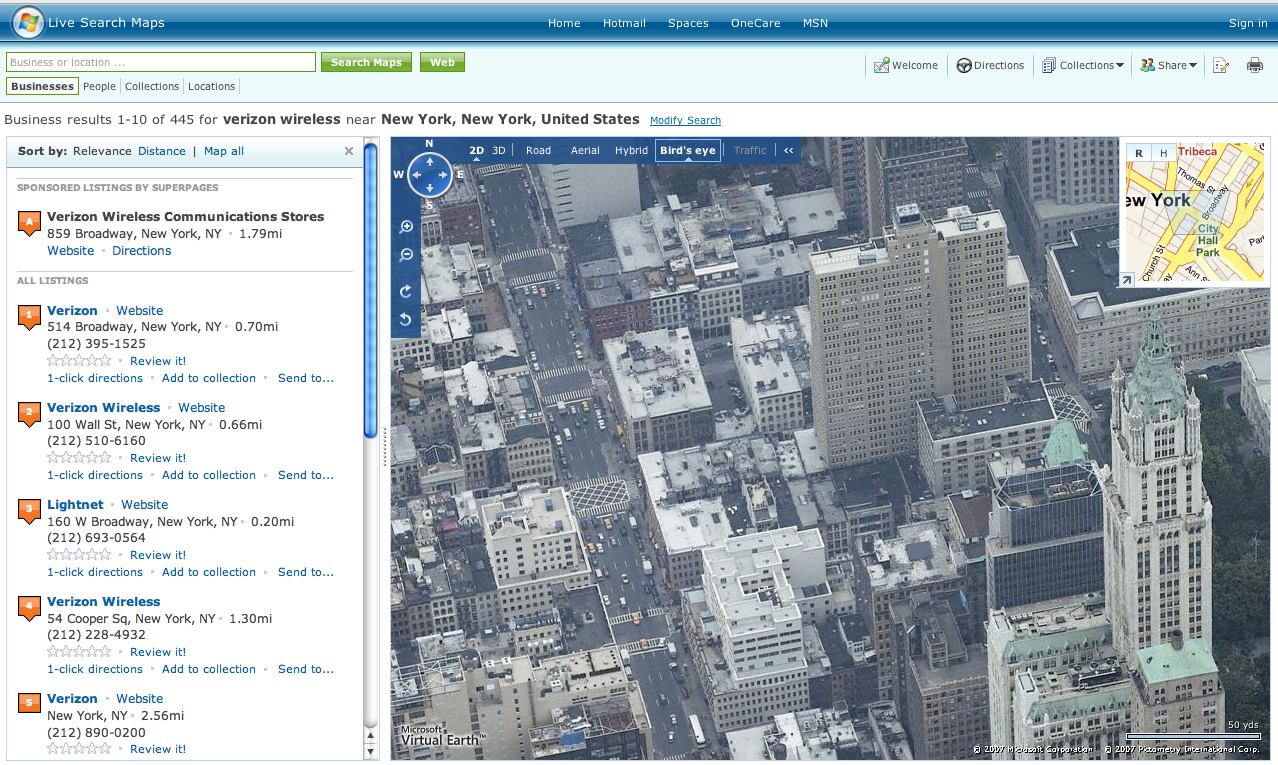
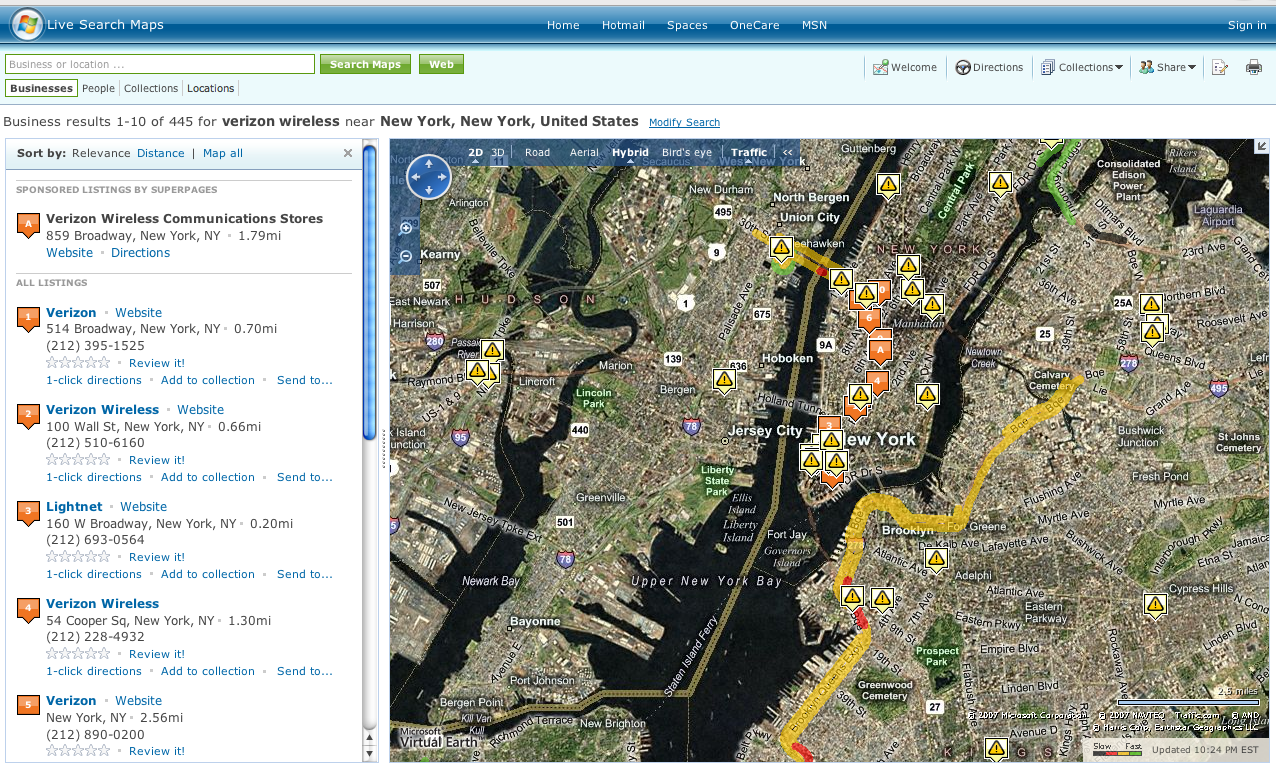
Live is able to locate Verizon Wireless stores in New York and provides five viewing options: Road, Aerial, Hybrid, Bird’s Eye and Traffic. Are their results relevant? Yes. Could we make our way to Verizon Wireless store or reach them by phone with the information Live provides? Yes.

With the Bird’s Eye view we may even be able to see what our destination looks like. Pretty cool.

Microsoft (US) Brand Search: Verizon Wireless New York, NY

Microsoft Live Verizon Wireless NY Road Map

Microsoft Verizon Wireless NY Road

Microsoft Live Verizon Wireless NY Aerial Map
Microsoft Verizon Wireless NY Aerial

Microsoft Live Verizon Wireless NY Hybrid Map

Microsoft Verizon Wireless NY Hybrid

Microsoft Live Verizon Wireless NY Bird’s Eye Map

Microsoft Verizon Wireless NY Bird’s Eye

Microsoft Live Verizon Wireless NY Traffic Map

Microsoft Verizon Wireless NY Traffic

How does Live perform outside the United States? A search for HSBC in London yields similar results. This particular brand search result is for a location near Trafalgar Square. If you aren’t going to be able to stop by a bank branch in London today, you can still take in the sights.

Microsoft (UK) Brand Search: HSBC London, England

Microsoft HSBC London UK Bird’s Eye Map

Microsoft HSBC London Bird’s Eye

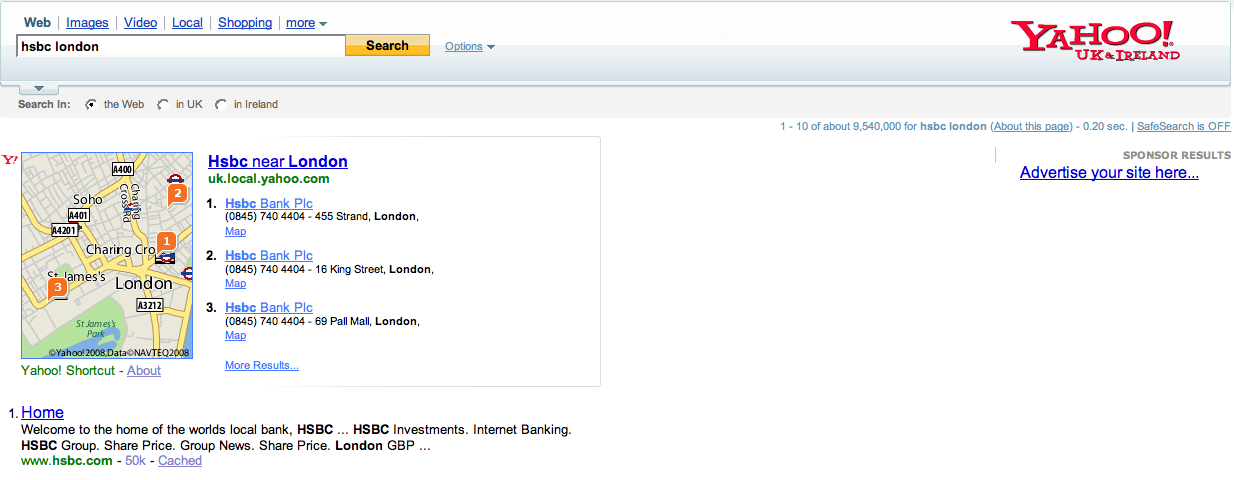
Now let’s try the same searches in Yahoo. Yahoo offers similar results. The look and feel isn’t too much different from those we received from Microsoft.

Initially though, I had difficulty locating the results I was hoping to find. Eventually I did find them – must have been my error.

Our options for connecting with one of the stores include: Getting directions, Save for later, Send to phone and Write a review.

Yahoo (US) Brand Search: Verizon Wireless, New York, NY

Yahoo Verizon Wireless NY “Find a Business”

Yahoo Verizon Wireless Find A Business

Yahoo Verizon Wireless New York

Yahoo Verizon Wireless New York

I can get the same type of UK map results from Yahoo however; I have to pull Yahoo’s UK web property up to get London results whereas with Microsoft I was able to get results from their US site.

Yahoo (UK) Brand Search: HSBC London, England

Yahoo HSBC UK Brand US Search

Yahoo HSBC UK US Search

Yahoo HSBC UK London UK Search

Yahoo (UK) Brand Search: HSBC London, England

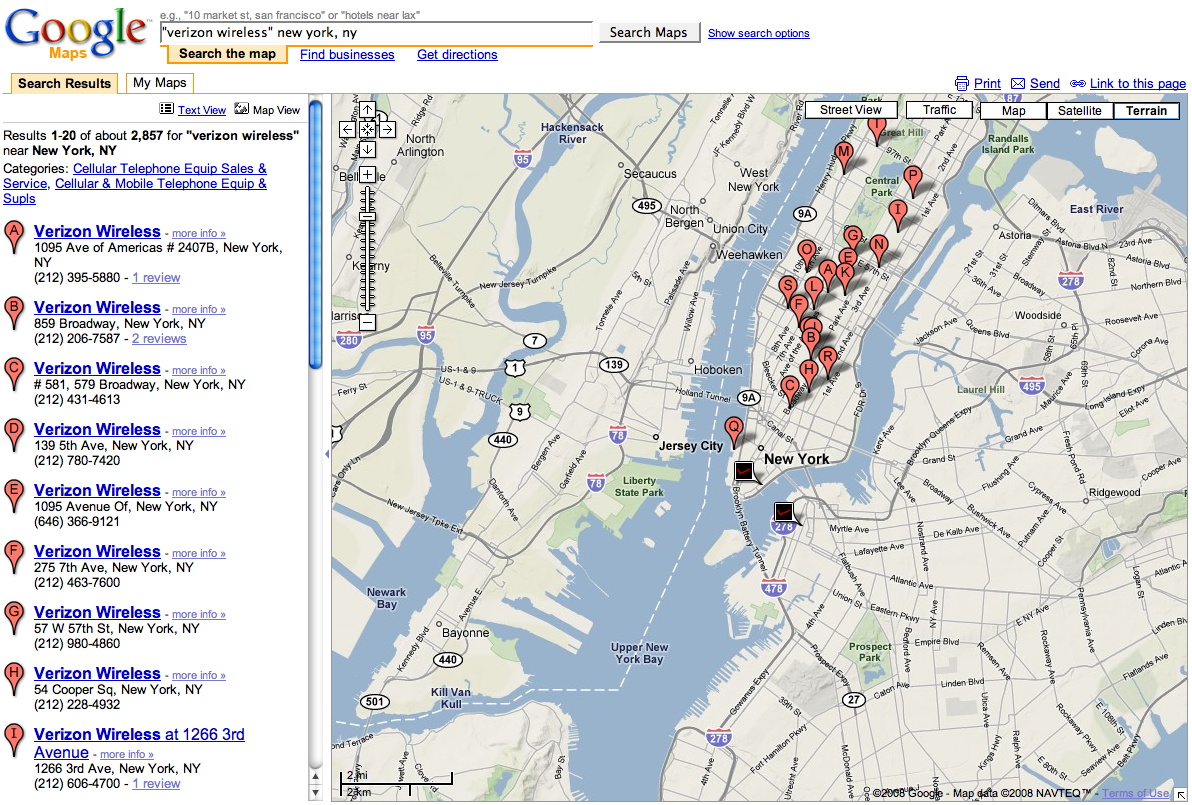
Now, let’s run searches for the same terms in Google. Like Microsoft, Google returns five types of views albeit under different button terms: Map, Street, Traffic, Satellite and Terrain Views.

The look and feel of Google’s views seem more visually pleasing than both the Microsoft and Yahoo products, however my appraisal is subjective.

Microsoft’s search and map features seem to be evenly matched with Googles’ and beyond those of Yahoo’s. Microsoft’s “Bird’s Eye” view does appear to ahead of its counterpart – Google’s satellite view.

Google (US) Brand Search: Verizon Wireless New York, NY

Google Verizon Wireless NY Map View

Google Verizon Wireless Map View

Google Verizon Wireless NY Street View

Verizon Street View

Google Verizon Wireless Traffic View

Google Verizon NY Traffic View

Google Verizon Wireless NY Satellite View

Google Verizon Wireless Satellite View

Google Verizon Wireless Terrain View

Google Verizon NY Terrain View

Google offers only three viewing options in the UK at this time compared to Microsoft’s five, yet I can fetch the results from Google’s US property unlike with Yahoo.

Google (UK) Brand Search: HSBC, London England

Google US HSBC Brand Search London UK Map View

Google (UK) Brand Search: HSBC, London England

Overall Microsoft, Google and Yahoo each offer their version of both business and brand rich search results.

From what I can tell, businesses and brands have yet to scratch the surface so to speak when it comes to reaching their potential customers in this new geographically rich and fertile target marketing environment.

Mobile Search and Reverse Business Telephone Number Lookup, a Visual 411

February 8, 2008

As local information requests are being keyed in from mobile devices, 411 and driving directions are becoming more visually rich and available via search.

Case in point: The business telephone number reverse lookup.

How does Microsoft’s Live render a reverse lookup for Microsoft’s own telephone number? Microsoft delivers the correct result along with the five previously mentioned view options: Road, Aerial, Hybrid, Bird’s Eye and Traffic. The map view does however default to Chicago, IL even though Microsoft is located in Bellevue, WA.

I can find the Microsoft campus on the map after scrolling over a couple thousand miles. I ran several more queries with each defaulting to the same Chicago starting point. I am not logged into a Microsoft account so I wouldn’t think it was based on my computers cookies or IP address which by the way is still several hundred miles south.

Evidently, Microsoft, Yahoo and Google all seem to generate their map results based on your past location specific searches.

Microsoft’s reverse lookup offers: 1 Click Directions, Add to collection, Send to Email, Mobile and GPS and Reviews. The send to GPS requires MSN Direct compatible navigation systems.

Reverse Business Lookup– 425-882-8080 Microsoft

Microsoft 425-882-8080

Microsoft 425-882-8080

A reverse lookup for Yahoo’s telephone number in Yahoo produces two results both of which are Yahoo locations. The map provides the same functionality found in their standard searches: Get Directions, Save for later, Send to phone and Write a review. If a web address is associated with the location it will be displayed too.

Reverse Business Lookup– 408-349-3300 Yahoo

Yahoo 408-349-3300

Yahoo 408-349-3300

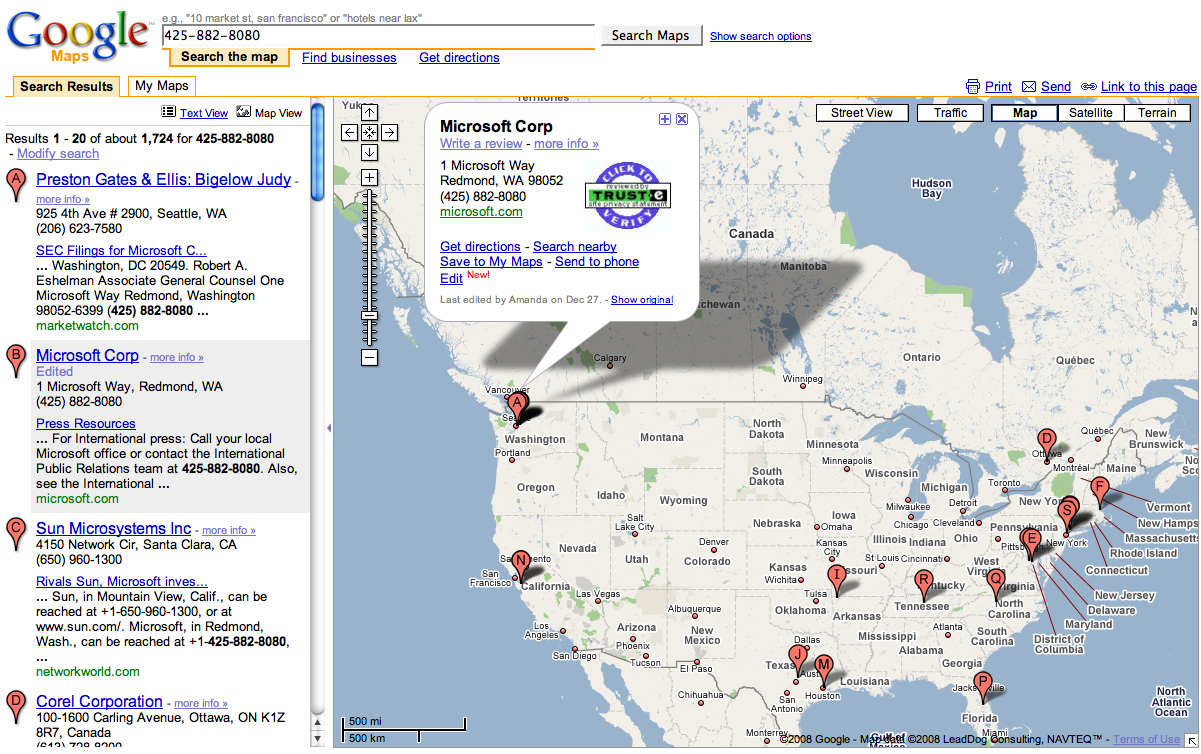
A search for Google’s telephone number yields the same five view options: Map, Street, Traffic, Satellite and Terrain Views as with the brand or business category search before. Additionally, Google provides a dialogue box with more options.

Searchers options are: Get directions, Search nearby, Street view, Save to My Maps, Send to phone and Edit. More information about the business and reviews are also one click away.

With “Search nearby” a searcher can locate additional businesses and services like finding Chinese takeout from their hotel.

Where Microsoft’s Bird’s Eye view appears to have bested Google’s satellite view, Google’s “street view” takes visualization to the next level.

With Google’s street view, Google provides eye level images of locations. It’s not available in every area yet. Coordination with volunteer picture geotagging projects may eventually speed the population of their street level image file.

Google’s new Edit feature lets anybody correct the location of a business. It also prompts business owners to “claim” their business in Google’s Local Business Center. These two options should eventually help them improve their data.

Reverse Business Lookup – 650-253-0000 Google

Google 650-253-0000

Google 650-253-0000

Google Street View

Google Street View

Edit Map Feature

Reverse Lookup Edit

By pushing more information out to users third screen (mobiles), Google, Microsoft and Yahoo regardless of their corporate status, have greater potential to attract ever-larger audiences and their keystrokes – a situation where all consumers ultimately win.

Microsoft and Yahoo vs. Google: The Battle for Audience and Keystrokes

February 7, 2008

The Redmond giant has sprung to its feet from its long and comfortable slumber.

Much like the browser business before it, Microsoft has realized it had better get into the search advertising business before its too late.

I think we all know who won the browser war. We also know how they did it.

Even with its proposed acquisition of Yahoo!, Microsoft may have already overslept and thus lost this battle.

On the surface this acquisition looks like a grab for a piece of the search advertising business.

However, just below the surface lie its real targets: the Internet audience and their keystrokes.

Internet Audience?

Keystrokes?

Both beachheads Microsoft has or has had control of nearly since their inception, keystrokes via the personal computer desktop and the Internet audience via browsers – not from birth but before the web’s infancy ended.

Like their importance to Microsoft’s franchise before, both have an equally and even greater importance going forward. Audience begets keystrokes and vice versa. However, It’s hard to control one if you don’t control the other.

Microsoft’s $44 billion offer to acquire Yahoo and its audience is an admission by Microsoft that if they aren’t able to augment their present audience now with an acquisition the size of Yahoo, they won’t ever be able to stem the audience gains being made by Google and their control of the largest and most valuable part of the internet audience – the search audience.

At this point, Microsoft’s not getting control of Yahoo’s audience is the single greatest risk facing their business – hence their offer price and the need to get the deal done. Maybe not today or tomorrow, but let unabated Microsoft faces continued losses in both audience and keystrokes.

Its not a market position Microsoft is familiar with or comfortable.

Why search is the most valuable audience on the Internet.

There are two types of audiences on the Internet. The old and familiar audience type, which is the one served and supported by display advertising.

Advertisers buy ads to reach an audience based on what content a publisher assembles to attract a particular audience. Ads are then priced and sold based on the desirability advertisers have in reaching that particular audience.

At any one time, a large percentage of the publisher’s audience is inactive – not interested in what the advertiser is selling.

Advertisers still have to pay to reach the publishers entire audience regardless of how many people may or may not be interested in the advertiser’s ads or products. Because display advertising is inefficient i.e., reaches more disinterested audience than audience of potential buyers – it sells for less and thus generates less income for publishers.

The other type of audience available to advertisers on the web is search advertising.

Unlike display advertising, search advertising reaches only an active audience – people who have explicitly requested advertisers information about their products or services – by their clicking on ads.

Search advertisers only incur costs to reach their audience when consumers click on their ads. Thus search advertising is significantly more efficient in delivering advertising messages to the exclusively active segment of the Internet audience – people who are actively searching for information.

By definition, search advertising only delivers advertisements to people actively seeking what the advertiser is advertising and selling. Because of this efficiency in targeting and delivery, search advertisers are able to reach more qualified prospects for less than through traditional media.

In turn, search advertising providers like Google are able to charge advertisers commensurate with the value the advertisers receive from reaching a efficiently targeted and active audience.

The result?

By my calculations, Google’s annualized gross revenue from advertising per visitor is roughly twice that of Yahoo’s and nearly four times Microsoft’s (gross advertising revenues divided by web property visits)

At a minimum, a search driven visit is worth at least twice – up to four times more than a non-search driven visit.

This is why Microsoft desperately needs Yahoo’s audience.

Although there are wide discrepancies over what percentage of search each company gets, Google receives between four to twenty times more search traffic than Microsoft and three to five times more search traffic than Yahoo, combined and assuming no market disruption – the two companies would still only generate one fourth to one half the search business of Google.

This acquisition also assumes Yahoo’s ad platform can continue to harvest one half the value Google does whether through Yahoo! or Microsoft’s search product without cultural distraction or interruption from the merger.

Even with their proposed clean room assembly, Microsoft’s acquisition of Yahoo! does not answer how they will make up difference (search volume + gross revenue per visitor).

By doubling their performance (revenue per visit) post merger to meet Google’s present level of performance, a MicroHoo search advertising business gross revenues per visitor would be half of Google’s.

In order for Microsoft to retain Yahoo’s audience, publishers and advertisers- the combined company will also need to produce:

Highly relevant search results for its audience, a functional ad platform for its advertisers, profitable ad distribution for its publishing partners and most importantly: a greater return on its advertisers’ investments.

Without which any new ad platform and search product may grab the attention of a larger audience and gain its keystrokes only to see it lost after they are unable to deliver what the internet audience has already come to expect, find and get from Google.

Of course, this also assumes Microsoft is somehow precluded from using its expanded platform and footprint to reroute ancillary chunks of audience to its new web properties acquired through the proposed acquisition along with their accompanying keystrokes.

In the absence thereof, there may be no stopping Google’s march.