Archive for the ‘Search Engine Marketing’ Category

The Listening Campaign

January 12, 2010

Several months ago I wrote a post called “The Listening Campaign: Getting Your Voice Heard Above The Crowd.”

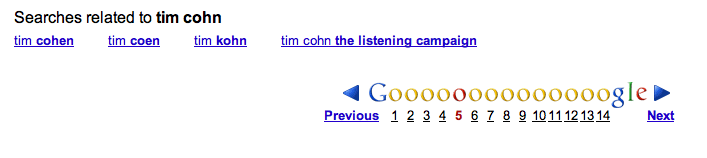
The post receives a fair amount of traffic yet I was surprised to see it appear on a Google related searches results list for my name.

Tim Cohn The Listening Campaign

Tim Cohn The Listening Campaign

I guess searchers listen too.

Google Social Circle Search Results Examples

October 30, 2009

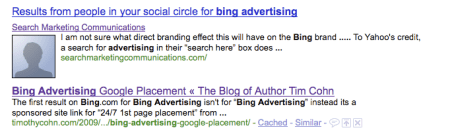
Today while logged into one of my Google accounts, I was searching for a keyword phrase and noticed my own blog (gleaned from another Google account) appearing in the search results.

Google Social Circle Search Results

Google Social Circle Search Results

I then ran several other searches for subjects I had written about recently.

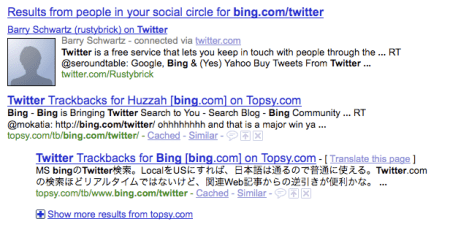
Although I couldn’t find any more of my own posts, I was able to find results for Barry Schwartz’s Twitter account from within a search page as well.

Google Social Search Results Twitter Bing

Google Social Search Results Twitter Bing

Each search result from within a Google Social Circle experiment begins with the link: “Results from people within your social circle for…” and is preceded by a nondescript silhouette.

Each of my Google account’s have avatars available, so I am not sure why silhouettes are generated in lieu of avatars.

It remains to be seen whether this Google trial will be adopted much further than beyond the borders of the search engine marketing community.

The Google social circle search product reminds to some degree of the previous Google product: “subscribed links”.

Although they take different approaches to providing Google search account holders trusted content, I believe both provide the same outcome – results links embedded within search pages from known and thus trusted sources.

Newspaper Enters Local Business Center Market

August 16, 2009

Today I saw an ad in my local newspaper for a new product they have launched called the Business Resource Center.

Business Resource Center

Business Resource Center

The new service appears similar to Google’s Local Business Center and looks like it provides all of the same features found in the Local Business Center.

The Business Resource Center touts the benefits of having a small business found under local searches and states:

Anything that you’d traditionally look for in the print yellow pages has become a “local search” on the Internet. For these queries, 75 percent of the top 100 keywords are non-branded, indicating that a majority of consumers have not decided on a specific brick and mortar store to do business with.

Local Search Business

Local Search Business

The site claims  “to stay on top of the internet so you don’t have to” and plans to provide the latest in local search, social networking, search engine marketing and social media optimization to its advertisers.

Local Business Resource Center

Local Business Resource Center

The newspaper’s local business resource center will provide advertisers with statistics like Google’s Local Business Center has begun providing in the US.

Local Business Resource Center Statistics

Local Business Resource Center Statistics

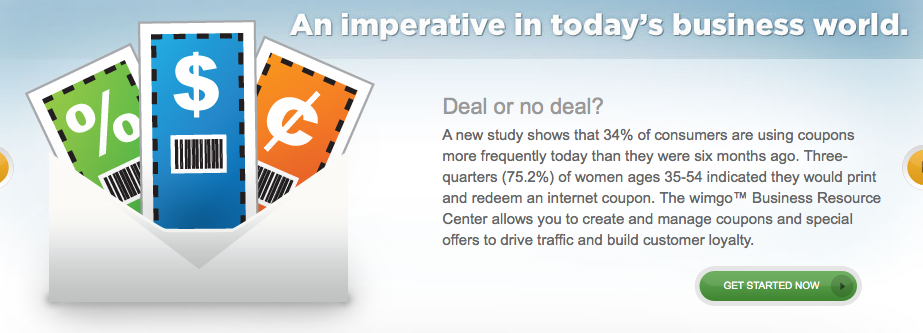
Like Google, the paper’s local Business Resource Center also lets advertisers “create and manage coupons and special offers to drive traffic and build customer loyalty”.

Local Business Center Coupons

Local Business Center Coupons

Similar to other directory and listing services, the newspaper’s business resource center alerts advertisers immediately when individuals rate or review their services, and allows them to reply directly to concerns or praise, giving businesses the ability to create stronger relationships with their customers.

Local Business Center Communications

Local Business Center Communications

The Beta version of their User Interface is clean and user friendly.

The site offers what appears to be primarily display advertising under keyword or category searches and claims to provide the largest local search audience reach.

Overall the newspaper’s launch of a Local Business Center is quite an accomplishment for any newspaper in this day and age.

Google Alerts Now Tracking Twitter Posts?

May 22, 2009

Google Web Alerts appears to now be reporting Twitter posts via its Google Alerts product.

Twitter Google Web Alert

Twitter Google Web Alert

I received the Google Alert above today for data gathered yesterday May 21, 2009.

This is the first Google Alert I have seen which included Twitter posts within Google Web Alerts.

What implications will this have on Search Engine Results Pages for search engine marketers and search engine optimizers – if any?

Twitter Job Search Engine

March 21, 2009

TwitterJobSearch.com is a UK based Twitter based job search engine.

TwitterJobSearch.com

TwitterJobSearch.com

From TwitterJobSearch.com about their search technology:

Until now, search engines for social media sites merely looked for words. We’re looking at context.

We use semantic tools to look at what was said.

We then look at what they’ve said before.

We then look at who was saying it.

If we do this right, we can figure out why they’re saying anything at all.

Although the service is based in the UK and still in Beta, a search for “Search Engine Marketing” yielded 5,831 results.

Search Engine Marketing

Search Engine Marketing

The same search also produced a Marketing Manager ad from Amazon.com for its Kindle product.

Amazon Kindle Marketing Manager

Amazon Kindle Marketing Manager

Further proof even innovative new products just don’t sell themselves.

Small Business Search Engine Marketing Too Costly, Time Consuming and Complex?

December 21, 2008

Microsoft adCenter conducted a survey of 400 small businesses with 250 employees or less to gauge small business sentiment toward search marketing and advertising.

Among the participants’ chief concerns, most cited the common misconceptions of cost, time and complexity as major hurdles to conducting search marketing campaigns for their businesses.

Key small business concerns regarding search engine marketing from the Microsoft adCenter study:

  • Nearly nine in 10 (89 percent) feared keywords may become too expensive.
  • 81% questioned if paid search marketing is the best use of their marketing budgets.
  • 25% of respondents believe paid search marketing is too complex.
  • 21% thought it would be too time-consuming.
  • 35% felt they would need an agency to help set up a search marketing campaign.

The most surprising finding from Microsoft’s adCenter Study? 7 in 10 small-business owners who participated revealed that they would rather try to do their own taxes than start a paid search marketing campaign!

The Microsoft study also revealed that 59 percent of small businesses with Web sites don’t currently use paid search marketing, and of those, 90 percent have never even attempted it.

Will search engine advertising providers like Microsoft ever overcome the general small business perception that search engine advertising is too costly, time consuming and complex?

Not until the small business advertiser has been convinced and shown otherwise that search engine marketing is inexpensive, quick and easy.

Google Maps Street View of the White House

November 6, 2008

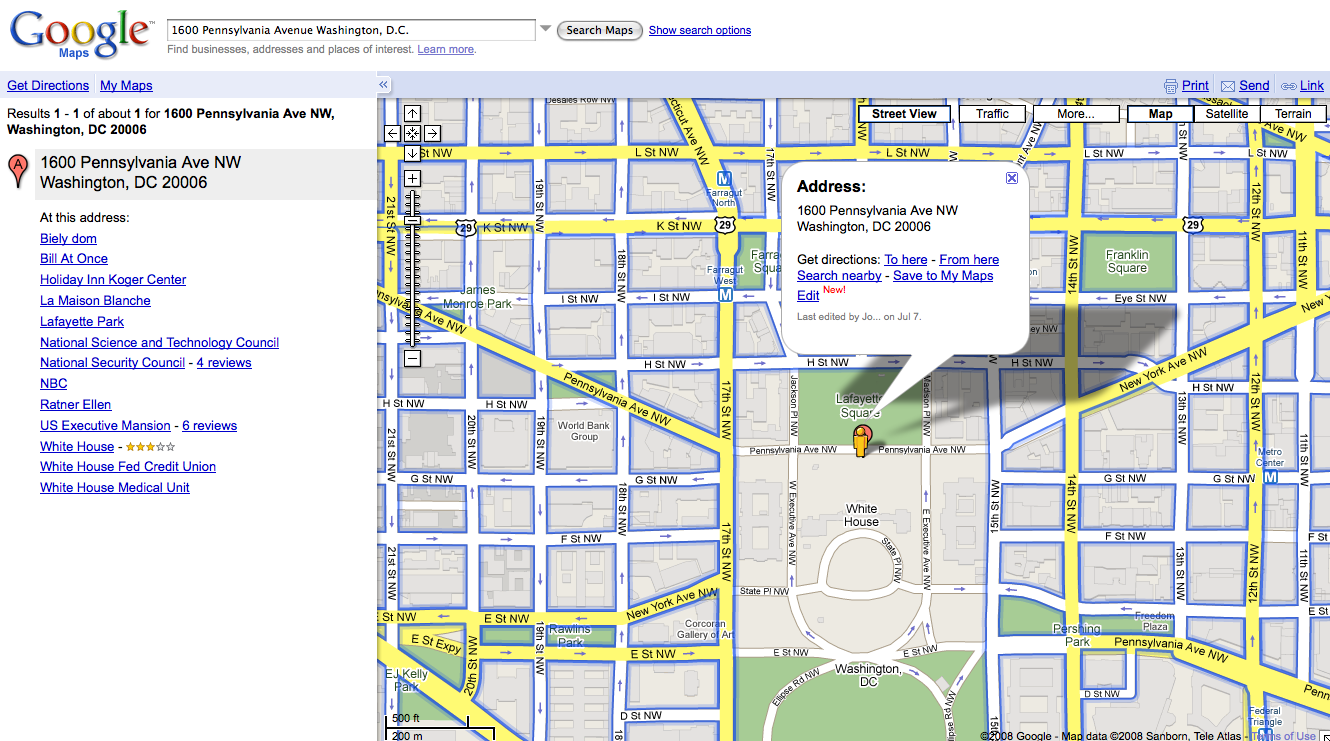
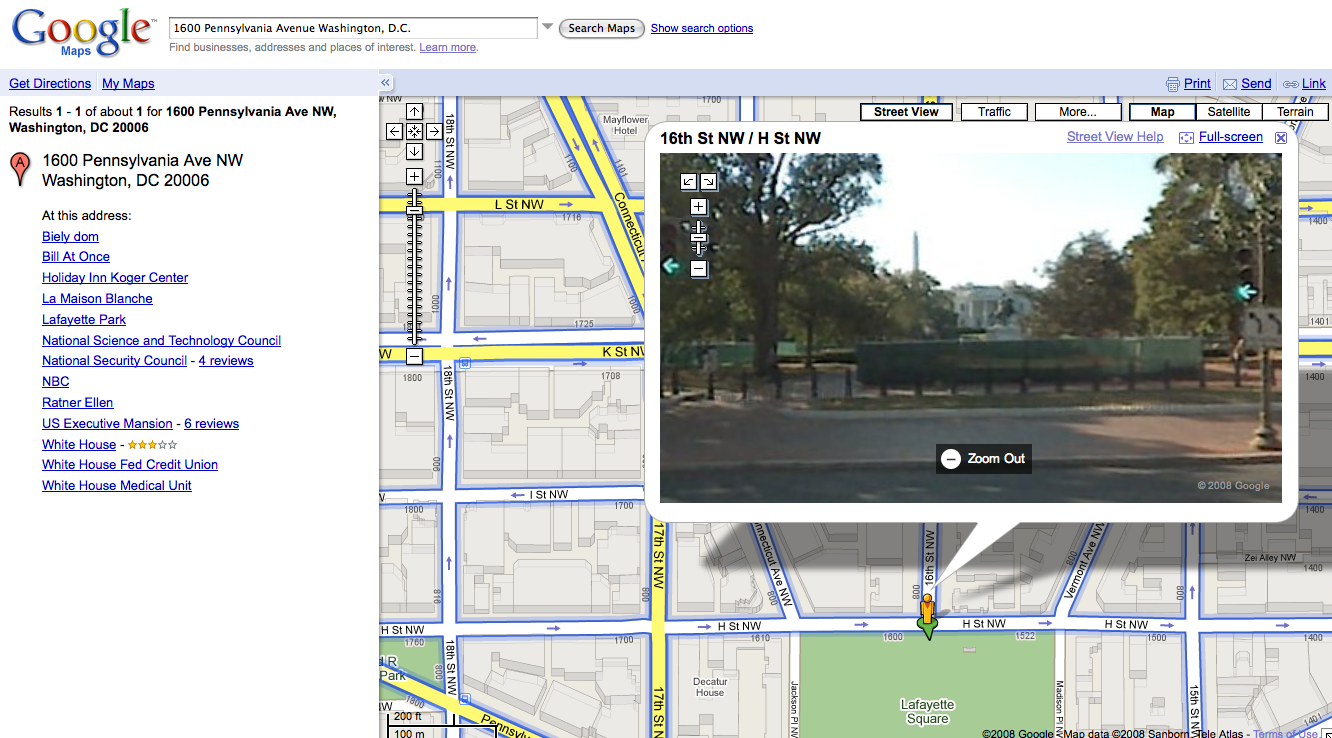
Washington D.C. now has Street View images available via Google Maps.

National landmarks including the Washington Monument, the Lincoln National Memorial, the Jefferson Memorial and even the White House are now visible from Google Maps Street View – albeit from afar.

To see your favorite national landmark, search for the landmark or its address in Google Maps and click street view.

1600 Pennsylvania Avenue Washington DC

1600 Pennsylvania Avenue Washington DC

Panning the camera angle will get the image and perspective you are looking for.

The White House

The White House

National security interests prevent vehicles equipped with cameras from getting to close to the White House, so this Google Street View from several blocks away will have to do.

However, pedestrians can still have their photo taken in front of the White House.

I was able to get this up close picture of the White House when I was in Washington D.C. earlier this year to give a search engine marketing presentation.

The White House Washington D.C.

The White House Washington D.C.

Search Engine Marketing Communications Survey

February 29, 2008

The following are some initial questions I ask potential clients when evaluating the search engine marketing potential of their business.

This multiple-choice Search Engine Marketing Communications Survey takes about two minutes to complete.

Download your copy of the Search Engine Marketing Communications Survey PDF.

What is your primary business?

A. Store-based merchant
B. Catalog
C. Virtual merchant
D. Consumer brand manufacturer

Which type of search engine marketing do you use the most?

A. More pay-per-click than organic
B. More organic than paid
C. Both equally

How does search engine marketing perform compared with your other marketing programs?

A. Better
B. Much better
C. Same
D. Worse
E. Much worse

How large is your keyword inventory?

A. Less than 50 words
B. 51 words to 100 words
C. 101 words to 200 words
D. 251 words to 500 words
E. 501 words to 750 words
F. 751 words to 1,000 words
G. 1,001 words to 5,000 words
H. 5,001 words to 10,000 words
I. More than 10,000 words

What percent of your online sales are attributable to search engine marketing?

A. 5% or less
B. 5.1% to 10%
C. 10.1% to 15%
D. 15.1% to 20%
E. 20.1% to 25%
F. 25.1% to 30%
G. 30.1% to 40%
H. 40.1% to 50%
I. More than 50%

What percent of shoppers who come to your site through your paid search program make a purchase?

A. 0.5% to 1%
B. 1.1% to 2%
C. 2.1% to 3%
D. 3.1% to 4%
E. 4.1% to 5%
F. 5.1% to 6%
G. 6.1% to 7%
H. 7.1% to 8%
I. 8.1% to 9%
J. 9.1% to 10%
K. 10.1% TO 15%
L. More than 15%

In the past year your pay-per-click conversion rate:

A. Went up
B. Went down
C. Stayed the same

By what percent did your pay-per-click conversion rate increase?
A. 2% or less
B. 2.1% to 5%
C. 5.1% to 6%
D. 6.1% to 7%
E. 7.1% to 8%
F. 8.1% to 9%
G. 9.1% to 10%
H. 10.1% to 12%
I. 12.1% to 15%
J. More than 15%

How much do you spend in a typical month on all types of search engine marketing (pay-per-click and search engine optimization)?

A. Less than $1,000
B. $1,001 to $2,000
C. $2,001 to $4,000
D. $4,001 to $6,000
E. $6,001 to $10,000
F. $10,001 to $20,000
G. $20,001 to $30,000
H. $30,001 to $40,000
I. $40,001 to $50,000
J. $50,001 to $60,000
K. $60,001 to $75,000
L. $75,001 to $100,000
M. More than $100,000

What percent of your online marketing budget is spent on search engine marketing?

A. 5% or less
B. 5.1% to 10%
C. 10.1% to 15%
D. 15.1% to 20%
E. 20.1% to 30%
F. 30.1% to 40%
G. 40.1% to 50%
H. 50.1% to 60%
I. 60.1% to 75%
J. More than 75%

What is the average amount you pay per click?
A. 5 cents or less
B. 6 to 10 cents
C. 11 to 15 cents
D. 16 to 20 cents
E. 21 to 25 cents
F. 26 to 40 cents
G. 41 to 50 cents
H. 51 to 75 cents
I. 76 to $1
J. More than $1

Will you increase your amount of pay-per click advertising this year?

A. Yes
B. No.

Do you manage your search engine marketing program in-house?

A. Yes
B. No

Do you plan to outsource your search engine marketing program?

A. Yes, within six months
B. Yes, within one year
C. Yes, within two years
D. No plans

Which search engine produces the best web sales results?

A. Google
B. Yahoo
C. AOL
D. MSN
E. LookSmart
F. Other

Which of the following programs or strategies are you using to improve your paid search program? (Check all that apply)

A. Adding more multiple word phrases to keyword inventory
B. Writing more descriptive ad copy
C. Testing keywords and phrases to land on appropriate home or product pages
D. Monitoring competitors’ use of keywords and phrases
E. Syncing keywords and phrases with product availability
F. Testing keyword inventory effectiveness using cluster analysis, data modeling and other tools
G. Other

Which of the following programs or strategies are you using to improve your organic search engine optimization? (Check all that apply)

A. Rewriting keyword descriptions on the home and product pages
B. Including the actual phrases commonly used by searchers on product pages
C. Including common product keywords in the image file names and in image display captions
D. Designing customized landing pages and creating exclusive merchandising sections
E. Enhancing site navigation
F. Increasing the use of header tags in content on the home page and product pages
G. Better use of web analytics
H. Other

What benchmarks do you use to measure the effectiveness of your search engine marketing program? (Check up to 3)

A. Site traffic
B. Sales
C. Conversions
D. Average order size
E. New customers
F. Click-throughs
G. Cost-per-clicks
H. Rank on main search engine page
I. Other

Did you allow your affiliates or other third-party resellers to bid on your brand name?

A. Yes
B. No

Do you bid on the brand names of your competitors?

A. Yes
B. No

What is the annual sales range of your online retail business?

A. Less than $1 million
B. $1 million to $4.9 million
C. $5 million to $9.9 million
D. $10 million to $24.9 million
E. $25 million to $50 million
F. More than $50 million

Thanks for taking the Search Engine Marketing Communications Survey.