Archive for August, 2009

Corporate Speak or Customer Speak?

August 11, 2009

Over the last several days, I have encountered several examples of corporate speak – language used by a service provider that in my opinion was different from the language their customers would have used had the customers been given the opportunity.

I checked into a hotel in Kansas City two nights ago and after checking in called the front desk to inquire about getting a larger room.

The front desk then told me if I wanted a larger room that I would have to pay an “upsell charge” of $50.00.

What?

I want to buy more of your products – ABC Hotel chain – but first I must buy a $50 “upsell charge” to get the larger room?

What corporate marketer instituted this particular customer service strategy and term across their hotel properties world wide?

What made them think the term uspell could be used to induce their captive audience to buy into their “uspelling” process?

Salesmanship in general raises prospects defenses – telling them your a selling let alone upselling them – only raises their defenses more so – and causes prospects to reject offers.

I didn’t buy the larger room because the ABC Hotel chain and I didn’t speak the same language – or share one  (Lingua Franca).

Are you speaking your language or are you speaking your customers language?

What is your market’s Lingua Franca?
Innovation: A New Dimension of Performance

August 10, 2009

While traveling across the country, I have begun considering what constitutes innovation.

Years ago, I read a quote from Peter Drucker regarding innovation where he defined innovation as “a new dimension of performance.”

While thinking about new products that successfully entered or disrupted markets, they all seem to have shared Drucker’s definition of innovation – a new dimension of performance.

What new product or service can hope to succeed ie., penetrate and serve a market let alone profit from it – without first having met his “new dimension of performance” definition?

Where Google Is Headed

August 9, 2009

Google CEO Eric Schmidt was recently interviewed by BusinessWeek about the future of Google.

The following is an excerpt from the BusinessWeek interview:

Maria Bartiromo

Where is the growth coming from in the next 5 or 10 years for Google? Is it more search opportunities? Is it mobility?

Eric E. Schmidt

Probably a combination. It’s obvious that the highest growth is in our core business as we get better and better at targeted ads, and those ads become more valuable. Our whole theory about advertising is that an advertisement that’s not targeted—just a random ad that you just walk by—is a waste of somebody’s money because you’re not going to buy. It wasn’t relevant to you.

Aren’t there three times as many phones out there as there are PCs now?
More than that. The rough number of PCs is around 800 million; the rough number of mobile phones is on the order of 3 billion. Even more important, the growth rate of mobile phones is quite a bit higher than that of personal computers. There’s an estimate of about 600 million mobile phones that are data- and Internet-capable. And that is the group that we really care about because those are the ones that are able to run powerful browsers. This was all kicked off by the iPhone. The iPhone sort of showed what you can do with a very powerful browser. Now there are many new kinds of devices with powerful browsers where you can have very high-quality ads, new applications, and, of course, the phone.

So how do you get to the next step in the mobile business? Do you need to partner with other companies to make sure that the speed is there, that the connectivity is there?
We’re doing that with our telecommunications partners. We actually share in the revenue for the ads that show up on the phones. So the advertiser pays us, and then we share it, literally, with the handset and mobile operator. And often we divide between both. And that seems to be the only way to really get money into that system. It’s very, very important that the telecom operators have enough capital to continue the build-outs of the so-called 3G and 4G networks.

What are the biggest challenges the mobile Web presents?
Let’s start with the fact that the phones are not fast, the networks are not as capable, the ad formats are not standardized. But on the other hand it’s very, very important to solve those problems because a phone is very personal. And so if we know a fair amount about a person, with their permission we can target a useful ad—you know, “It’s Eric. You had a hamburger yesterday, do you want pizza today? There’s a pizza store on the right.” That kind of ad is likely worth a lot of money to an advertiser because it will generate a sale.

In other words, you send a message to the person’s cell phone, saying: “Look, we know you had a burger yesterday. If you want pizza today, just go around the block”?
Right. It may sound creepy, but it might also be quite valuable. People could use advice as to what to eat and where the food is—and of course you can turn it off. So the important thing here is advertising that has value to the person is advertising that is a valuable business. That’s the business we’re in.

New Adwords Interface Webinars

August 8, 2009

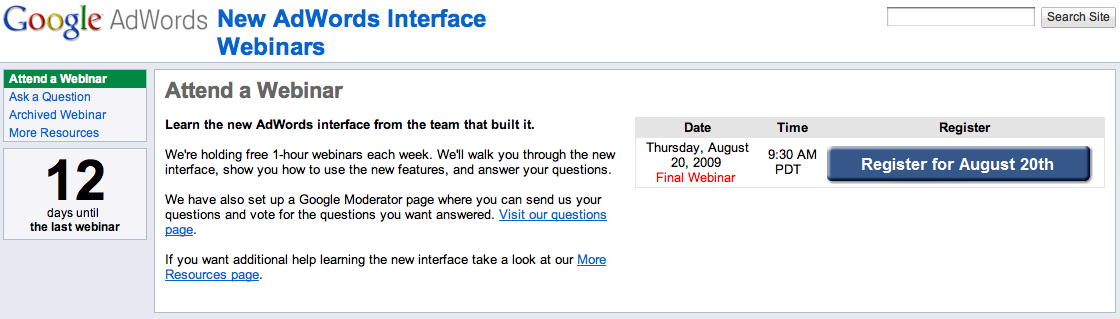
Learn the new AdWords interface from from the Google team that built it.

Final Adwords Interface Webinar

Final Adwords Interface Webinar

Ariel Bardin, Product Management Director for the new AdWords interface will host a final instructional webinar on August 20, 2009 At 9:30 PDT.

Webinar attendees will learn how to manage their accounts using the new interface and how to make use of the new features.

Bardin will close the webinar with a Q&A session where Adwords users can get their questions answered by the new AdWords interface team.

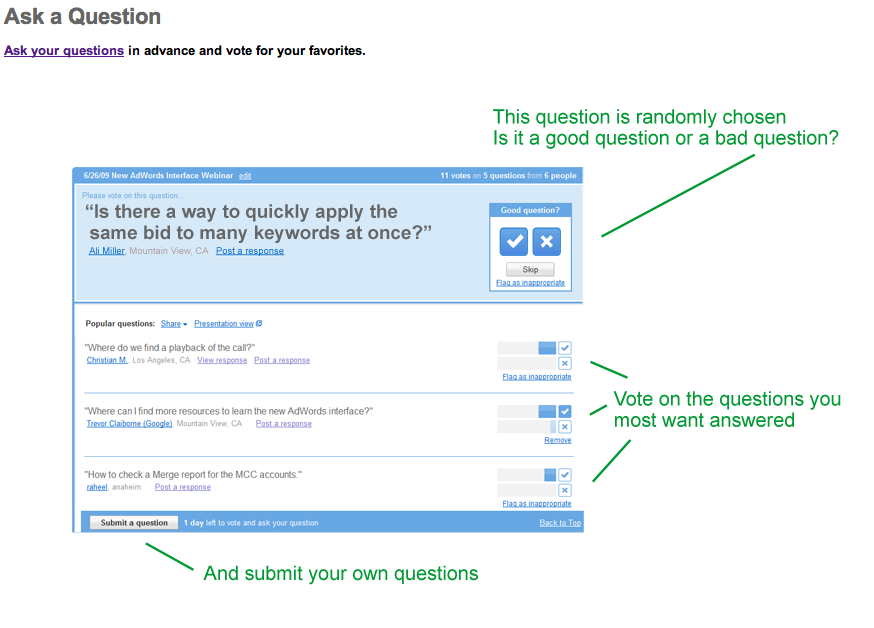
Participants can submit in advance the questions they would like most to have answered.

Ask a Google Adwords Question

Ask a Google Adwords Question

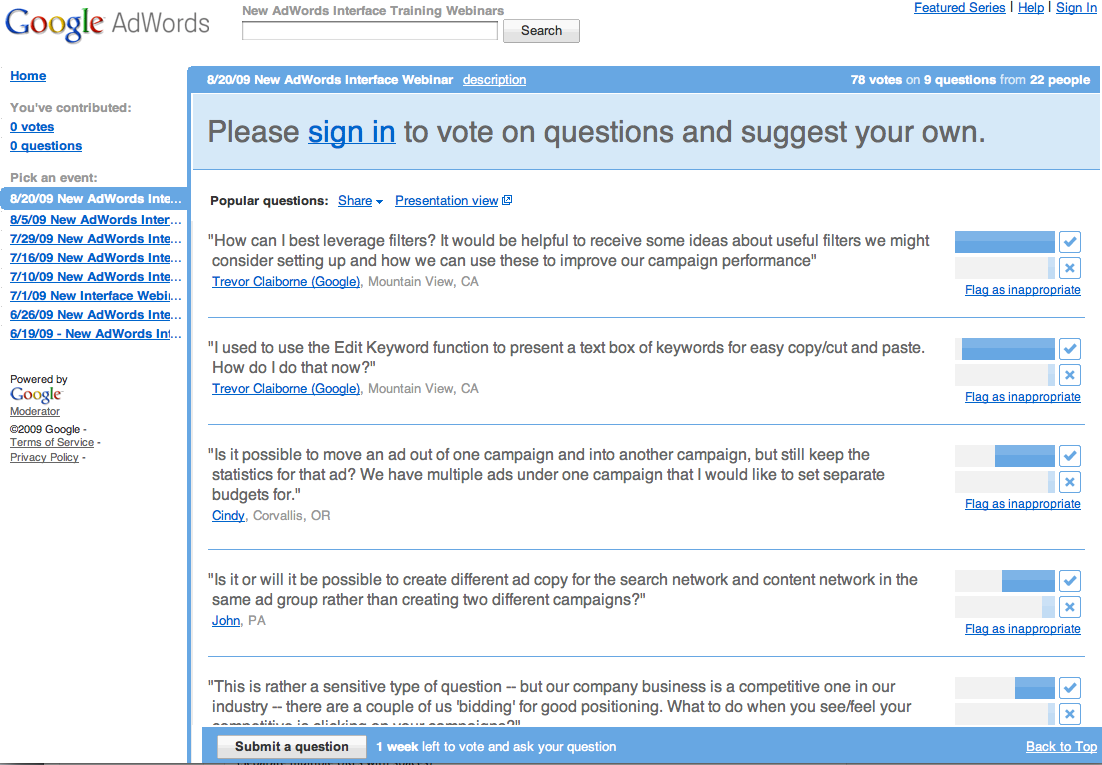
Webinar attendees can also vote for the questions already submitted they want to have answered.

Submit Adwords Questions

Submit Adwords Questions

With twelve days until the final New Adwords interface webinar, 226 people have submitted 94 questions and cast 830 votes.

Sign up here for the final Adwords interface webinar.

Google Site Links Adds Images

August 7, 2009

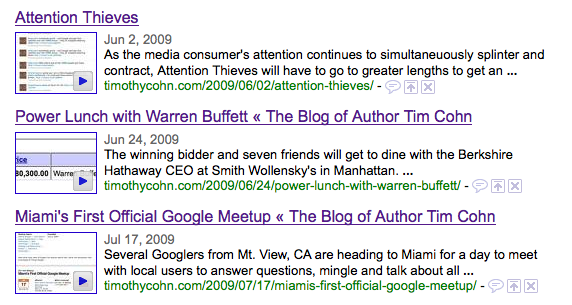
Today while searching Google for pages indexed at one of my sites, I found images were included in Google’s results.

Google Site Search

Google Site Search

There were also play buttons with each image although they were no videos archived – just static screen shots.

Do you have any idea how long images have been included in the site search results at Google?

Twitter Down: Distributed Denial of Service Attack (DDOS)

August 6, 2009

Twitter.com is offline and has been for several hours now.

The Twitter blog says the service has been under a Distributed Denial of Service (DDOS) attack.

Twitter DDOS Attack Outage

Twitter DDOS Attack Outage

40+ million people like myself from around the world have come to rely on Twitter.

Recently, I became concerned with Twitter’s ability to preserve let alone archive my Tweets so I set up my on rudimentary ReTweetings backup on my personal blog.

Why?

Because, if Twitter can’t keep their service up – how can I trust they will keep my Tweets preserved?

If Twitter hopes to become the “pulse of the planet” they will first need to figure out how to check and keep their own pulse beating.

OpenStreetMap.org Wiki

August 5, 2009

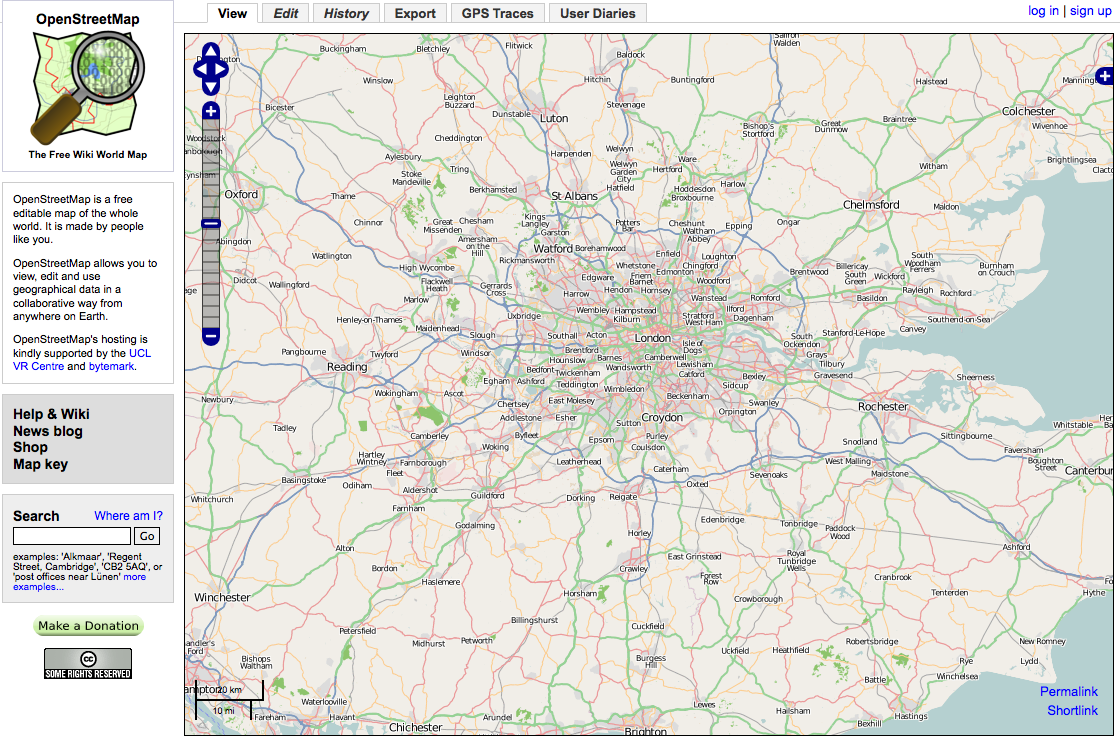
OpenStreetMap.org is an open map wiki.

From OpenStreetMap.org:

OpenStreetMap is a free editable map of the whole world. It is made by people like you.

OpenStreetMap allows you to view, edit and use geographical data in a collaborative way from anywhere on Earth.

OpenStreetMap Wiki

OpenStreetMap Wiki

Through Open Street Map Wiki, I learned my favorite London hotel – the Conrad International –  is now the London Grand Wyndham Hotel.

Open Street Map Wiki Wyndham Grand Hotel London

Open Street Map Wiki Wyndham Grand Hotel London

Google Maps show results for both hotels – the defunct Conrad International Chelsea Harbour – and its re-branded replacement the London Grand Wyndham Chelsea Harbour Hotel.

What are the implications if any of an Open Map wiki for business listings?

What are the implications if any for Google Maps or MapQuest?

What other types of facts could be open sourced through this type of wiki and would have value to the global internet audience?

Vivu.TV @ AlwaysOn Summit

August 4, 2009

As mentioned here and on my personal blog, I attended the AlwaysOn Summit @ Stanford last week and was impressed by the degrees of innovation discussed not only from within the panels and the Summit’s speakers but also that which was applied by the AlwaysOn conference itself.

As a virtual conference attendee, my experience was made entirely possible by technology that was  incorporated into the show’s production.

Vivu.TV was the webcast / video provider for AlwaysOn and their technology made my virtual attendance possible.

Vivu.TV

Vivu.TV

More about Vivu.TV from their website:

Founded by startup veterans from Cisco, Alcatel-Lucent and a team of IIT graduates, ViVu develops first-of-its-kind Participative Event Platform that enables live video participation from a PC, Mac or Linux without any proprietary downloads and seamlessly integrates with most of the popular streaming video and conference solutions.

The team developed the first enterprise quality video over IP a decade ago and is now building a participative platform that scales and provides the ease-of-use, quality and availability expected in an enterprise. ViVu solution is targeted at enterprises and is being used in a variety of ways: remote training courses, sales training on new products, and remote live video caller participation during Webcasts.

Like their site says – I am a Mac user and I was easily able to log into and participate in the AlwaysOn conference without having to download anything.

Peter Drucker defined Innovation as “a new dimension of performance”.

If Mr. Drucker were alive today, I am pretty sure the Vivu.TV “participative event platform” would qualify under his definition of innovation.

Twitter Analyzer: Twitter Audience Segmentation

August 3, 2009

According to its site, TwitterAnalyzer.com is the most advanced Twitter account analytics system in the world.

I am not sure how their claim can be confirmed, however their site does parse Twitter account data into segments I hadn’t yet seen.

Twitter Analyzer users can view an account by Tweets, Chats, Popularity, Reach, Subjects, HashTags, Links and Apps.

Twitter Analyzer Tweets

Twitter Analyzer Tweets

Tweets graph a Twitter account’s Tweet activity over a thirty day period.

Twitter Analyzer Reach

Twitter Analyzer Reach

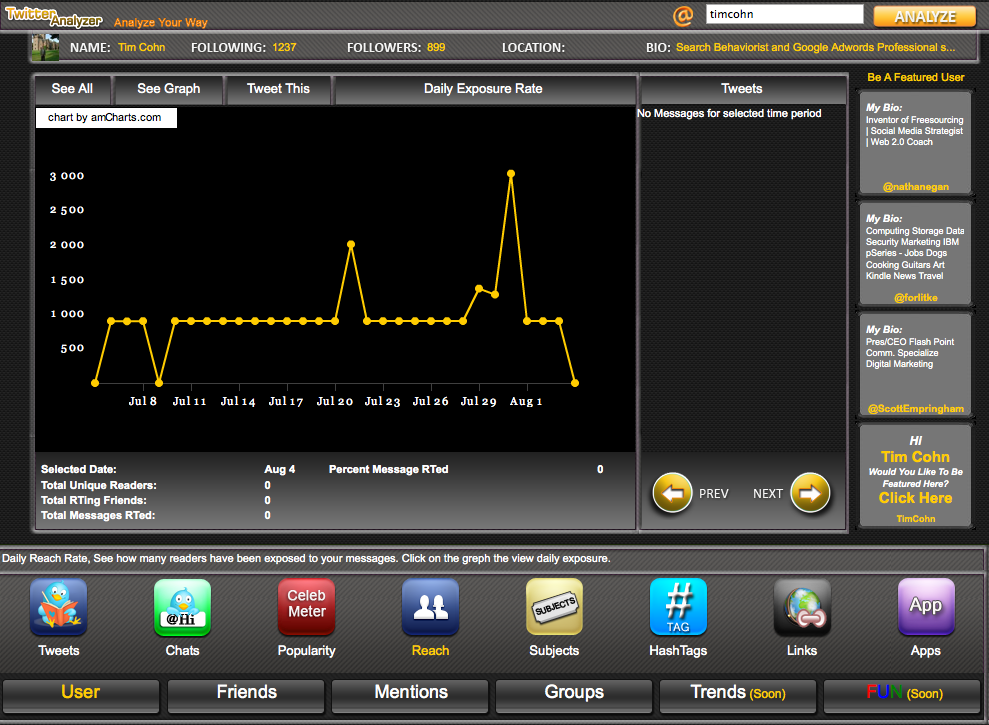
Twitter Analyzer reach charts the reach of a Twitter account daily over a thirty day period.

Twitter Analyzer Subjects

Twitter Analyzer Subjects

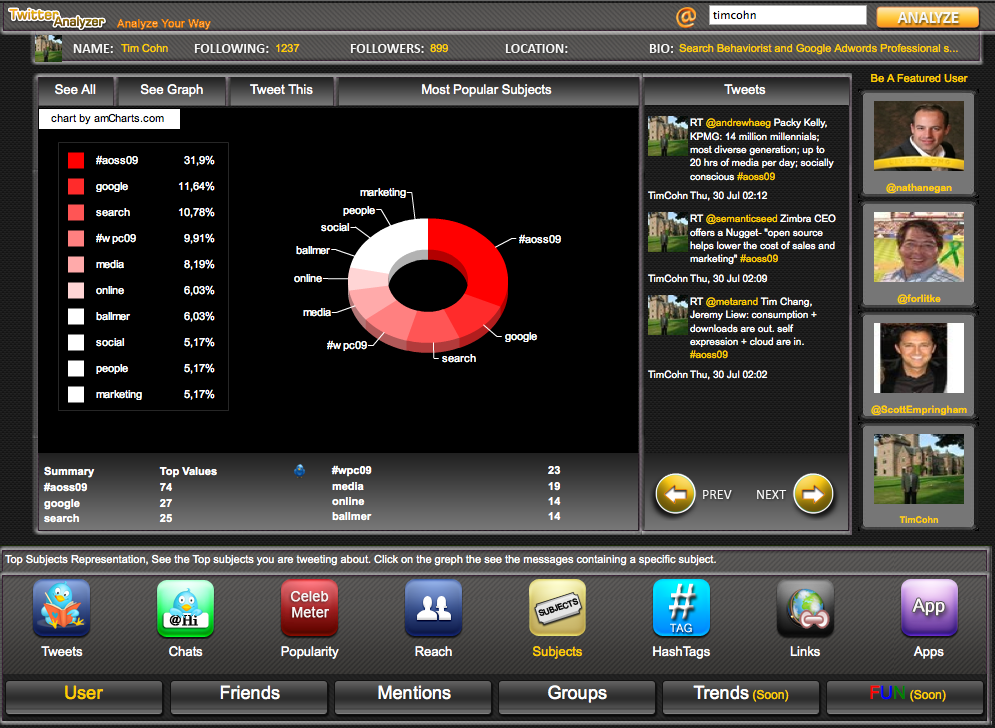
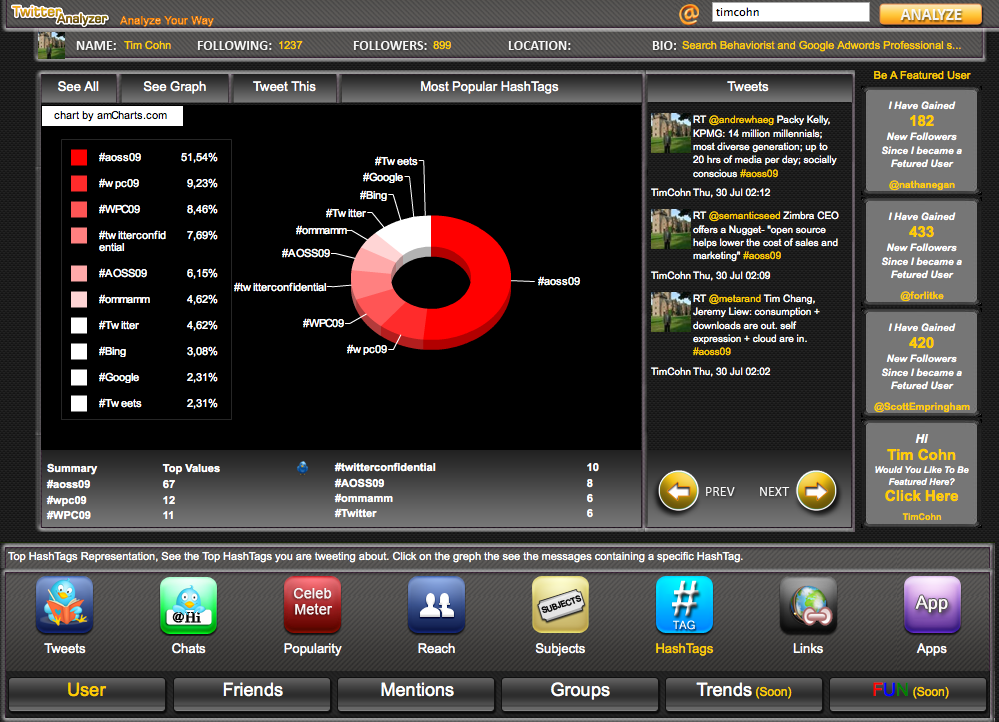
My favorite charts at Twitter Analyzer are the ones for Subjects and Hashtags.

Subjects produces a graph of the top ten subjects tweeted from an account in both descending order and via pie chart.

Twitter Analyzer Hashtags

Twitter Analyzer Hashtags

Hashtags presents Twitter account hashtag data also in both a descending frequency order and by pie chart.

If you have someone you are following who has Tweeted a lot, Twitter Analyzer tools can provide data centric insight into which segment of the Twitter audience their messaging most likely resonates.

Purchasing Associated Press Articles via iCopyright

August 2, 2009

The Associated Press has begun selling their content via a site called iCopyright.

AP Copy and Paste Excerpt

AP Copy and Paste Excerpt

Understandably, the Associated Press membership is trying to find new ways to monetize content generated from their printing press era cost structures in the digital age.

AP Pricing

AP Pricing

I am not sure how the AP arrived at their article pricing structure though.

Websites can use up to four words for free. Using 5 up to 25 words will cost users $12.50.

Websites using Associated Press articles with over 251 words will cost $100.00

AP Referring Web Site

AP Referring Web Site

If I were to guess how well the AP’s new article licensing service and its pricing structure will sell , I would guess not very well.

At least not very well to anyone other than those companies or people who were themselves the subject of an Associated Press article.

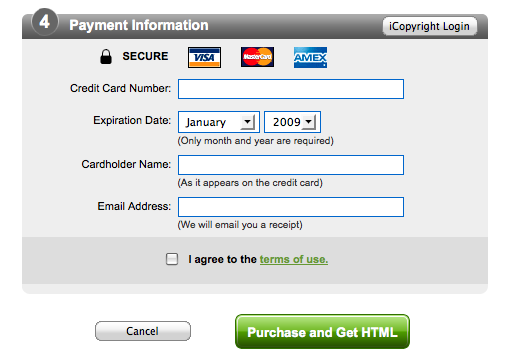
AP Article Purchase

AP Article Purchase

Why?

Two reasons:

1. General circulation news is perishable and has little value to the internet audience beyond the time in which it was generated.

2. Advertisers accustomed to targeting and measuring buyer activity on the internet will find news related content converts less frequently into buyers and thus makes advertiser justification for supporting internet based news nil.