The Future of Newspapers

May 4, 2009

From today’s Wall Street Journal, Warren Buffet owner of the Buffalo News and an investor in the Washington Post shared his outlook for the newspaper industry:

“For most newspapers in the United States, we would not buy them at any price They have the possibility of going to just unending losses.”

According to Buffet, as long as newspapers were essential to readers, they were essential to advertisers.

Indeed without a targeted audience, what media can hope to attract advertisers let alone monetize and profit from their content?

The newspaper industry has three strikes against it – a print cost structure, a shrinking audience and a contracting, transitory advertiser base.

Unfortunately, the future of newspapers no longer appears essential to either readers or advertisers.

Search Advertising Small Business Market Penetration

May 3, 2009

Australian small businesses are in line for some stimulus money from search companies Google and Yahoo.

According to the Australian, “Yahoo Search Marketing is offering businesses $150 in search inventory, while Google is giving away up to $75 per new customer.”

Why?

Its estimated ” just 2 per cent of the 1.9 million small businesses in Australia use paid search advertising. A key reason is that many businesses still do not have a website.”

Search advertising small business penetration in the United States is surely higher isn’t it?

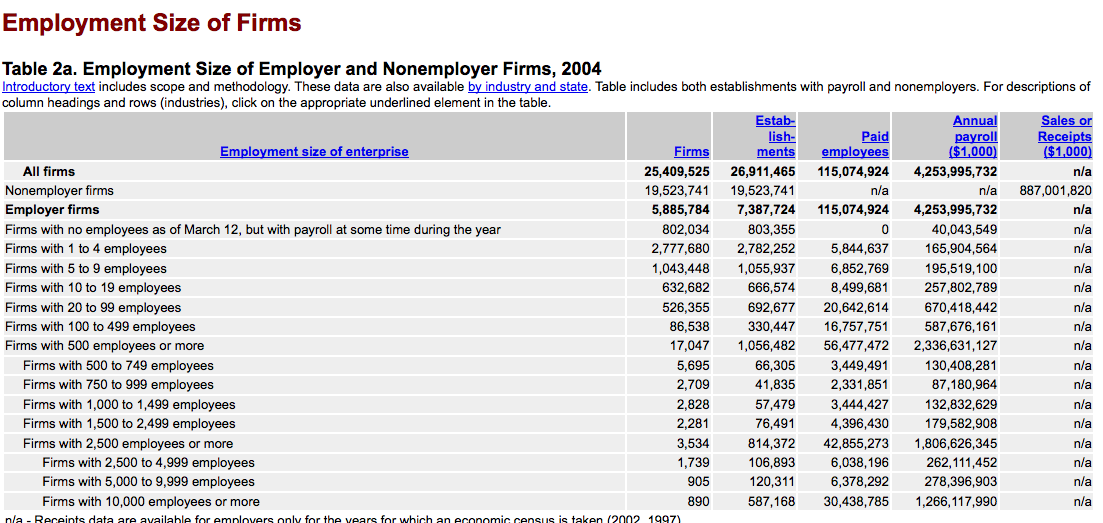
Number of Small Businesses in the United States

Number of Small Businesses in the United States

What percentage of small businesses in the United States buy search advertising?

What percentage of small businesses in the United States have a website?

DoubleClick Studio

May 2, 2009

DoubleClick has introduced a new suite of rich media tools call DoubleClick Studio.

The new suite of tools helps web designers create and manage their rich media workflow.

When Did You Join Twitter?

May 1, 2009

Don’t remember when you joined Twitter?

Curious when someone  joined Twitter?

Neville Ridley-Smith has created a handy Twitter application called WhenDidYouJoinTwitter.com to provide Twitter users with date an account was opened.

Join Twitter

Join Twitter

According to WhenDidYouJoinTwitter.com, I opened my Twitter account on February 6, 2008.

Biz Stone co-founder of Twitter opened his account and launched the first Tweet on March 21, 2006.

When Did You Join Twitter

When Did You Join Twitter

Google’s Largest Agency Client and Customer?

April 30, 2009

The final issue of Portfolio magazine has an interview with Sir Martin Sorrell of WPP Group.

As head of the marketing communications giant, Sorrell oversees more than 100 companies specializing in everything from advertising to consumer research.

Recently Sorrell had characterized his firm’s relationship with Google as that of “frenemies.”

In the Portfolio interview, Sorrell reclassifies WPP’s relationship with Google as “friendly frenemy” because Google competes with WPP through its acquisition of Doubleclick.

Sorrell then goes on to say what I believe hadn’t yet otherwise been made public before … “we buy about $850 million worth of search advertising from them. We’re their biggest agency customer.”

At an average CPC of $1.00, WPP’s $850 million spend on search advertising with Google would generate 850 million clicks.

Wow.

Although I am not absolutely certain Sir Martin – and unless eBay has doubled or tripled its Adwords spend recently – I think buying $850 million worth of search advertising from Google not only makes WPP Google’s largest agency client – its also makes WPP Google’s largest customer – period.

Swine Flu, Mexico, Google Flu Trends and the CDC

April 29, 2009

Google.org has created experimental estimates of flu activity in Mexico using aggregated search data.

Google Flu Trends

Google Flu Trends

Unlike its Google Flu Trends for the U.S., this Flu data for Mexico has not been validated against confirmed cases of flu.

For more information about confirmed cases and the current status of the Swine Flu outbreak visit the Center for Disease Control (CDC).

US Human Cases of Swine Flu Infection

US Human Cases of Swine Flu Infection

A/B Testing with Google Website Optimizer

April 28, 2009

Looking for tips on how to use Google Website Optimizer?

Google’s UK office has launched a site for Google Website Optimizer beginners called “The Beginners Guide to Website Optimiser“.

New Google Optimiser users can use this new online resource to launch their first A/B test.

The Guide Google Optimiser Guide is divided into four parts:

1. Planning your first experiment
2. Identifying what content to test
3. Installation guide
4. Interpreting your report

Developers and advanced users of Google Website Optimizer looking for more details can download The Techie Guide to Website Optimiser.

The 26 page guide covers just most everything about the technical ins and outs of Website Optimiser.

The Techie Guide to Website Optimiser includes:
A detailed explanation of the Website Optimiser experiment scripts
How to implement segmentation in your experiments
How to test with dynamic content
Click here to get your copy of the The Techie Guide to Website Optimiser.


All Major Industries Job Postings Decline

April 27, 2009

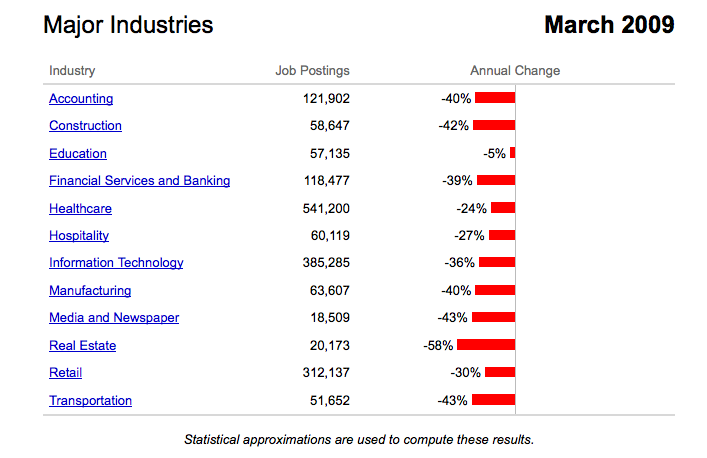
Indeed Job Search Engine’s March 2009 job posting and click count data for major U.S. industries showed declines across all 12 major sectors compared to March 2008.

Accounting, Construction, Financial Services and Banking, Healthcare, Hospitality, Manufacturing, Media and Newspaper, Real Estate, Retail and Transportation all experienced double digit contraction.

Major Industries Job Postings March 2009

Major Industries Job Postings March 2009

Indeed.com uses statistical approximations to compute their results.

As expected, the Real Estate sector showed the largest percentage decline of job postings of all industries contracting 58%.

Transportation, Media and Newspaper and Construction saw the next largest percentage drop in job postings with 43%, 43% and 42% respectively.

The only major industry to experience a single digit percentage decline was Education shrinking just 5%.

Swine Flu Outbreak on Google Maps

April 26, 2009

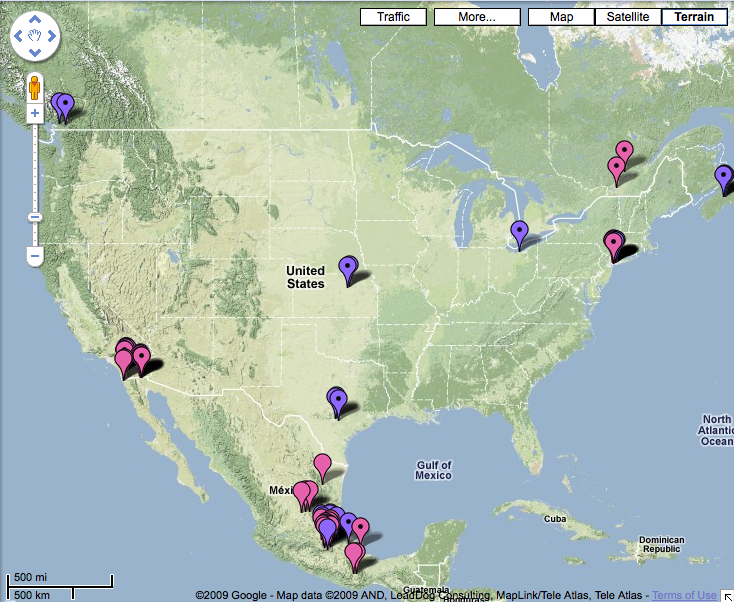
A biomedical researcher from the Pittsburgh area has created a Google Map of the recent H1N1 Swine Flu outbreak.

Swine Flu in Google Maps

Swine Flu in Google Maps

Google account holder Niman’s Google map uses pink markers to identify suspect Swine Flu cases and purple markers to denote confirmed cases.

Deaths resulting from Swine Flu don’t have a dot in the marker.

View Niman’s Google Map to keep up to date on the status of 2009 Swine Flu Outbreak.

RIP: General Circulation Print Media aka Newspapers

April 25, 2009

Maureen Dowd writes about the current state of the newspaper industry in her latest New York Times column titled: Slouching Towards Oblivion.

In her article she quotes two key figures from opposite sides of the same content coin; Eric Schmidt and Sam Zell.

Let’s start with the content game’s biggest loser’s comments first – Sam Zell.

Zell now realizes his purchase of the LA Times and Chicago Tribune was “a mistake”.

Zell adds, “It’s very obvious that the newspaper model in its current form does not work and the sooner we all acknowledge that, the better.” Zell also said he probably would not try for a merger because “that’s like asking someone in another business if they want to get vaccinated with a live virus.”

I don’t know about the virus metaphor, but I do know that any business expecting to profit by reaching an audience through sales of print ads is an obsolete business model.

Now to comments from the content games biggest winner – Eric Schmidt, CEO of Google, Inc.

Via Dowd, Schmidt, “reassured me that newspapers would last 500 years, but only for a boutique market: commuters taking trains, cabs and subways on the East Coast and in cities like London and Paris.”

“For somebody who lives in the suburbs,” he said, “especially if they’re driving and they have kids screaming in the back seat, why would they prefer a physical newspaper over something that is more personal.”

I don’t know if newspapers will last five hundred years or not but agree those that do survive will do so serving a niche market – not a general market – like the markets every major daily newspaper serves.

In no other way can a print media distribution cost structure begin to even hope to compete with a digital media distribution cost structure.

The new Content Kings will be those who’s business cost structure and distribution model is build on bytes not paper and ink costs and distribution.