Archive for the ‘Search Engine Marketing’ Category

State Of Inbound Marketing: Report

April 27, 2010

I read the following headline regarding a report on the state of “inbound marketing’ –

Major Social Media Channels Provide Leads to 4 in 10 Companies

Then comes the paragraph below:

More than four in 10 companies overall have acquired a customer from four major social media channels. Forty-one percent of companies have acquired a customer from both Twitter and LinkedIn. That figure rises to 44% for Facebook and 46% for a company blog.

Whether by design or oversight, the following three simple words explicitly sum up the value proposition of social media as a marketing channel:

“…acquired a customer”

Notice how their study doesn’t say social media channels predictably acquire customers, it says “acquired a customer”… yep just one customer.

Until social media channels can predictably acquire customers, social media should change its name to social messengers.

When the majority of social channel users can predictably acquire more than just one customer social channels can then call themselves media.

Until then, the social channel will remain just another type of digital salesman.

Why Facebook Must Expand Its Footprint

April 26, 2010

Without additional externally generated data points from sites reporting Facebook “likes”, its ability to extrapolate audience psychographics and woo new advertisers will be nil thus rendering Facebook’s ad inventory nothing more than online display advertising.

Word Of Mouth Marketing

April 25, 2010

What factors determine whether or not a favorable message is:

Question #1). Carried?

Question #2). Heard?

Word Of Mouth

Word Of Mouth

Answer #1): Schemas

Answer #2): I know the answer, but I am not telling here..

New Ad Formats In Google Adwords

April 24, 2010

To provide a better search ads experience, Google has been developing and testing a variety of new ad formats.

Learn more about the new ad models and ad extensions Google has developed in this video.

Measuring Google Adwords Success

April 23, 2010

Measure the success of your Google AdWords ads and use this information to improve your AdWords account performance.

Facebook’s Annual Revenue Per User

April 22, 2010

Facebook is approaching 500 million users worldwide.

Its been reported Facebook’s 900 employess generate revenues of close to $1 Billion annually.

With average annual revenue per user of $2.00 ($1 Billion revenue / 500 million users = $2.00) and a daily income production of .005 per user, Facebook.com’s revenue potential looks to have nowhere to go but up.

Online Video Ads Vs. TV Ads

April 21, 2010

From Nielsen:

With most U.S. homes connected to broadband, the viewing of online video has never been easier.  Whether watching a short clip on YouTube or an entire TV program, almost three-quarters (72%) of Internet users view videos online — amounting to 144 million people.  To marketers, this presents a huge – and largely untapped – audience to reach.  And while online advertising fell overall in 2009, ad spend on online videos grew 41%.

In a recent presentation at the Advertising Research Foundation’s annual RE: Think conference, Dave Kaplan, Senior Vice President, Product Leadership at Nielsen IAG, and Beth Uyenco, Director of Global Research at Microsoft, discussed the ins and outs of online advertising and how to effectively reach video viewers.  Evaluating 238 brands encompassing 412 products in 951 ad executions in streaming full-episode TV programs, Nielsen IAG used the key brand impact metrics of ad recall, brand recall, message recall and likeability to determine the effectiveness of ads.  More than 14,000 surveys were conducted.

The patterns they uncovered were consistent:  video ads run during online full-episode TV programs yield deeper brand impact than corresponding on-air TV ads, with the difference most pronounced among younger viewers age 13-34.

Online Ads Vs. TV Ads

Online Ads Vs. TV Ads

What accounts for this variation in impact between online video and traditional TV? Data shows that web video viewers are more engaged and attentive to the programs they are watching, which is likely a function of the viewing environment and the oft-required active mouse-clicking to initiate nd continue content. Online video is also still a relative novelty compared to traditional forms of media.  Further, and most significantly, reduced ad clutter and the inability to easily skip ads are considerable recall-enhancing factors.

While creating a unique ad specifically for use in online video may be desirable, advertisers might want to consider that TV ads repurposed for online full episodes actually generated the top results. It may be that the TV executions possess higher production values, or that online full episode viewers still prefer the absorptive and passive nature of traditional-style TV spots.

“Advertisers might be able to save money by utilizing those ads already in the hopper. Even when controlling for exposure, we see that repurposed TV spots resonate quite well in the streaming full-episode environment,” said Kaplan.

Is it not obvious to brand advertisers that redistribution of high quality television advertising online and the effects of congruent messaging across all channels compounds overall message effectiveness?

I guess not.

Not All Peer Impressions Are Created Equally

April 20, 2010

From Advertising Age via Jeff Bornhoff @ Forrester Research:

Everyone knows people make impressions on each other — it’s called word of mouth. The question marketers always asked us was: just how many impressions? And who is responsible for the mass of those impressions?
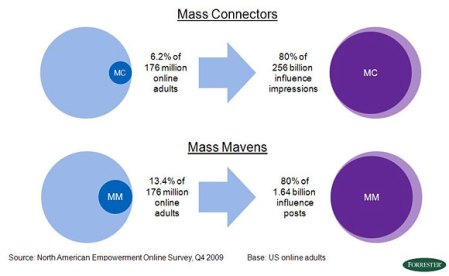
Now we know. People make over 500 billion impressions on each other about products and services every year. And a small group of mass influencers are responsible for 80% of those impressions. This is the beginning of what we call Peer Influence Analysis.

Here’s how it works. Start by counting every instance in which a person influences another person online about a product or service. (We model this from Forrester’s 10,000 person survey, which asks how frequently they post, in what places, how many followers they have, and what products and services they post about.)

This influence comes in two types.

First, there is influence from people posting within social networks: Facebook, Twitter, MySpace and so on. We call these instances influence impressions. Based on our surveys, we estimate people in the U.S. create 256 billion influence impression on each other in social networks every year. (Has anyone ever measured this number before?) Of these influence impressions, 62% come from Facebook.

Second, there is influence created by posts: blog posts, blog comments, discussion forum posts, and ratings and reviews. We call these influence posts. We estimate that people in the U.S. create 1.64 billion influence posts every year. If around 150 people view each of these posts (a conservative estimate, based on our research), that’s another 250 billion-plus impressions. Blog posts and blog comments account for about 40% of these posts.

Add the impressions from both social networks and posts together and you get the 500 billion impressions.
Mass Influence

Mass Influence

Once you start analyzing this huge pool of influence, you can draw some very interesting conclusions. Here are a few.

People’s influence on each other rivals online advertising. For comparison, for a 12-month period ending September 30 last year, Nielsen Online estimates advertisers created 1.974 trillion online advertising impressions, compared to the 500 billion impressions people make on each other about products and services. So people’s online impressions on each other about products and services are about one-fourth of the online advertising impression. And peer impressions are more credible than advertising, since they come from friends. Take those numbers into your next budget meeting!

A minority of people generate 80% of the impressions. Take a look at the graphic. About 6.2% of the online adults generate 80% of the influence impressions. Around 13.8% of the online adults generate 80% of the influence posts. We call these two groups Mass Connectors and Mass Mavens (if you’ve read “The Tipping Point” you know where we got the names.). If you’re a marketer, you probably want to know who these people are (demographics, where they share, that kind of thing) — once we’ve identified them, we can find that all out through the survey.

You can do peer influencer analysis for any type of product or service. For example, mass influencers in consumer electronics are far more concentrated, somewhat more affluent and quite a bit more male than the general mass influencers. If you want to build a word-of-mouth strategy, you have to start with the information on mass influencers in your market.

It’s time to start analyzing peer influence with the same discipline we apply to media. And it’s time word-of-mouth got a budget that reflects the amount of influence people have, and who has it.

On the surface its sounds reasonable to conclude “peer impressions are more credible than advertising, since they come from friends.”

However, I’m not convinced.

If peer impressions were more credible than advertising – why then can’t all company’s switch to an Amwayesque multi-level marketing sales organization model to promote and sell their products?

Because not all peer impressions are created equally.

Top Gaining Site Categories By Percentage March 2010

April 19, 2010

From comScore:

Automaker discounts and incentives compelled millions of Americans to visit auto manufacturer sites to seek information and investigate possible purchases. Political news and information sites also saw sizeable gains in traffic as Americans tuned into the debate over passage of the congressional healthcare bill.

“Auto manufacturers relied on incentives and promotions to boost sales before the end of the quarter, sending more Americans to research their purchases online prior to buying,” said Jack Flanagan, executive vice president of comScore Media Metrix. “As automakers compete in this challenging market, it is ever more important for consumers to research all of their options online before making these important purchase decisions. Americans also looked to stay abreast of the monumental healthcare bill negotiations in March by closely following political news and information online.”

Automakers Drive the Deals Home

Auto Manufacturers ranked as the top-gaining site category in March, growing 23 percent to more than 30 million visitors, as potential buyers researched vehicle options online. General Motors led the category with 7.6 million visitors, up 32 percent during the month. Hyundai Motors, Inc. grabbed the #2 position with 5.4 million visitors, representing a 222-percent surge since February. Toyota attracted 5.1 million visitors, followed closely by Ford Motor Company with 5.0 million (up 3 percent). Chevrolet.com grew 71 percent to 4.4 million visitors, while Honda attracted 3.6 million visitors.

Americans Debate Healthcare Reform Online

Political sites grew 18 percent in March to 20.5 million visitors as Americans sought the latest news and analysis on the political landscape, including the hotly debated healthcare reform bill. PoliticsDaily.com attracted 5.3 million unique visitors, while The Economist Group grew 35 percent to 2.7 million visitors and Politico.com grew 10 percent to 1.8 million visitors. The number of visitors to BarackObama.com more than doubled during the month, growing 133 percent to 1.5 million visitors.

Online Trading Sites Flourish as Stock Market Recovers

As the stock market continued to rebound in March so did traffic to Online Trading sites, which grew 13 percent to 11.5 million unique visitors. Fidelity Investments ranked as the #1 investment site, rising 10 percent to 3.5 million visitors. Scottrade Sites ranked second with 1.6 million visitors (up 7 percent), followed by ShareBuilder.com with 1.5 million visitors (up 20 percent), and ETrade Financial Network with 1.3 million visitors (up 25 percent).

Top Gaining Site Categories

Top Gaining Site Categories

If double digit gains in visits to industry sector websites are an indicator of future economic activity, it looks like the American consumer is once again showing signs of life.

Google Web Analytics TV Episode #8

April 18, 2010

Google Analytics Experts Avinash Kaushik & Nick Mihailovski answer  questions about Analytics and other Google tools.

Topics covered in this video include macro vs. micro conversions, using analytics on affiliate sites, tracking different domains, and more.