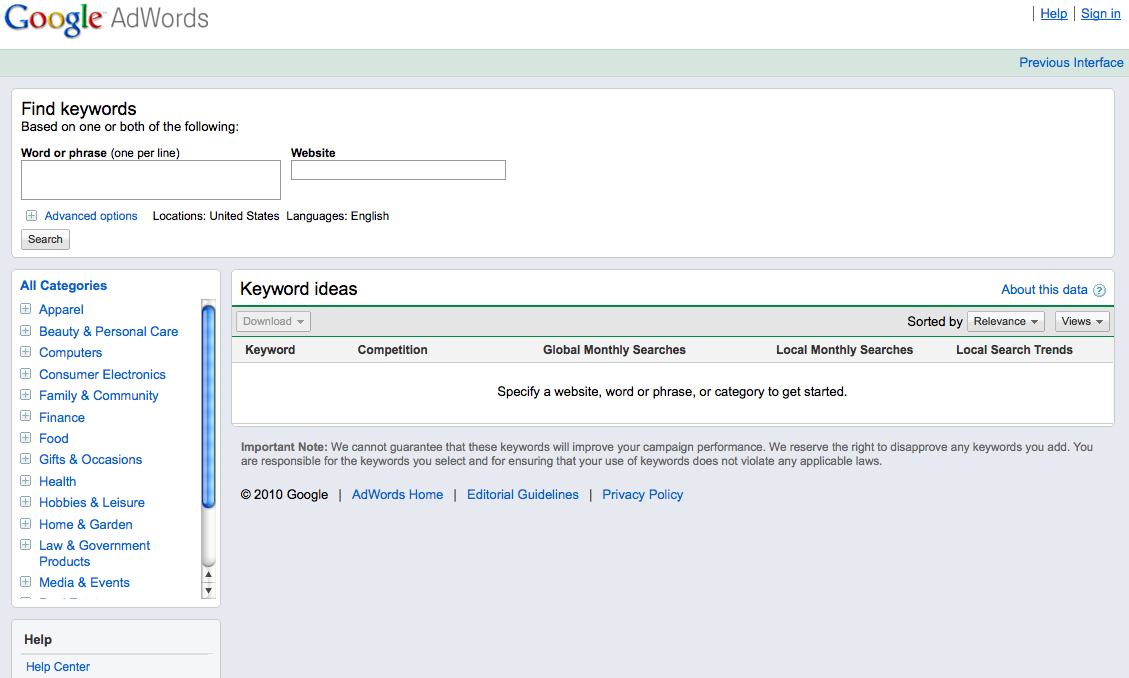
Google AdWords for mobile lets advertisers keep track of key account developments from their Android, iPhone, and Palm Pre devices by showing AdWords advertisers the alerts and filters they have set up for their keywords and campaigns.
Tech Triumphs in annual in BrandZ Top 100 Most Valuable Global Brands
BrandZ Top 100 worth over $2 trillion, a 40 percent growth over five years, strong brands outperformed the stock market and proved resilient in recession
Strong brands prove their resilience to recession in the fifth annual Millward Brown Optimor BrandZ Top100 Most Valuable Global Brands ranking released today. When most key financial indicators plummeted, the value of the top 100 brands rose by four percent in the last year to more than $2 trillion. The BrandZ Top 100, commissioned by WPP, is the only valuation in the world that takes into account customers’ opinions on brands and demonstrates this with a dollar value.
“In the past, many companies were quick to cut their marketing spend during a down economy,” said Joanna Seddon, CEO of Millward Brown Optimor. “A new trend has emerged in the wake of the recession as more companies realized the importance of maintaining and even increasing budgets to support brand loyalty and engagement.”
Top 10 Most Valuable Global Brands 2010
Can’t Tech’s Brand triumph as a group be correlated with Moore’s Law and the ability of the integrated circuit to deliver ever greater degrees of performance?
I read the following headline regarding a report on the state of “inbound marketing’ –
Major Social Media Channels Provide Leads to 4 in 10 Companies
Then comes the paragraph below:
More than four in 10 companies overall have acquired a customer from four major social media channels. Forty-one percent of companies have acquired a customer from both Twitter and LinkedIn. That figure rises to 44% for Facebook and 46% for a company blog.
Whether by design or oversight, the following three simple words explicitly sum up the value proposition of social media as a marketing channel:
“…acquired a customer”
Notice how their study doesn’t say social media channels predictably acquire customers, it says “acquired a customer”… yep just one customer.
Until social media channels can predictably acquire customers, social media should change its name to social messengers.
When the majority of social channel users can predictably acquire more than just one customer social channels can then call themselves media.
Until then, the social channel will remain just another type of digital salesman.
Without additional externally generated data points from sites reporting Facebook “likes”, its ability to extrapolate audience psychographics and woo new advertisers will be nil thus rendering Facebook’s ad inventory nothing more than online display advertising.
Facebook is approaching 500 million users worldwide.
Its been reported Facebook’s 900 employess generate revenues of close to $1 Billion annually.
With average annual revenue per user of $2.00 ($1 Billion revenue / 500 million users = $2.00) and a daily income production of .005 per user, Facebook.com’s revenue potential looks to have nowhere to go but up.
With most U.S. homes connected to broadband, the viewing of online video has never been easier. Whether watching a short clip on YouTube or an entire TV program, almost three-quarters (72%) of Internet users view videos online — amounting to 144 million people. To marketers, this presents a huge – and largely untapped – audience to reach. And while online advertising fell overall in 2009, ad spend on online videos grew 41%.
In a recent presentation at the Advertising Research Foundation’s annual RE: Think conference, Dave Kaplan, Senior Vice President, Product Leadership at Nielsen IAG, and Beth Uyenco, Director of Global Research at Microsoft, discussed the ins and outs of online advertising and how to effectively reach video viewers. Evaluating 238 brands encompassing 412 products in 951 ad executions in streaming full-episode TV programs, Nielsen IAG used the key brand impact metrics of ad recall, brand recall, message recall and likeability to determine the effectiveness of ads. More than 14,000 surveys were conducted.
The patterns they uncovered were consistent: video ads run during online full-episode TV programs yield deeper brand impact than corresponding on-air TV ads, with the difference most pronounced among younger viewers age 13-34.
Online Ads Vs. TV Ads
What accounts for this variation in impact between online video and traditional TV? Data shows that web video viewers are more engaged and attentive to the programs they are watching, which is likely a function of the viewing environment and the oft-required active mouse-clicking to initiate nd continue content. Online video is also still a relative novelty compared to traditional forms of media. Further, and most significantly, reduced ad clutter and the inability to easily skip ads are considerable recall-enhancing factors.
While creating a unique ad specifically for use in online video may be desirable, advertisers might want to consider that TV ads repurposed for online full episodes actually generated the top results. It may be that the TV executions possess higher production values, or that online full episode viewers still prefer the absorptive and passive nature of traditional-style TV spots.
“Advertisers might be able to save money by utilizing those ads already in the hopper. Even when controlling for exposure, we see that repurposed TV spots resonate quite well in the streaming full-episode environment,” said Kaplan.
Is it not obvious to brand advertisers that redistribution of high quality television advertising online and the effects of congruent messaging across all channels compounds overall message effectiveness?





 Search Marketing Communications
You must be logged in to post a comment.