Archive for March, 2009

Google Holiday Shopping Ads in March?

March 11, 2009

Today while in my Gmaill account I spotted an Adwords ad from Google for its holiday shopping products.

The Google Ad reads:

Tip from Google: Check out this seasons top gifts and save with exclusive discounts.

Gmail Tips from Google Adwords Ad Holiday Shopping

Gmail Tips from Google Adwords Ad Holiday Shopping

Apparently whoever was in charge of running this particular ad campaign for Google forgot to shut it down after the holiday shopping season ended – 60+ days ago.

Curious Gmail account holders who see this particular ad like I did will find the ad’s broken link routes them to a non-existent Google search results page.

Google Holiday Shopping Page

Google Holiday Shopping Page

As a rule, Google eventually finds ads with broken links and suspends the ad until the advertiser can fix or replace the faulty link.

I guess this hasn’t yet happened with this particular Google ad.

Local Digital Advertising Will Continue To Grow…

March 10, 2009

Traditional Media Advertising will continue to shrink.

A new report from the Kelsey Group and BIA predicts the overall market for Local Advertising will shrink 1.4% by 2013.

The report shows Traditional Local Media Advertising will contract a total of 4.5% over the next five years, yet Local Digital Advertising will experience compound annual growth of 18.0% through 2013.

Its not surprising to see a prediction for a contraction in money spent on Traditional Media Advertising over the next five years. Spending on traditional local media is forecast to fall from $141.3 billion in 2008 to barely over $112 in 2013.

Nor is it surprising to see continued growth in Local Digital Advertising.

However, it is somewhat surprising to see Total Local Advertising predicted to contract over the next five years even if only by 1.4%.

If the economy sheds as many retailers and small businesses during the present recession as predicted, those factors alone might be enough to account for a flat to slightly smaller advertising spend in both digital and traditional media over the next five years.

US Local Advertising Spending

US Local Advertising Spending

From eMarketer:

The good news is that the local online ad market is growing, and will continue to make up a larger percentage of the local advertising sector. In 2009, nearly 12% of local ad spending will be digital, with dollars focused on Internet yellow pages, local search, e-mail marketing and other online tactics.

In 2013, the digital share will jump to over 22%, and might grow even higher.

“The share shift we expect [between traditional and digital] could actually be more pronounced if the major traditional media are not able to integrate new interactive products into their bundle,” said Neal Polachek of Kelsey.

US Local Advertising Spending Share

US Local Advertising Spending Share

I think the Kelsey / BIA report’s predictions regarding share of advertising spent with digital media vs. traditional media over the time period will ultimately be proved too conservative.

As the economy careens toward its trough, the surviving businesses will more aggressively seek the ability to measure returns on their advertising investment.

Measuring return on advertising investment is a tall order for most traditional media yet native to digital advertising.

This flight to quality will cause Local Digital Media to grow more rapidly than predicted while also accelerating the reduction in money spent on any unmeasurable traditional media advertising.

Has Direct Mail Marketing Peaked?

March 9, 2009

Will the Direct Mail industry not follow the same life and death cycle (obsolescence) trajectory its cousins  in the Newspaper industry are presently grappling with?

Has print as an advertising medium not peaked?

If a report released today is any indication of future of direct mail marketing – then the answer is: Yes.

Few media if any who have seen their sales contract since the birth of the internet have also been fortunate enough to see their sales reach new highs let alone return to their historical norms after shrinking.

The same will hold true for the Direct Mail industry.

As with newspapers, when marketers’ dollars are ultimately redeployed they will be done so within media that meets marketers ever exacting needs for measurably higher returns on investment.

Absent some type of innovation in buyer audience targeting and delivery – direct mail like its newsprint cousin; as an advertising medium – has officially reached its peak.

Print – albeit the ultimate form of personalized communication – simply has too many inexpensive digital competitors willing to carry the same advertising message for 1/10 the cost.

When marketing dollars do return they will go where they have the greatest probability of earning a return on their investment –  online.

According to a new report from the Winterbury Group via eMarketer:

For the first time since direct mail began to be tracked in 1945, figures show that both direct mail spending and volume declined sharply in 2008.

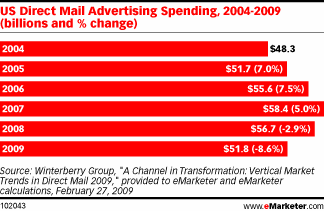
According to “A Channel in Transformation: Vertical Market Trends in Direct Mail 2009,” from the Winterberry Group, US direct mail spending fell nearly 3% last year.

Spending dropped from $58.4 billion in 2007 to $56.7 billion in 2008.
Direct Mail Drop

Direct Mail Drop

Winterberry also projects that direct mail spending will fall another 8% to 9% this year.

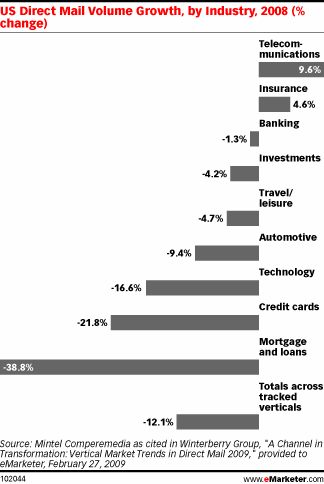
Additionally, Mintel Comperemedia found that the volume of direct mail among the leading vertical industries fell an average of 12.1% in 2008.

Direct Mail Growth

Direct Mail Growth

From Mintel Comperemedia:

“Direct mail volumes declined dramatically—even more precipitously than the falloff in spending, in fact—as mailers sought to integrate more precise targeting methodologies, production efficiencies and other value focused initiatives in an attempt to cut costs and preserve the economic return of their mail programs,” Winterberry analysts wrote in the report. “Direct mail has seen its influence as a high-volume, mass-oriented response driver all but vanish.”

Reasons for the drop in direct mail were rising costs in postage, labor and production while the financial services industry crisis also contributed to the contractions in both volume mailed and the amount spent on direct mail.

Increased postage, labor and production costs compared with near frictionless digital delivery and its lower labor and production costs will continue to make digital media marketing and advertising the choice of cost and performance conscious marketers over direct mail.

… which are the reasons why Direct Mail Marketing has peaked.

100 Million Youtube Viewers

March 8, 2009

comScore reports Youtube surpassed 100 Million Viewers for the first time in January 2009.

14.8 Billion videos were viewed during January 2009, with Google sites including Youtube accounting for over 6.3 Billion videos viewed.

Videos Viewed January 2009

Videos Viewed January 2009

From comScore:

More than 147 million U.S. Internet users watched an average of 101 videos per viewer in January. Google Sites grew to 102 million online video viewers during the month, or more than two out of every three Internet users who watched video.

Top Online Video Properties

Top Online Video Properties

Online video watchers are not like the television viewing audience. The average video watcher viewed only 3 1/2 minutes of video online.

WordPress Domain Change and Google Indexing Issues

March 7, 2009

On January 28, 2009 I moved my several year old blog to a new domain while still hosting the site at WordPress.

In addition to the blog no longer being picked up by Google blog search or Technorati, the new domain hasn’t had any new posts crawled or indexed by Google since switching domains.

Google Search Marketing Communications

Google Search Marketing Communications

I verified the site with Google as suggested several weeks ago yet still no luck.

On the other hand, I haven’t verified the new domain with Yahoo or Microsoft Live.

Yahoo Search Marketing Communications

Yahoo Search Marketing Communications

Yet both Yahoo and Live are crawling and indexing my new blog domain address hosted at WordPress.com.

Live Search Marketing Communications

Live Search Marketing Communications

What gives?

Ironic? Microsoft Cashback Buying Ads in Google

March 6, 2009

I was reading Greg Sterling’s report in Search Engine Land about Microsoft’s Cashback search promotion being added to the MSN Toolbar.

After completing the article I scrolled to the bottom of the page where I noticed two Google Adsense ads.

Google’s distributed advertising on web publishers sites is called Google Adsense.

Adsense analyzes content on web pages where it places ads and since this article was about Microsoft and Cashback – Google searched and found within its ad inventory the most relevant advertiser ads.

Microsoft Cashback Google Adwords Ads

Microsoft Cashback Google Adwords Ads

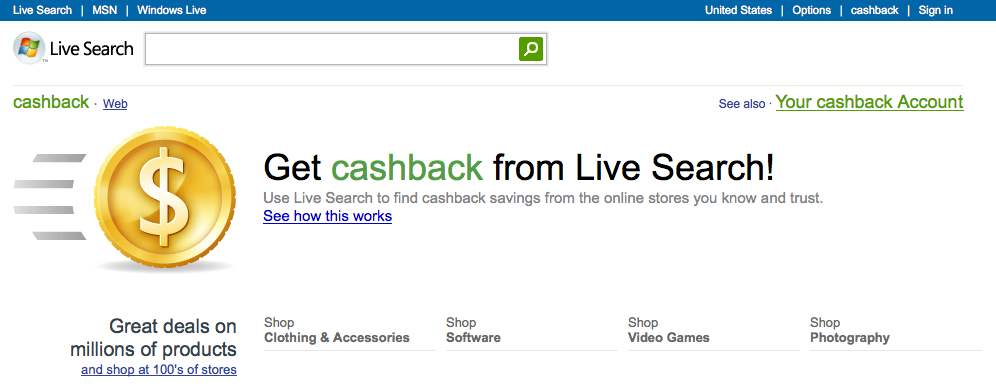
Somewhat surprisingly, the first ad titled “Rebate” Search that Pays You Back. Search Now and Save! is an advertisement from none other than Microsoft itself for their Cashback program.

Clicking through takes readers to the Cashback Live Search page.

Cashback Live Search

Cashback Live Search

Microsoft’s advertising on Google’s publishing partner sites isn’t too unusual.

It does seem a bit ironic to me however that Microsoft is also advertising their Cashback search product on Google.

Google Search Cashback

Google Search Cashback

Do competing media networks advertise their television products on networks other than their own?

I guess the search business hasn’t yet considered what implications there may be – if any –  by allowing competitors to advertise their business on each others respective search networks.

Twitter Search, Profile and Settings Now Visible @ Web Login

March 5, 2009

Today while logging into Twitter, I noticed my account now features the Twitter Search box in the upper right hand corner of the page.

Placing Twitter Search atop Twitter account pages makes using their search feature much more likely.

Searching Twitter before the search box required scrolling to the bottom of the page and clicking Search or having to navigate directly to Twitter search in another browser window.

Having search on the same page will keep Twitter users on Twitter’s site.

Twitter Search

Twitter Search

Clicking on Search takes users to Twitter’s real time search box where Twitter users can “See what’s happening – right now.”

Twitter Trends

Twitter Trends

Searching Twitter produces a list of the 15 most recent “real time” Tweets containing the searched term.

Search Twitter

Search Twitter

Just to the left of the Search Now box, Twitter also provides a “Trends” drop down tool box.

Clicking on Trends takes account holders to a list of Twitter’s Top 10 most mentioned terms.

Twitter Trends Toolbox

Twitter Trends Toolbox

Click on any one of the terms to reach the real time stream of Tweets for any of Twitter’s Top 10 Trends.

Here Twitter also provides a list of Tweets containing the Trending term along with a list of Matching users and Featured users like it does on their “realtime results” page.

By providing Matching and Featured users Twitter gives its users a chance to explore topics they have already confirmed they have an interest in.

Matching Users Featured Users

Matching Users Featured Users

Twitter has also pushed links to both the account holder’s “Profile” and “Settings” to the Twitter users home page.

Name, Location, Web and Bio information are still found on the Twitter account holder’s public page.

Twitter Profile

Twitter Profile

By placing account related links on the “What are you doing” page, Twitter has reduced the number of clicks required to navigate Twitter account while also simplifying overall Twitter account management.

Twitter Settings

Twitter Settings

If the web continues to account for the majority of Twitter’s use as previously reported, surely adding search to every Twitter account will increase both Twitter’s use and usefulness further.

Microsoft+Yahoo+Twitter = Microhooter! to the Rescue?

March 4, 2009

While thinking about commenting on another blog regarding all the blather about how this company or that company will kill Google and its lead in the search space, I believe I stumbled upon the perfect Google killer: Microhooter!

Combined or by reputation alone couldn’t Microsoft’s desktop monopoly, Yahoo’s display ad business and Twitter’s mass texting be enough to derail Google’s money making search engine?

Maybe in theory but not in practice.

No, not even Microhooter! will save the day.

The search audience is an army of one – one billion people online that is – an army which will continue to march where it can find and get the answers it needs when and where they are needed.

With or without a Microhooter, for the time being and for the foreseeable future that place will remain Google.

You can go back to work now.

Stacking the Deck in Google Maps?

March 4, 2009

Could it be Public Storage has a monopoly on the self storage market in Oklahoma City or do they just appear to have one because of their dominance in Google’s search results?

Oklahoma City Storage Google Maps

Oklahoma City Storage Google Maps

Not sure whether these results are Public Storage’s handiwork or Google’s lack therof.

In either case, I am pretty sure Google prefers to deliver more varied business results for generic search terms like Oklahoma City Storage.

A quick check for “storage” in other cities doesn’t show the same degree of repetition of a single listing’s data.

Are these results spam or a Google anomaly?

McKinsey and Company’s Innovation Clusters Heat Map

March 3, 2009

McKinsey and Company has partnered with the World Economic Forum to produce a map of innovation clusters by market location.

From McKinsey and Company:

…in times of economic turbulence, innovation remains the most important differentiator separating economic winners from also-rans.

Global Innovation Heat Map

Global Innovation Heat Map

The McKinsey report places innovation clusters into four categories: Dynamic oceans, Silent lakes, Hot springs and Shrinking pools.

More from McKinsey about their report:

…we have examined the evolution of hundreds of such clusters around the world and analyzed over 700 variables, including those driving innovation (business environment, government and regulation, human capital, infrastructure, and local demand) along with proxies for innovation output (for example, economic value added, journal publications, patent applications) to identify trends among the success stories. In the process, we have found patterns that suggest the critical ingredients required to grow, nurture, and sustain innovation hubs.

Not without surprise, Silicon Valley is the largest Dynamic ocean of innovation in the world.

Financial engineering and marketing advantage excluded, I am convinced all new profits are fueled in part by technological advancements.

From where I sit in Oklahoma and for some time, it has looked like the majority of America’s innovations (technological advancements) and the world’s for that matter – have originated from Northern California (Silicon Valley & San Francisco).

Thus for any business to capture new profits from within its market  – and again barring financial engineering and marketing advantage – the profit seeking business must embrace technological innovation – innovations more than likely developed in Silicon Valley.

Coincidentally, the combination of these factors were what lead to my decision to become a Google Adwords Professional long ago.