Facebook: The Brand Experience Channel?

May 18, 2010

A long time friend and I were talking today about his recent privacy score of .09 on Facebook.

Because he is a well known author and speaker within his industry he is a celebrity of sorts and as such he lives his life publicly both offline and online – particularly within his Facebook account.

Hence his .09 privacy score.

As both a celebrity and brand he expects less privacy than most and was only somewhat concerned about his .09.

I on the other hand have a 10.0 Facebook privacy score – which also coincidentally confirms I am not a celebrity – so he and I occupy opposite ends of the privacy continuum.

He also knows I think Facebook is a waste my attention and keystrokes.

Today he surprised me with his “case” for marketing on Facebook.

My friend stages seminars across the U.S. and Costa Rica and sells his products online.

He has lots of Facebook “friends” and uses Facebook primarily as a channel for staying connected to his customers.

He then floored me when he said he has gotten new business as a result of the time he has spent connecting with customers i.e., “marketing” on Facebook.

No way!

Yes way – he insiststed!

I asked how.

He cited two examples –

1). Three previous prospects contacted through other media channels converted into buyers after “friending” him and his then friending them back.

2). Fourteen new seminar attendees became buyers as a result of being friends of his existing friends (customers / buyers).

Are you kidding me?

While he didn’t have hard data supporting his claims, he was personally convinced the sales resulted in the manner he outlined.

His case then for using Facebook as a channel for maintaining relationships with customers began to sound pretty compelling.

I was somewhat taken back.

How could Facebook actually produce new customers?

After further investigation and discussion, I concluded Facebook Fan pages or Facebook sites set up to cultivate and maintain business relationships on behalf of personalities and brands like my friend who provide valuable noteworthy experiences can produce new buyers because Facebook users who are satisfied with a particular brand who in turn post about the good times they had with the product or service can capture, communicate and convey the consumer’s unique experience and perception of the brand.

This type of experience and perspective is generally considered more trustworthy than that of the brand’s marketing and advertising messaging which tells consumers what they should think experiences with the brand will be like.

Isn’t the implicit message of a trusted friend more valuable than almost any brand’s explicit message?

In my friend’s case, he provides an experience his buyers often want to share with their friends -and they do en masse- which in turn results in positive word of mouth being generated and spread to friends of their friends and their network of friends.

Voila!

Thus the friend’s message becomes an implicit endorsement which can then travel freely across the social network as far as the network decides is appropriate.

Although I am still not convinced Facebook’s power as a direct response channel will ever rival Google’s, I can now see how Facebook’s potential as a “brand experience channel’ may find traction with marketers provided they don’t abuse their friends and fan’s trust in the process.

Kurrently.com Real Time Search

May 17, 2010

Kurrently.com does a nice job of mashing up and delivering results from multiple sources into a real time search feed.

Kurrently

Kurrently.com Real Time Search

I know there are a handful of other real time search engines but I don’t recall seeing them work as well as Kurrently appears to.

How To Generate A Google Adwords Content Network Placement Report

May 16, 2010

In this video learn how to run a Placement Performance Report from your Google AdWords account, and interpret the Placement Performance Report data.

Will Facebook Best Google?

May 15, 2010

It seems the more negative pieces that appear about Facebook’s plans to profit from its users privacy the more fluff pieces appear about how Facebook is instead going to somehow become the next Google.

For example – this piece in TechCrunch:

Will Facebook Dethrone Google

Will Facebook Dethrone Google?

I have grown tired of reading pieces like the TechCrunch article above that are written by people who obviously don’t know what they don’t know.

The answer to my headline’s question?

NO.

YouTube Video Targeting Tool

May 14, 2010

In this video, learn about Video Targeting and how to place ads in or around relevant YouTube videos.

Two YouTube stats:

1. Over 20 hours of video are uploaded to YouTube every minute.

2. People watch over 1 billion videos each day on YouTube.

YouTube Video Targeting offers two types of ad formats – an in-video overlay or in-stream ad that will run before the videos you have targeted.

Visit Google.com/VideoTargeting to advertise on YouTube.

One Trillion Display Ads “Received” in Q1 2010

May 13, 2010

From comScore’s Ad Metrix:

U.S. Internet users received a record 1.1 trillion display ads during the first quarter, marking a 15-percent increase versus year ago. Total U.S. display ad spending in Q1 reached an estimated $2.7 billion, with the average cost per thousand impressions (CPM) equal to $2.48.

*Display ads include static and rich media ads; excludes video ads, house ads and very small ads (< 2,500 pixels in dimension)

Facebook Ranks as Top Display Advertising Publisher in Q1 2010

Popular social networking site Facebook.com led all online publishers during Q1 with 176 billion display ad impressions, representing 16.2 percent market share. Yahoo! Sites ranked second with 132 billion impressions (12.1 percent), followed by Microsoft Sites with 60 billion impressions (5.5 percent) and Fox Interactive Media with 53 billion impressions (4.9 percent).

Top 10 Online Display Advertising Publishers

Top 10 Online Display Advertising Publishers

AT&T Ranks as Top Display Advertiser in Q1 2010

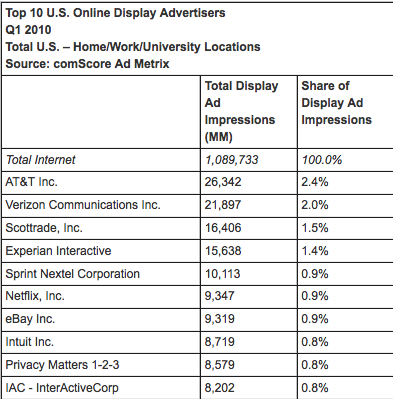
AT&T led competitor Verizon as the top online display advertiser in Q1 with 26.3 billion impressions, accounting for 2.4 percent of display ads. Verizon held the second position with 21.9 billion (2.0 percent), followed by Scottrade Inc. with 16.4 billion (1.5 percent) Experian Interactive with 15.6 billion (1.4 percent) and Sprint Nextel Corporation with 10.1 billion (0.9 percent).

Top 10 U.S. Online Display Advertisers

Top 10 U.S. Online Display Advertisers

The operative word relative to all the above comScore display advertising data is “Received”.

It seems to me the headline could have read “one trillion display ads delivered in Q1 2010″ but that wouldn’t have necessarily framed comScore’s position on the value of online display advertising as favorably.

Google Adwords Certification Program Learning Center Upgraded

May 11, 2010

With the launch of their new Certification Program, Google has also improved their Adwords Certification Program Learning Center.

There are now four exams offered within the Adwords Certification program instead of one.

The new Google Adwords exams are:

To become Individually Qualified in Google Adwords, exam takers must pass both the Advertising Fundamentals exam and one advanced-level exam.

There are fifteen sections of Adwords curriculum within the Adwords Certification Program Learning Center.

However, not all sections or lessons within the new AdWords Certification Program curriculum are featured on every exam. Several of the topics will appear on multiple exams, with basic questions appearing on the Fundamentals exam and more challenging questions appearing on the three Advanced Exams.

The following are the fifteen lesson sections:

1. Introduction to Google AdWords

2. AdWords Account and Campaign Basics

3. AdWords Ad Formats

4. AdWords Targeting and Placements

5. AdWords Bidding and Budgeting

6. Policies and Ad Policy Topics

7. AdWords Billing and Payments

8. Display Advertising on the Google Content Network

9. Display Advertising on YouTube

10. AdWords Tools

11. Performance Monitoring and Conversion Tracking

12. Google Analytics

13. Optimizing Performance

14. Managing Multiple Accounts

15. Selling and Representing AdWords

I am reviewing these materials now to prepare to take the Google Advertising Fundamentals exam and one of their advanced level exams to renew my Individually Qualified Adwords Professional status for the third time.

Google E-Commerce YouTube Channel

May 10, 2010

Google has launched its E-Commerce YouTube Channel an interactive source for demo, feature launch and instructional videos for Google Checkout and Product Search.

This video shows how to setup Shipping in Google Checkout.

An aside – Google’s choice of the Shopping Cart for its Google Checkout logo has some coincidental and personal significance for me.

Google Checkout | Shopping Cart

Google Checkout | Shopping Cart

The shopping cart was invented and patented by Oklahoman Sylvan Goldman.

I once lived in Mr. Goldman’s house @ 6900 Grand Blvd.  in Nichols Hills, OK.

An Overview Of Google’s Search Appliance

May 9, 2010

The Google Search Appliance (GSA) brings fast, relevant search to the business website or intranet, whether they index thousands, millions, or even billions of documents.

With increased administrative customization options and the ability to scale across all of the content searched, the GSA is Google’s most powerful search solution.

The Google Search Appliance comes in two simple models the  GB – 7007 for businesses needing to search between 500,000 and 10,000,000 documents and the GB  – 9009 for businesses wanting to search between 10,000,001 up to billions of documents.