Archive for the ‘Search Engine Advertising’ Category

2008 Holiday Retail Search Traffic Forecast

November 7, 2008

Microsoft’s adCenter blog has posted their 2008 Holiday Advertising Guide for search advertisers.

Some of the guide’s highlights:

“Online retail shopping increases in November by more than 100 percent.1 Adding promotions like free shipping make an enormous difference—57 percent of consumers stated that free shipping is a reason for them to shop online.2 For search and display advertising, online buying will peak on Black Friday, November 28, followed by Cyber Monday, December 1.”

1. Hitwise Market Share in all Categories, 2008.
2. iCongo/Harris Interactive, April 22, 2008.

Based on the percentage of consumer interest and barring any data suggesting otherwise, shipping costs appear to have become the largest remaining barrier to consumers shopping and buying online.

Can elimination of shipping costs insure and increase internet retailers sales prospects this 2008 holiday season?

As the largest online retailer, Amazon.com demonstrated their understanding of the power of free shipping by offering it during the 2007 holiday season.

Amazon is again offering free shipping this holiday shopping season with some conditions through their Amazon Prime Member program.

Amazon Prime

Amazon Prime

In this current economic climate, aren’t internet retailers who don’t follow Amazon’s lead by offering some type of free shipping risking transaction losses to internet retailers – like Amazon – who do?

According to Microsoft’s Holiday Advertising Guide and their traffic data from 2007, Internet retailers can expect four peak search traffic periods during this holiday season:

1. Black Friday

2. Cyber Monday

3. Holiday Crunch

4. Post Holiday

Holiday Search Traffic

Holiday Search Traffic

Important search traffic dates for internet retailers this year will be:

1. Black Friday: November 28, 2008

2. Cyber Monday: December 1, 2008

3. Holiday Crunch: Occurs between December 4, 2008 and December 18, 2008

4. Post Holiday: Begins on December 26, 2008

Internet retailers who advertise free shipping this holiday season can forecast a larger percentage of transactions generated via search from within their market than internet retailers who don’t.

Ask.com Sponsored Listings Conversion Tracking Now Available

October 20, 2008

Ask.com and their search advertising product – Sponsored Listings – is now offering conversion tracking to their advertisers.

Ask Conversion Tracking

Ask Conversion Tracking

More about Ask.com conversion tracking offer:

“When you activate ASL conversion tracking and track at least one valid conversion by October 31st, you’ll receive a $25 credit! We’ll automatically credit your account after your conversion tracking has been verified.*”

Ask.com’s reasoning for deploying Conversion Tracking within their Sponsored Listings product:

* Increase your ROI: Measure and optimize your cost per acquisition (CPA) and improve your overall Return on Advertising Investment

* Gain deeper insight into your campaigns: Remove under performing traffic sources

* Get comprehensive reporting: View your Ask.com advertising by account, campaign, ad, keyword, conversion type, and date

Ask.com’s conversion tracking offer’s boiler plate:

“*Offer Terms and Conditions: in order to qualify for the $25 account credit, you must place the ASL conversion tracking tag on your web page and record at least 1 conversion by October 31st, 2008. ASL will verify your conversion and credit your account within 15 days of your conversion. Only one credit will be given for each individual account, web domain, and/or company.”

Its been a long time coming but all four major search engine advertising providers – Google, Yahoo, MSN and Ask.com now provide conversion tracking within their search advertising platforms.

If not for all search advertisers now – soon – precise measurement of search advertising return on investment will be the rule not the exception.

Geotargeting Search Advertising in Microsoft adCenter

October 12, 2008

In a previous post I wrote about the differences I found between the four major search engines Google, Yahoo, MSN and Ask and their search advertising geo-targeting options.

I stated Microsoft didn’t offer geotargeted search advertising options to its advertisers.

However, Dave Naffziger pointed out Microsoft AdCenter’s geotargeting features can be found under the “edit ad group settings” instead of the “edit campaigns settings” like in Google, Yahoo and Ask.

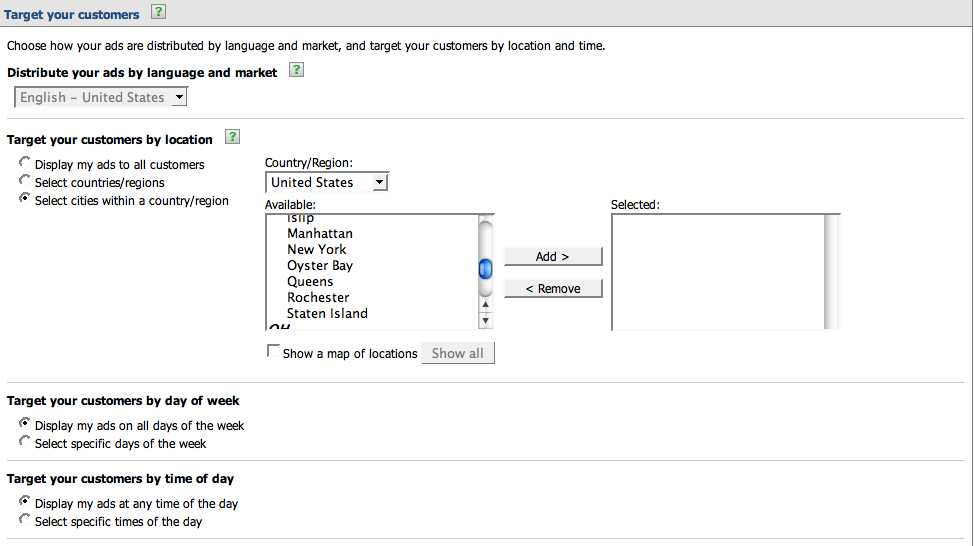
The following are screen shots of Microsoft adCenter’s geotargeting capabilities:

Like with other search advertising platforms, Microsoft ads can be targeted by country or region and then targeted specifically to cities within a region.

Microsoft Adcenter Geotargeting

Microsoft Adcenter Geotargeting

Although Microsoft lists all countries worldwide available for targeting, only five countries can be selected for geo-targeting search advertising through Microsoft’s adCenter at this time.

The five countries are:

The United States, Canada, United Kingdom, France and Singapore.

Microsoft Adcenter Country Targeting

Microsoft Adcenter Country Targeting

Once a country or region has been selected, advertisers can select a limited number of cities within each state to distribute their ads to.

Microsoft Adcenter Ad Group Geotargeting

Microsoft Adcenter Ad Group Geotargeting

Advertisers can’t target their ads specifically for distribution at the state level like they can in Google, Yahoo and Ask.

Microsoft Adcenter Geotargeting States or Cities

Microsoft Adcenter Geotargeting States or Cities

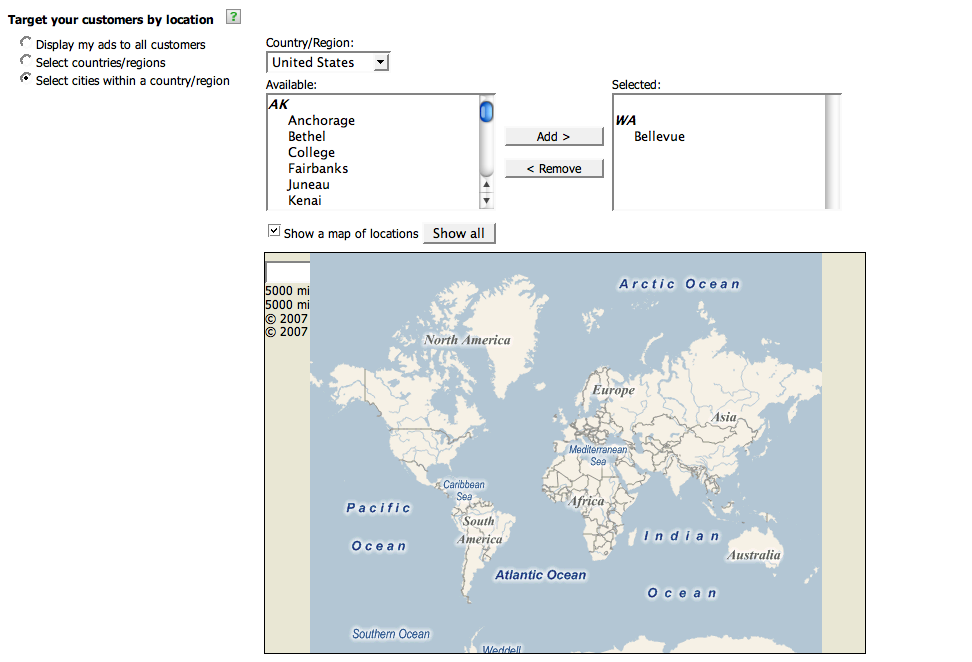
Once a city or cities have been selected for geotargeted search advertising, adCenter then provides a map of the targeted area.

Microsoft Adcenter Geotargeting Bellevue WA

Microsoft Adcenter Geotargeting Bellevue WA

I haven’t yet been able to get the adCenter map to display any of the locations of my geotargeted ads.

adCenter search advertising features still require further development before they will match the features and functionality already available from the other three major search advertising providers.

Web Display and Search Advertising Combined; Their Sum Greater Than Parts

August 22, 2008

Gian Fulgoni chairman of comScore, recently wrote about his firm’s research on the impact online display and search advertising have on in-store retail sales.

How does comScore measure the impact online advertising has on retail offline sales? According to Fulgoni, “using the comScore panel, off line sales impact can be measured by linking panelists’ exposure to online ads with their in-store buying (through the use of retailers’ loyalty card data).’

Fulgoni draws two interesting conclusions from comScore’s
research:

1. “Search advertising provides higher sales lift than display advertising, but when combined, the synergy provides the highest lift…”

comScore Shoplocal.com Lift

comScore Shoplocal.com Lift

Search and Display Ads Lift

2. “While search advertising results in a higher sales lift than display advertising among the people exposed to the ads, the number of people reached by display advertising is typically markedly higher than the number of people reached by search advertising …

comscore shoplocal.com reach

comscore shoplocal.com reach

Online Advertising Reach

For media buyers planning to increase their brand message reach and lift consider the following;

1. An online display advertising campaign often reaches further than a search advertising campaign but online display ads will have less lift than search ads.

2. Search advertising will have more lift than online display ads but search ads may not reach as far as online display advertising.

Brand managers buying either online display advertising or search advertising but not both online display advertising and search advertising are likely diluting their brand’s message power – and along with it the ability to maximize their return on either form of online advertising they may have invested in.

Google Ad Manager Service

March 13, 2008

While Microsoft is still trying to get its arms around Yahoo and its share of the online search and display advertising market, Google has taken one step to closer to consolidation of the online advertising market with the recent EU approval of their DoubleClick acquisition.

With its acquisition of DoubleClick and its roughly 60% share of the online display advertising market, Google has now created a dominant market share position in both the online display and search advertising markets.

Google’s challenge now remains vertical integration in both markets – greater penetration of search advertising sales within the online brand advertising market and deeper penetration within the small to medium size publishing segment within the online display advertising market.

To achieve its objectives in the online display advertising market, Google has announced its new service called the Google Ad Manager.

From the official Google Blog:

Google Ad Manager is a free, hosted ad and inventory management tool that can help publishers sell, schedule, deliver and measure their directly-sold and network-based ad inventory. It offers an intuitive and simple user experience with Google speed and a tagging process so publishers can spend more time working with their advertisers and less time on their ad management solution. And by providing detailed inventory forecasts and tracking at a very granular level, Ad Manager helps publishers maximize their inventory sell-through rates.”

The Google Ad Manager will both allow the small to medium size publisher to greater optimize its advertising inventory yield through access to advertising inventory tools previously only available through DoubleClick while also furthering Google’s pursuit to better serve its primary market – small to medium size businesses – now through the small to medium size publisher.

The Google Ad Manager Service:

Google Ad Manager

Microsoft and Yahoo vs. Google: The Battle for Audience and Keystrokes

February 7, 2008

The Redmond giant has sprung to its feet from its long and comfortable slumber.

Much like the browser business before it, Microsoft has realized it had better get into the search advertising business before its too late.

I think we all know who won the browser war. We also know how they did it.

Even with its proposed acquisition of Yahoo!, Microsoft may have already overslept and thus lost this battle.

On the surface this acquisition looks like a grab for a piece of the search advertising business.

However, just below the surface lie its real targets: the Internet audience and their keystrokes.

Internet Audience?

Keystrokes?

Both beachheads Microsoft has or has had control of nearly since their inception, keystrokes via the personal computer desktop and the Internet audience via browsers – not from birth but before the web’s infancy ended.

Like their importance to Microsoft’s franchise before, both have an equally and even greater importance going forward. Audience begets keystrokes and vice versa. However, It’s hard to control one if you don’t control the other.

Microsoft’s $44 billion offer to acquire Yahoo and its audience is an admission by Microsoft that if they aren’t able to augment their present audience now with an acquisition the size of Yahoo, they won’t ever be able to stem the audience gains being made by Google and their control of the largest and most valuable part of the internet audience – the search audience.

At this point, Microsoft’s not getting control of Yahoo’s audience is the single greatest risk facing their business – hence their offer price and the need to get the deal done. Maybe not today or tomorrow, but let unabated Microsoft faces continued losses in both audience and keystrokes.

Its not a market position Microsoft is familiar with or comfortable.

Why search is the most valuable audience on the Internet.

There are two types of audiences on the Internet. The old and familiar audience type, which is the one served and supported by display advertising.

Advertisers buy ads to reach an audience based on what content a publisher assembles to attract a particular audience. Ads are then priced and sold based on the desirability advertisers have in reaching that particular audience.

At any one time, a large percentage of the publisher’s audience is inactive – not interested in what the advertiser is selling.

Advertisers still have to pay to reach the publishers entire audience regardless of how many people may or may not be interested in the advertiser’s ads or products. Because display advertising is inefficient i.e., reaches more disinterested audience than audience of potential buyers – it sells for less and thus generates less income for publishers.

The other type of audience available to advertisers on the web is search advertising.

Unlike display advertising, search advertising reaches only an active audience – people who have explicitly requested advertisers information about their products or services – by their clicking on ads.

Search advertisers only incur costs to reach their audience when consumers click on their ads. Thus search advertising is significantly more efficient in delivering advertising messages to the exclusively active segment of the Internet audience – people who are actively searching for information.

By definition, search advertising only delivers advertisements to people actively seeking what the advertiser is advertising and selling. Because of this efficiency in targeting and delivery, search advertisers are able to reach more qualified prospects for less than through traditional media.

In turn, search advertising providers like Google are able to charge advertisers commensurate with the value the advertisers receive from reaching a efficiently targeted and active audience.

The result?

By my calculations, Google’s annualized gross revenue from advertising per visitor is roughly twice that of Yahoo’s and nearly four times Microsoft’s (gross advertising revenues divided by web property visits)

At a minimum, a search driven visit is worth at least twice – up to four times more than a non-search driven visit.

This is why Microsoft desperately needs Yahoo’s audience.

Although there are wide discrepancies over what percentage of search each company gets, Google receives between four to twenty times more search traffic than Microsoft and three to five times more search traffic than Yahoo, combined and assuming no market disruption – the two companies would still only generate one fourth to one half the search business of Google.

This acquisition also assumes Yahoo’s ad platform can continue to harvest one half the value Google does whether through Yahoo! or Microsoft’s search product without cultural distraction or interruption from the merger.

Even with their proposed clean room assembly, Microsoft’s acquisition of Yahoo! does not answer how they will make up difference (search volume + gross revenue per visitor).

By doubling their performance (revenue per visit) post merger to meet Google’s present level of performance, a MicroHoo search advertising business gross revenues per visitor would be half of Google’s.

In order for Microsoft to retain Yahoo’s audience, publishers and advertisers- the combined company will also need to produce:

Highly relevant search results for its audience, a functional ad platform for its advertisers, profitable ad distribution for its publishing partners and most importantly: a greater return on its advertisers’ investments.

Without which any new ad platform and search product may grab the attention of a larger audience and gain its keystrokes only to see it lost after they are unable to deliver what the internet audience has already come to expect, find and get from Google.

Of course, this also assumes Microsoft is somehow precluded from using its expanded platform and footprint to reroute ancillary chunks of audience to its new web properties acquired through the proposed acquisition along with their accompanying keystrokes.

In the absence thereof, there may be no stopping Google’s march.

Microsoft adCenter Advertising

June 27, 2007

Microsoft adCenter advertises its search engine advertising products via Google Adwords.

I wonder how much money Microsoft spends with Google to promote their search engine advertising products?

Microsoft adCenter Google Adwords