How else can an individual let alone a company engage in a conversation with any one without having first determined what topic is being discussed?
Indeed…
More from Google’s ThinkTech 2010 event in NYC on October 6, 2010 – Boost Your Signal!
What are Google AdWords Location Extensions?
Location extensions allow you to extend your Google AdWords campaigns by dynamically attaching your business address to your ads.
In addition to the description lines and URL that appear in your ad text, your AdWords ad can also display your business name, address, and telephone number.
This helps promote your business, brand, products, and services, and associates your business with a specific location of interest to the user.
Location extensions were originally activated from within the Settings section of AdWords campaigns.

Ad Extensions Campaign Settings
However, Ad Extensions have since been moved to the Tabs level in Campaigns.

Ad Extension Options
AdWords location extensions can be linked to a Google Places account or use a manually entered address.

Google AdWords Location Extension Statistics
Any advertising activity generated by location extensions also produces statistics in the AdWords advertisers account.
Location extensions when used properly can provide an additional level of differentiation and visibility at a time when and a place where searchers are searching for a local solution.

Google AdWords Location Extensions
With the advent of Google Place Search, won’t the practice of Place SEO soon follow?
Pounding away at national and local online marketing for longer than I care to remember, it now appears my work hasn’t been in vain.
In the sample Google Places page below (reached from an incognito browser), both my Google Adwords paid search ad and my Google Places listing sit atop Google’s new Places results page.

Place SEO
A quick check of several other keywords relevant to my business produced similar results.
As an added bonus, my expanded paid and organic place results occupy roughly 50% of the available screen real estate above the fold.
From a marketer’s perspective, it looks like everything has fallen into place – the right place.
After several years of uneven and inconsistent communications from the Google Local Business Center now Google Places – I finally got clarification to the Places dashboard message – “this listing does not comply with our policy of allowed terms.”
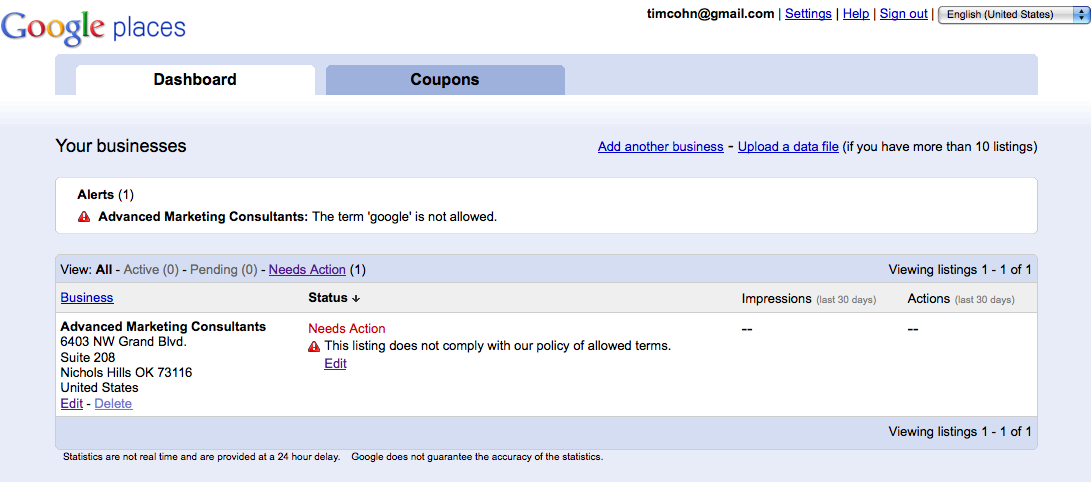
Google Places Policy of Allowed Terms
Although I had suspected for some time using the terms Google Adwords Qualified Individual and Google Adwords Professional in my business listing description field might have been problematic, Google never pointed me or anyone else for that matter to a list of terms they automatically reject.
Yet in today’s message Google revealed at least one word they don’t approve of in Google Places listings…
The word?
Google.
I have removed Google from my business description and resubmitted my listing.
It now appears my listing has been automatically approved after resubmitting.
However, the “Your Business Info” section of my Google Places listing still shows my listing is only 90% complete.

Google Places: Your Business Info
I guess my Google Places listing will always be a work in progress.
Heard about “remarketing” but don’t quite yet know what it is?
Watch this video from Google to learn what remarketing is and how to enable remarketing within your Google AdWords account.
To maintain my company’s new Google Certified Partner status, I had to take and pass the Search Advertising Fundamentals Exam.

Qualified Individual
I am pleased to have passed the exam and have my Google Certification Program account updated accordingly.
Google recently hosted its Think Real Estate Event in New York.
From the Google Think Real Estate invitation:
Opportunities are arising to reach consumers using more efficient marketing tactics, connecting with audiences by leveraging new media platforms, and establishing new relationships with innovative solutions to drive your business forward.
Watch the following video to learn more from Google about the next trends in local and mobile search.
I was surprised to find the following message about my “How To Move A Storage Shed” in my YouTube account today:

YouTube Partnership Program
What’s amazing about this video is I shot it on a fluke and it has received over 28,000 views to date.
To sign up for the YouTube Partnership program, a video producer must review YouTube’s instructions.

Instructions
To enter a revenue sharing agreement with YouTube, a video must meet the following criteria –

YouTube Revenue Sharing
Once a producer has accepted YouTube’s Video Monetization Agreement, they must link their video to a Google Adsense account and then answer some simple questions about their video.
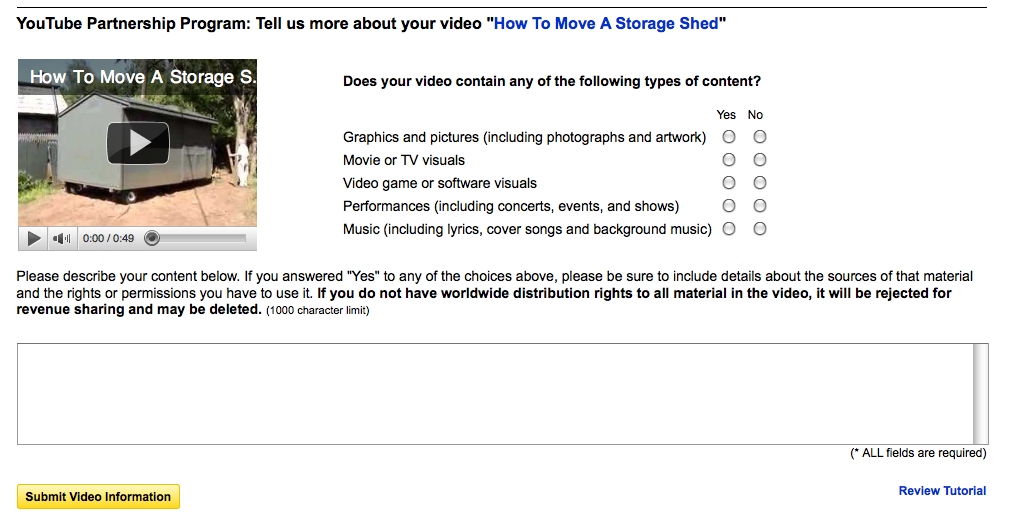
Video Monetization
Once a video has been successfully submitted for revenue sharing consideration and if it is approved, the video producer will start to see ads displayed next to their video.
Processing a video for consideration can take up to 2 weeks.
Here is the link to my new Advanced Marketing Consultants Google AdWords Certified Partner page.
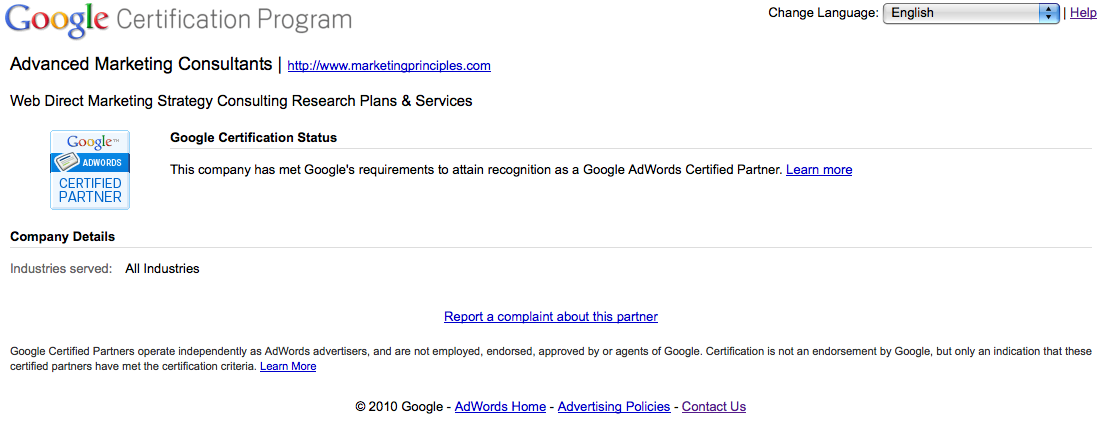
Google Certification Program Advanced Marketing Consultants
While the Google Adwords Certified Partner program is transitioning from the old system to the new one, Google Partner Search appears to be the only way I can get to the Advanced Marketing Consultants Google Certification Program verification page.
I am sure once the Google Certification Program team has got everything ready for the reported October 31, 2010 retirement date, most if not all of the remaining verification and connection details will have been resolved.
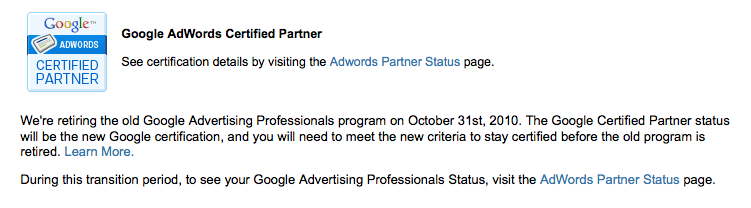
Google Advertising Professionals Program Retiring
I don’t know why Google chose October 31 for the transition date, but I am pretty sure they aren’t planning on providing any Google Partner costumes for those of us who have met the new program’s requirements.

 Search Marketing Communications
You must be logged in to post a comment.