Archive for February, 2008

Mobile Search and Reverse Business Telephone Number Lookup, a Visual 411

February 8, 2008

As local information requests are being keyed in from mobile devices, 411 and driving directions are becoming more visually rich and available via search.

Case in point: The business telephone number reverse lookup.

How does Microsoft’s Live render a reverse lookup for Microsoft’s own telephone number? Microsoft delivers the correct result along with the five previously mentioned view options: Road, Aerial, Hybrid, Bird’s Eye and Traffic. The map view does however default to Chicago, IL even though Microsoft is located in Bellevue, WA.

I can find the Microsoft campus on the map after scrolling over a couple thousand miles. I ran several more queries with each defaulting to the same Chicago starting point. I am not logged into a Microsoft account so I wouldn’t think it was based on my computers cookies or IP address which by the way is still several hundred miles south.

Evidently, Microsoft, Yahoo and Google all seem to generate their map results based on your past location specific searches.

Microsoft’s reverse lookup offers: 1 Click Directions, Add to collection, Send to Email, Mobile and GPS and Reviews. The send to GPS requires MSN Direct compatible navigation systems.

Reverse Business Lookup– 425-882-8080 Microsoft

Microsoft 425-882-8080

Microsoft 425-882-8080

A reverse lookup for Yahoo’s telephone number in Yahoo produces two results both of which are Yahoo locations. The map provides the same functionality found in their standard searches: Get Directions, Save for later, Send to phone and Write a review. If a web address is associated with the location it will be displayed too.

Reverse Business Lookup– 408-349-3300 Yahoo

Yahoo 408-349-3300

Yahoo 408-349-3300

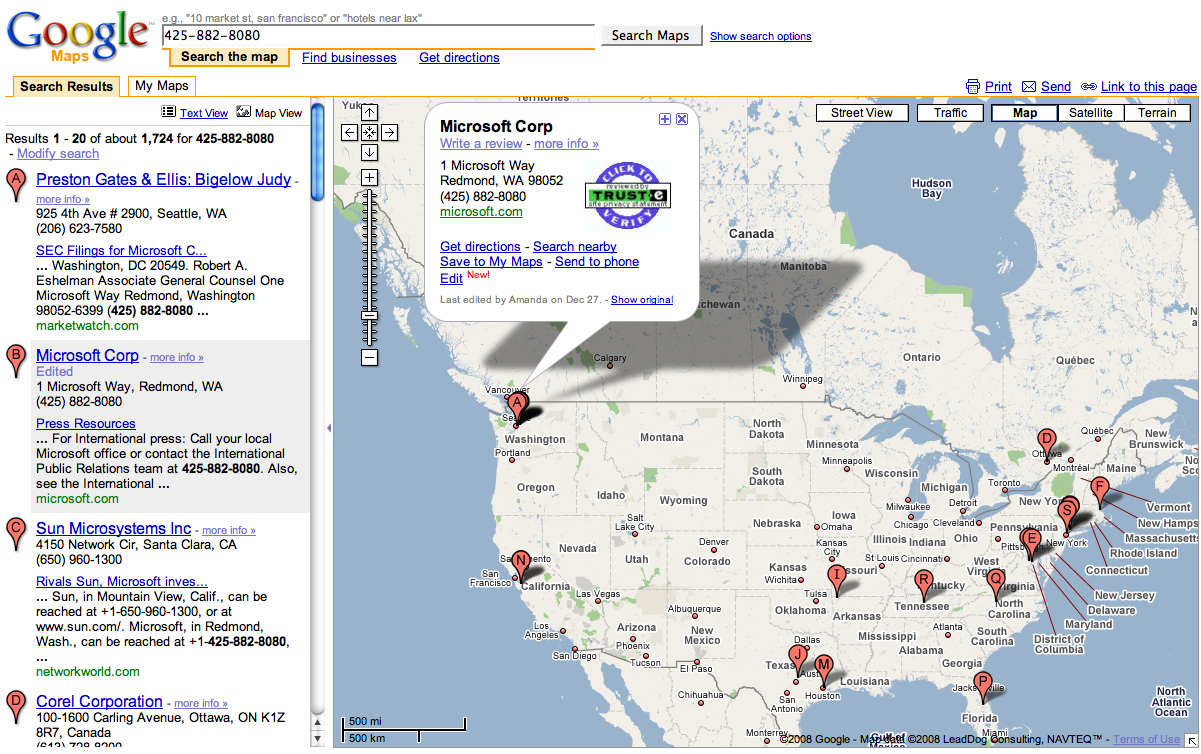
A search for Google’s telephone number yields the same five view options: Map, Street, Traffic, Satellite and Terrain Views as with the brand or business category search before. Additionally, Google provides a dialogue box with more options.

Searchers options are: Get directions, Search nearby, Street view, Save to My Maps, Send to phone and Edit. More information about the business and reviews are also one click away.

With “Search nearby” a searcher can locate additional businesses and services like finding Chinese takeout from their hotel.

Where Microsoft’s Bird’s Eye view appears to have bested Google’s satellite view, Google’s “street view” takes visualization to the next level.

With Google’s street view, Google provides eye level images of locations. It’s not available in every area yet. Coordination with volunteer picture geotagging projects may eventually speed the population of their street level image file.

Google’s new Edit feature lets anybody correct the location of a business. It also prompts business owners to “claim” their business in Google’s Local Business Center. These two options should eventually help them improve their data.

Reverse Business Lookup – 650-253-0000 Google

Google 650-253-0000

Google 650-253-0000

Google Street View

Google Street View

Edit Map Feature

Reverse Lookup Edit

By pushing more information out to users third screen (mobiles), Google, Microsoft and Yahoo regardless of their corporate status, have greater potential to attract ever-larger audiences and their keystrokes – a situation where all consumers ultimately win.

Before and After Picture: Local Search Engine Optimization in Oklahoma City

February 8, 2008

The following email came from a client who received a “targeted” search engine optimization services pitch from a search engine optimization salesman who was prospecting for clients.

I changed the search engine optimization company and client names.

This is after my optimization of their old website started “miraculously” producing over 4,000 web visitors per month and new business – telephone calls, online and in store sales – where none had came from before.

Clients amaze me!

Hi Tim-

What do you think about this e-mail? I thought this was what your website optimization was supposed to accomplish. Help?

[Preferred Client]

—–Original Message—–
From: [ABC SEO Company]

Sent: Wednesday, February 06, 2008 3:14 PM
To: Website owner
Subject: Attn: [Jane Doe] Regarding [preferredclient.com]

Hello [Jane],

I was recently looking through [ABC Consumer] magazine and saw your advertisement. I took a look at your website and found it very appealing. I decided to do a little research on Google to see if your website was on the first page.

I searched for “[general product term] Oklahoma City” and your site did not come up in the natural search results on Google. I then tried “[another general product term] Oklahoma City” and even “[and even another general product term] Oklahoma City” again with no results. Potential customers are currently using keyword phrases similar to these to search for a company like yours. [PreferredClient.com] could and should be on the first page of major search engines like Google, Yahoo and MSN.

I work for ABC SEO Company, a search engine marketing firm. We help position websites on multiple search engines so you will come up for targeted keywords. It is surprising how many more customers you can attract with online marketing. If you have a couple minutes I would be happy to give you some information on how our services could benefit your business.

Please let me know if you have a few minutes to talk.

Best Regards,

ABC SEO Salesman

Research and Development
ABC SEO Salesman

PH: xxx-xxx-xxxx
Fax: xxx-xxx-xxxx

My response:

Hi [Preferred Client],

Well, my work sent 4,127 visitors from 11 different search engines between January 6, 2008 and February 5, 2008 via 1,528 keywords whereas prior to my work your site received 0 visitors monthly via 0 search engines.

During the same time period the visitors who came to your site via the 11 search engines on average viewed 13.46 pages each and spent 3:48 of their time on your site.

84.01% of the 4,127 visitors who arrived at your site via search engines had never been to the [PreferredClient.com] website before.

Search Engine Optimization

I don’t know whether the progression from 0 searches to 1, 2, 3 searches etc. is considered arithmetic, geometric or quadratic but I think the difference is quantifiable.

I also don’t know how many searches he thinks his recommendations would yield daily, weekly, monthly or yearly but I would definitely ask him for his estimate.

I think all you can do when you receive these type of emails is ask the sender what kind of search traffic they estimate their recommendations will deliver and then weigh their response with what your before and after search experience has been and is now.

I think only then would you have the necessary information needed for deciding whether pursuing their recommendations or not would be in the best interest of your business.

Wouldn’t you agree?

Let me know if there is anything else I can do for you.

Thanks and all the best,

Tim Cohn

Microsoft and Yahoo vs. Google: The Battle for Audience and Keystrokes

February 7, 2008

The Redmond giant has sprung to its feet from its long and comfortable slumber.

Much like the browser business before it, Microsoft has realized it had better get into the search advertising business before its too late.

I think we all know who won the browser war. We also know how they did it.

Even with its proposed acquisition of Yahoo!, Microsoft may have already overslept and thus lost this battle.

On the surface this acquisition looks like a grab for a piece of the search advertising business.

However, just below the surface lie its real targets: the Internet audience and their keystrokes.

Internet Audience?

Keystrokes?

Both beachheads Microsoft has or has had control of nearly since their inception, keystrokes via the personal computer desktop and the Internet audience via browsers – not from birth but before the web’s infancy ended.

Like their importance to Microsoft’s franchise before, both have an equally and even greater importance going forward. Audience begets keystrokes and vice versa. However, It’s hard to control one if you don’t control the other.

Microsoft’s $44 billion offer to acquire Yahoo and its audience is an admission by Microsoft that if they aren’t able to augment their present audience now with an acquisition the size of Yahoo, they won’t ever be able to stem the audience gains being made by Google and their control of the largest and most valuable part of the internet audience – the search audience.

At this point, Microsoft’s not getting control of Yahoo’s audience is the single greatest risk facing their business – hence their offer price and the need to get the deal done. Maybe not today or tomorrow, but let unabated Microsoft faces continued losses in both audience and keystrokes.

Its not a market position Microsoft is familiar with or comfortable.

Why search is the most valuable audience on the Internet.

There are two types of audiences on the Internet. The old and familiar audience type, which is the one served and supported by display advertising.

Advertisers buy ads to reach an audience based on what content a publisher assembles to attract a particular audience. Ads are then priced and sold based on the desirability advertisers have in reaching that particular audience.

At any one time, a large percentage of the publisher’s audience is inactive – not interested in what the advertiser is selling.

Advertisers still have to pay to reach the publishers entire audience regardless of how many people may or may not be interested in the advertiser’s ads or products. Because display advertising is inefficient i.e., reaches more disinterested audience than audience of potential buyers – it sells for less and thus generates less income for publishers.

The other type of audience available to advertisers on the web is search advertising.

Unlike display advertising, search advertising reaches only an active audience – people who have explicitly requested advertisers information about their products or services – by their clicking on ads.

Search advertisers only incur costs to reach their audience when consumers click on their ads. Thus search advertising is significantly more efficient in delivering advertising messages to the exclusively active segment of the Internet audience – people who are actively searching for information.

By definition, search advertising only delivers advertisements to people actively seeking what the advertiser is advertising and selling. Because of this efficiency in targeting and delivery, search advertisers are able to reach more qualified prospects for less than through traditional media.

In turn, search advertising providers like Google are able to charge advertisers commensurate with the value the advertisers receive from reaching a efficiently targeted and active audience.

The result?

By my calculations, Google’s annualized gross revenue from advertising per visitor is roughly twice that of Yahoo’s and nearly four times Microsoft’s (gross advertising revenues divided by web property visits)

At a minimum, a search driven visit is worth at least twice – up to four times more than a non-search driven visit.

This is why Microsoft desperately needs Yahoo’s audience.

Although there are wide discrepancies over what percentage of search each company gets, Google receives between four to twenty times more search traffic than Microsoft and three to five times more search traffic than Yahoo, combined and assuming no market disruption – the two companies would still only generate one fourth to one half the search business of Google.

This acquisition also assumes Yahoo’s ad platform can continue to harvest one half the value Google does whether through Yahoo! or Microsoft’s search product without cultural distraction or interruption from the merger.

Even with their proposed clean room assembly, Microsoft’s acquisition of Yahoo! does not answer how they will make up difference (search volume + gross revenue per visitor).

By doubling their performance (revenue per visit) post merger to meet Google’s present level of performance, a MicroHoo search advertising business gross revenues per visitor would be half of Google’s.

In order for Microsoft to retain Yahoo’s audience, publishers and advertisers- the combined company will also need to produce:

Highly relevant search results for its audience, a functional ad platform for its advertisers, profitable ad distribution for its publishing partners and most importantly: a greater return on its advertisers’ investments.

Without which any new ad platform and search product may grab the attention of a larger audience and gain its keystrokes only to see it lost after they are unable to deliver what the internet audience has already come to expect, find and get from Google.

Of course, this also assumes Microsoft is somehow precluded from using its expanded platform and footprint to reroute ancillary chunks of audience to its new web properties acquired through the proposed acquisition along with their accompanying keystrokes.

In the absence thereof, there may be no stopping Google’s march.

Google Advertising Professional Video

February 6, 2008

As a Google Advertising Professional, I use the Google Adwords keyword suggestion tool daily.

Here is my Google Adwords video showing how to use  keyword suggestion tool and a link to the Google Adwords external keyword suggestion tool.

SalesGenie.com Super Bowl Ad

February 5, 2008

97.5 million viewers on average watched Super Bowl XLII.

Advertisers paid $2,700,000 for a 30 second spot. The advertisers effectively paid .027 per impression to reach the second largest television audience ever recorded.

Only large brands or smaller ones betting the company can afford Super Bowl commercials.

An important question for any business contemplating making such a large one-time purchase is – what percentage of the audience is inactive? What percentage of the audience is unreceptive to my company and its offer?

80% inactive audience?

90% inactive audience?

99.99% inactive audience?

100% inactive audience?

More importantly, what percentage of the television audience is an active audience? An audience who will at some point now or in the future be interested in what I am selling let alone buy it?

100% active audience?

10% active audience?

1% active audience?

0% active audience?

It would be an interesting case study to see what amount – if any – Salesgenie.com recoups from its Super Bowl XLII brand messaging and offer investment.

Alternatively with the same $2,700,000, Salesgenie.com could have bought 2,700,000 active audience members @ $1.00 clicks through a Google Advertising Professional.

Even bidding and paying $5.00 a click, SaleGenie.com could have reached and connected with 540,000 American salesmen looking for leads.

I wonder how many sales people acted on their Super Bowl ad? 5 million? I doubt it. There probably aren’t 5 million sales leads buyers in the United States.

What are the odds they reached, fielded let alone converted 540,000 leads (.0055 of the entire Super Bowl audience) from their Super Bowl XLII ad?

Did SalesGenie.com advertising gamble beat the odds or get beaten by them?