In this video, learn more about Enhanced CPC, an automatic Google AdWords bid management feature designed to increase your conversions while lowering your costs.
Archive for August, 2010
The Three Types of Media
August 20, 2010Its Friday afternoon and all I can muster at this point is this fine hand drawn sketch from my iPad of the three types of media.
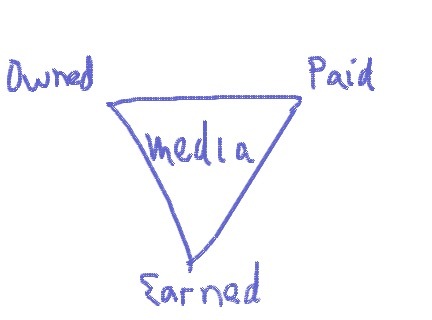
Three Types of Media
Taking artistic license, I hereby dub this image – the Media Cone.
GeoTextual: Geo Targeted Contextual Advertising
August 19, 2010After reading ad nauseam about Facebook Places and how their new service is going to do this or do that, I have reached a conclusion or two.
The first is that regardless of what the feature does for consumers, Places will become the basis of GeoTextual advertising.
Geotextual?
Since Facebook is a content display platform -not a search appliance – the best they can hope for vis-a-vis reaching an audience with relevant advertising is contextual and maybe eventually behavioral advertising.
Short of all out behavioral targeting and in order to further woo brands to its advertising platform – Facebook will need to provide additional audience coordinates through user “features” like Places.
When they do, Facebook will have content and consumer location but not their intent.
Short of consumer intent they will have to sell it as GeoTextually targeted and thus “relevant” advertising.
Whether the product as decribed materializes anytime soon remains to be seen.
Explicit Core Search Share: Not All Searches Are Created Equal
August 18, 2010From comScore:
RESTON, VA, August 17, 2010 – comScore, Inc. (NASDAQ: SCOR), a leader in measuring the digital world, today released its monthly comScore qSearch analysis of the U.S. search marketplace. With the July 2010 qSearch data release, comScore will now be reporting “Explicit Core Search” results alongside its standard “Total Core Search” results in order to provide transparency around the impact of contextually driven searches. For a more detailed explanation behind this reporting enhancement, please refer to the following blog post: http://blog.comscore.com/2010/08/comscore_explicit_core_search.html

Explicit Core Search Share
In general, comScore added the Explicit Core Search Share label to combat both Microsoft and Yahoo from inflating their search market share through inclusion of contextually generated searches – not search engine originated search queries – in their search market share claims.
You can’t blame Microsoft and Yahoo for trying to get their contextually generated searches counted within their search properties but then that wouldn’t be playing fair now would it?
Congratulations go to comScore for catching, announcing and reporting the distinction between the two types of searches in their rankings.
More Google Places Confusion
August 17, 2010As mentioned here previously, my Google business listing has been missing in action and under review for at least a year.
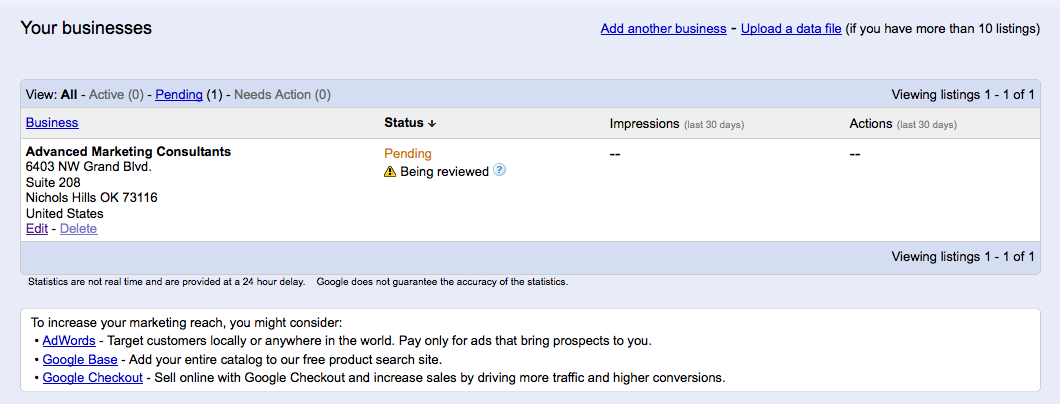
Google Places Status
This after having my business listing appear as a one box result in Google search results for as long as I can remember.
I recently resubmitted my listing to the new and improved Google Local Business Center project now known as Google Places.
In doing so I also agreed to receive their newsletter and any other materials they may send out.
Today I received the August 2010 Google Places newsletter.
Nothing surprising there.
What is surprising is how two thirds of the newsletter is devoted to Google Places optimization tips.
All well and good if your Google Places account is active.
Instead of sharing tips for how to optimize Places listings, Google Places should focus on optimizing their own listings application and approval process.
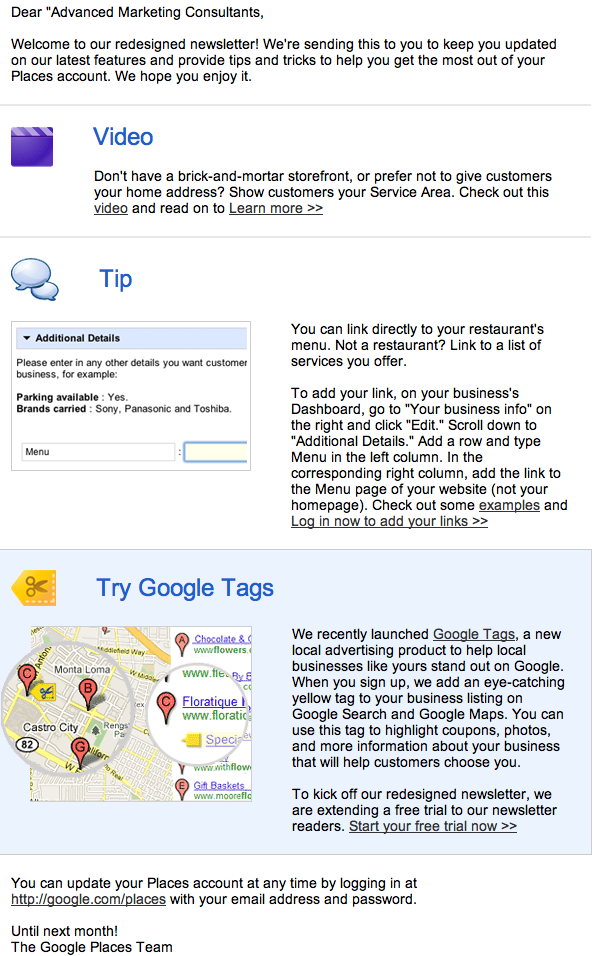
Google Places August 2010 Newsletter
To add insult to injury, the Google Tags free advertising offer doesn’t take into consideration or account for Google Places accounts already in an indefinite listing approval queue.

Google Places Offer
The Google Tags offer presupposes only new business listings are receiving the newsletter.
Not in my case Google Places.
Google Research: Consumers Plan To Spend The Same Or More This Holiday Season
August 16, 2010From Google Research:
Google’s latest research shows that consumers are feeling good about the holiday season: 64% of shoppers plan to spend the same or more this holiday season as they spent in 2009.
The following categories are the top ten which consumers plan to spend more this holiday season than last year:

Top Categories Consumers Plan To Spend More On
Web Traffic Formula
August 15, 2010Jonah Peretti of BuzzFeed presented his ideas for creating compelling websites and I thought this slide was particularly instructive.

Traffic Formula
Peretti argues targeting an audience segment with Obsessive-Compulsive Personality Disorder is key to success for Wikipedia, online games and blog comments.
I think Peretti is correct.
I also think Peretti thesis applies to any high traffic web property.
Why?
In the final analysis, content must resonate with its audience and content targeting an obsessed audience is all but guaranteed to be heard.
Google Webmaster Tools Disconnect Between Data and Search Engine Results
August 14, 2010Ever wonder why the search queries report in Webmaster Tools shows some keywords ranking yet after searching for them they are nowhere to be found?
Google’e Matt Cutts provides a comprehensive answer to this question in the video below.
Yahoo Bing Search Alliance Update
August 13, 2010From the Search Alliance Transition team:
Soon, you’ll need to either create a new adCenter account, or link an existing adCenter account to your Yahoo! Search Marketing account. Later this month, you’ll see an “adCenter” tab within your Yahoo! Search Marketing account. Clicking there will take you to the beginning of the account transition process, where we’ll walk you through the simple steps to create or link accounts.
Yippee!
I can’t wait…
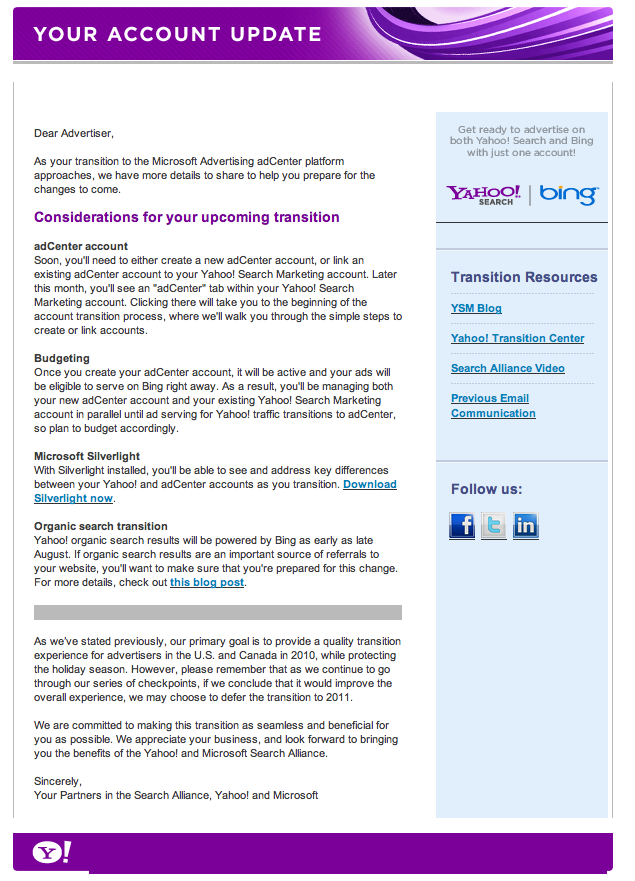
Search Alliance Update
I am sure the professionals at both Yahoo and Bing will be doing everything in their power to make sure the transition goes off without a hitch – I just hope the new Yahoo Bing Search Alliance doesn’t end up costing advertisers like myself more time and money.
Google Insights For Search: JetBlue Traffic Takes Off
August 12, 2010According to Google Insights for Search, web search traffic for JetBlue has really taken off since flight attendant Steven Slater quit his job.

Google Insights for Search - JetBlue
It appears JetBlue has received a five-fold increase in search traffic since Slater “quit” his job.

 Search Marketing Communications
You must be logged in to post a comment.