Microsoft adCenter advertises its search engine advertising products via Google Adwords.
I wonder how much money Microsoft spends with Google to promote their search engine advertising products?

Microsoft adCenter advertises its search engine advertising products via Google Adwords.
I wonder how much money Microsoft spends with Google to promote their search engine advertising products?
Are the parents of profit.
The internet is rife with both.
Free has been declared one of the most powerful words in a marketers’ arsenal.
Whether or not to use “free” or not in your marketing communications is often debated.
Although I haven’t tested it yet, I believe a business could offer free dead cats and get a 1% response rate.
I received the following free website marketing analysis from a gentlemen in Sri Lanka this morning.
I would be happy to fulfill his request.
However in order to provide him with a marketing analysis of his web site, he must first have one!
Submitted on Tuesday 6/26/2007 7:58:48 AM
(Free Website Marketability Analysis Request)
Free Website Marketability Analysis Request from:
Company name: jagoda
Contact: 94773295264
Email Address: jagoda@cdl.lk
Phone Number: 94773295264
Address: 34/1 mowbray lane , modara
City: colombo 15
State: colombo
Postal Code: 00000
Country: sri lanka
Website Address: no
I am amazed at some of the comments and inquiries my sites receive.
Lately I have been receiving a slew of email spam for top placement in Google.
However, the following was entered by hand at marketingprinciples.com.
The irony is that the salesman who’s name and company I have changed to protect the guilty, found my site via a search engine!
Submitted on Tuesday 6/26/2007 8:36:31 AM
(Profitable Internet Marketing)
“Joe Blow” sends the following:
Dear Website Owner, If I could get you five times the RELEVANT traffic at a substantially reduced cost would you be interested?
“Acme Optimizers” can place your website on top of the Natural Listings on Google, Yahoo and MSN.
Our Search Engine Optimization team delivers more top rankings than anyone else and we can prove it. We do not use “link farms” or “black hat” methods that Google and the other search engines frown upon and can use to de-list or ban your site.
The techniques are proprietary, involving some valuable closely held trade secrets. Our prices are less than half of what other companies charge.
I would be happy to send you a proposal using the top search phrases for your area of expertise. Please contact me at your convenience so I can start saving you some money.
Please do not hesitate to email or call me if you would like further information.
Sincerely,
“Joe Blow”
Executive Vice President
“Acme Optimizers”
123 Main Street
Anytown, USA 98765
Toll Free: 1-800-Optimizers
joeblow@gmail.com
Profitable Internet Marketing
“Customers don’t always know what they want. The decline in coffee-drinking was due to the fact that most of the coffee people bought was stale and they weren’t enjoying it. Once they tasted ours and experienced what we call “the third place”… a gathering place between home and work where they were treated with respect… they found we were filling a need they didn’t know they had.” Howard Schultz – Starbucks
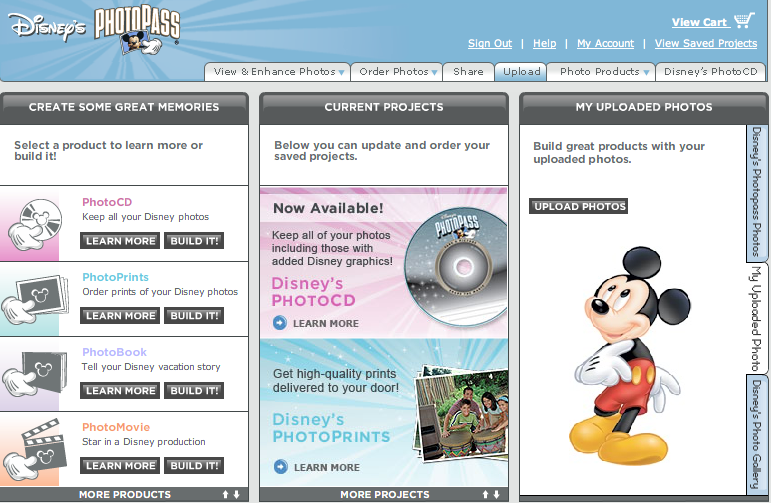
In a previous post I wrote about how I was unable to access the DisneyPhotoPass.com site.
I have since been able to get in and try the site out.
The service has some neat features I haven’t yet found in the other photography lab sites I have studied.
Although the site still runs a little slow and doesn’t work with my Mac + Firefox, the Disney Photo Pass site appears to be best of breed in the photo marketing industry.
Their most promising feature is the PhotoMovie. You can drag and drop up to one hundred photos into their movie builder and “star” along side a cast of Disney characters.

Is it any wonder GoDaddy.com is the largest domain registrar?
Today I received the following email offer from Network Solutions after I had already bought my domain names for the day from GoDaddy.

I am sure there are compelling reasons to pay twice as much to register your domains at Network Solutions than at GoDaddy.
Since Network Solutions hasn’t been able to convey to me exactly what those reasons are, I will continue to register my domains with GoDaddy.

According to a Chinese fortune cookie I once received, “Valuable things aren’t cheap and cheap things are of no value.”
The trick to discovering and capturing value is to acquire it before the market has fully recognized and priced it.
If there is any one group of people on the planet who know market value as well as Wall Street does I would have to guess it would be us folks who operate in both the search engine marketing and domain industries.
DotSauce.com reports Mike Mann and his firm WashingtonVC have acquired Seo.com for $5 million.
With DNJournal’s report of Gary Kremen’s Sex.com selling for $12 million, the importance of domain ownership and its relevance in a search addicted society have never been greater.
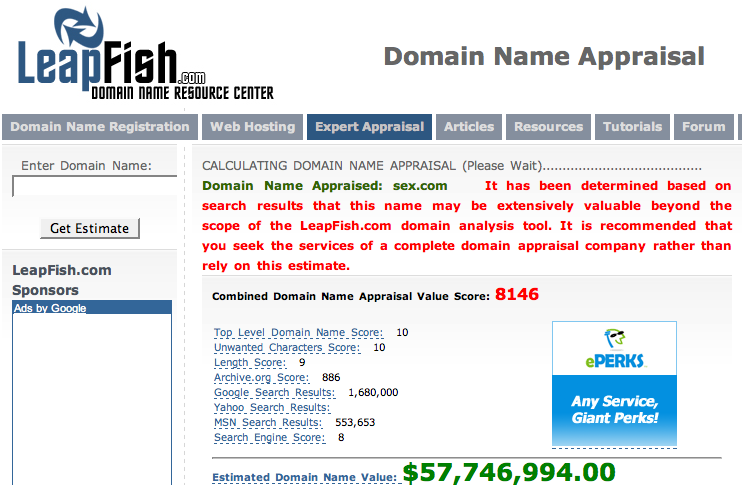
To get a rough idea of what your domain’s potential market value check out the new domain name appraisal tool from LeapFish.com
Although a domain is only worth what someone else is willing to pay for it, I think the Leap Fish free domain appraisal tool is off to a good start.
When the tool is able to calculate and appraise multivariate data, they will really have something of value.
The following are Leap Fish appraisals for the domains mentioned above:

Came across YouChoose.net a site that “Turns Passions Into Actions”.
What caught my attention initially was their petition “Stop Domain Name Parking and Cybersquatting.”
It will be interesting to learn which of their users “Passions” becomes the first whose petition creates the desired result.

The following is the speech Bill Gates gave as principal speaker at the Afternoon Exercises during Harvard’s 356th Commencement on June 7, 2007. Gates is a member of the Harvard College Class of 1977, which celebrated its 30th reunion during Commencement Week.
I had my thirteen-year-old son William read Mr. Gates speech to his nine year old brother Edward and I on a recent trip to our lake house. It didn’t take him too long to read and I believe it left a favorable impression on both of them.
In his speech Gates describes his four-step process for identifying and solving complex problems:
1. Determine a goal
2. Find the highest-leverage approach
3. Discover the ideal technology for that approach
4. Make the smartest application of the technology that you already have — whether it’s something sophisticated or simple.
I found Gates formula unique in that he makes finding the “highest-leverage approach” a requisite for developing sustainable solutions.
It also reminds me of the Archimedes quote:
“Give me a lever long enough and a fulcrum on which to place it, and I shall move the world.”
By Bill Gates, 06/07/07
President Bok, former President Rudenstine, incoming President Faust, members of the Harvard Corporation and the Board of Overseers, members of the faculty, parents, and especially, the graduates:
I’ve been waiting more than 30 years to say this: “Dad, I always told you I’d come back and get my degree.”
I want to thank Harvard for this timely honor. I’ll be changing my job next year … and it will be nice to finally have a college degree on my résumé.
I applaud the graduates today for taking a much more direct route to your degrees. For my part, I’m just happy that the Crimson has called me “Harvard’s most successful dropout.” I guess that makes me valedictorian of my own special class … I did the best of everyone who failed.
But I also want to be recognized as the guy who got Steve Ballmer to drop out of business school. I’m a bad influence. That’s why I was invited to speak at your graduation. If I had spoken at your orientation, fewer of you might be here today.
Harvard was just a phenomenal experience for me. Academic life was fascinating. I used to sit in on lots of classes I hadn’t even signed up for. And dorm life was terrific. I lived up at Radcliffe, in Currier House. There were always lots of people in my dorm room late at night discussing things, because everyone knew I didn’t worry about getting up in the morning. That’s how I came to be the leader of the antisocial group. We clung to each other as a way of validating our rejection of all those social people.
Radcliffe was a great place to live. There were more women up there, and most of the guys were science-math types. That combination offered me the best odds, if you know what I mean. This is where I learned the sad lesson that improving your odds doesn’t guarantee success.
One of my biggest memories of Harvard came in January 1975, when I made a call from Currier House to a company in Albuquerque that had begun making the world’s first personal computers. I offered to sell them software.
I worried that they would realize I was just a student in a dorm and hang up on me. Instead they said: “We’re not quite ready, come see us in a month,” which was a good thing, because we hadn’t written the software yet. From that moment, I worked day and night on this little extra credit project that marked the end of my college education and the beginning of a remarkable journey with Microsoft.
What I remember above all about Harvard was being in the midst of so much energy and intelligence. It could be exhilarating, intimidating, sometimes even discouraging, but always challenging. It was an amazing privilege – and though I left early, I was transformed by my years at Harvard, the friendships I made, and the ideas I worked on.
But taking a serious look back … I do have one big regret.
I left Harvard with no real awareness of the awful inequities in the world – the appalling disparities of health, and wealth, and opportunity that condemn millions of people to lives of despair.
I learned a lot here at Harvard about new ideas in economics and politics. I got great exposure to the advances being made in the sciences.
But humanity’s greatest advances are not in its discoveries – but in how those discoveries are applied to reduce inequity. Whether through democracy, strong public education, quality health care, or broad economic opportunity – reducing inequity is the highest human achievement.
I left campus knowing little about the millions of young people cheated out of educational opportunities here in this country. And I knew nothing about the millions of people living in unspeakable poverty and disease in developing countries.
It took me decades to find out.
You graduates came to Harvard at a different time. You know more about the world’s inequities than the classes that came before. In your years here, I hope you’ve had a chance to think about how – in this age of accelerating technology – we can finally take on these inequities, and we can solve them.
Imagine, just for the sake of discussion, that you had a few hours a week and a few dollars a month to donate to a cause – and you wanted to spend that time and money where it would have the greatest impact in saving and improving lives. Where would you spend it?
For Melinda and for me, the challenge is the same: how can we do the most good for the greatest number with the resources we have.
During our discussions on this question, Melinda and I read an article about the millions of children who were dying every year in poor countries from diseases that we had long ago made harmless in this country. Measles, malaria, pneumonia, hepatitis B, yellow fever. One disease I had never even heard of, rotavirus, was killing half a million kids each year – none of them in the United States.
We were shocked. We had just assumed that if millions of children were dying and they could be saved, the world would make it a priority to discover and deliver the medicines to save them. But it did not. For under a dollar, there were interventions that could save lives that just weren’t being delivered.
If you believe that every life has equal value, it’s revolting to learn that some lives are seen as worth saving and others are not. We said to ourselves: “This can’t be true. But if it is true, it deserves to be the priority of our giving.”
So we began our work in the same way anyone here would begin it. We asked: “How could the world let these children die?”
The answer is simple, and harsh. The market did not reward saving the lives of these children, and governments did not subsidize it. So the children died because their mothers and their fathers had no power in the market and no voice in the system.
But you and I have both.
We can make market forces work better for the poor if we can develop a more creative capitalism – if we can stretch the reach of market forces so that more people can make a profit, or at least make a living, serving people who are suffering from the worst inequities. We also can press governments around the world to spend taxpayer money in ways that better reflect the values of the people who pay the taxes.
If we can find approaches that meet the needs of the poor in ways that generate profits for business and votes for politicians, we will have found a sustainable way to reduce inequity in the world. This task is open-ended. It can never be finished. But a conscious effort to answer this challenge will change the world.
I am optimistic that we can do this, but I talk to skeptics who claim there is no hope. They say: “Inequity has been with us since the beginning, and will be with us till the end – because people just … don’t … care.” I completely disagree.
I believe we have more caring than we know what to do with.
All of us here in this Yard, at one time or another, have seen human tragedies that broke our hearts, and yet we did nothing – not because we didn’t care, but because we didn’t know what to do. If we had known how to help, we would have acted.
The barrier to change is not too little caring; it is too much complexity.
To turn caring into action, we need to see a problem, see a solution, and see the impact. But complexity blocks all three steps.
Even with the advent of the Internet and 24-hour news, it is still a complex enterprise to get people to truly see the problems. When an airplane crashes, officials immediately call a press conference. They promise to investigate, determine the cause, and prevent similar crashes in the future.
But if the officials were brutally honest, they would say: “Of all the people in the world who died today from preventable causes, one half of one percent of them were on this plane. We’re determined to do everything possible to solve the problem that took the lives of the one half of one percent.”
The bigger problem is not the plane crash, but the millions of preventable deaths.
We don’t read much about these deaths. The media covers what’s new – and millions of people dying is nothing new. So it stays in the background, where it’s easier to ignore. But even when we do see it or read about it, it’s difficult to keep our eyes on the problem. It’s hard to look at suffering if the situation is so complex that we don’t know how to help. And so we look away.
If we can really see a problem, which is the first step, we come to the second step: cutting through the complexity to find a solution.
Finding solutions is essential if we want to make the most of our caring. If we have clear and proven answers anytime an organization or individual asks “How can I help?,” then we can get action – and we can make sure that none of the caring in the world is wasted. But complexity makes it hard to mark a path of action for everyone who cares — and that makes it hard for their caring to matter.
Cutting through complexity to find a solution runs through four predictable stages: determine a goal, find the highest-leverage approach, discover the ideal technology for that approach, and in the meantime, make the smartest application of the technology that you already have — whether it’s something sophisticated, like a drug, or something simpler, like a bednet.
The AIDS epidemic offers an example. The broad goal, of course, is to end the disease. The highest-leverage approach is prevention. The ideal technology would be a vaccine that gives lifetime immunity with a single dose. So governments, drug companies, and foundations fund vaccine research. But their work is likely to take more than a decade, so in the meantime, we have to work with what we have in hand – and the best prevention approach we have now is getting people to avoid risky behavior.
Pursuing that goal starts the four-step cycle again. This is the pattern. The crucial thing is to never stop thinking and working – and never do what we did with malaria and tuberculosis in the 20th century – which is to surrender to complexity and quit.
The final step – after seeing the problem and finding an approach – is to measure the impact of your work and share your successes and failures so that others learn from your efforts.
You have to have the statistics, of course. You have to be able to show that a program is vaccinating millions more children. You have to be able to show a decline in the number of children dying from these diseases. This is essential not just to improve the program, but also to help draw more investment from business and government.
But if you want to inspire people to participate, you have to show more than numbers; you have to convey the human impact of the work – so people can feel what saving a life means to the families affected.
I remember going to Davos some years back and sitting on a global health panel that was discussing ways to save millions of lives. Millions! Think of the thrill of saving just one person’s life – then multiply that by millions. … Yet this was the most boring panel I’ve ever been on – ever. So boring even I couldn’t bear it.
What made that experience especially striking was that I had just come from an event where we were introducing version 13 of some piece of software, and we had people jumping and shouting with excitement. I love getting people excited about software – but why can’t we generate even more excitement for saving lives?
You can’t get people excited unless you can help them see and feel the impact. And how you do that – is a complex question.
Still, I’m optimistic. Yes, inequity has been with us forever, but the new tools we have to cut through complexity have not been with us forever. They are new – they can help us make the most of our caring – and that’s why the future can be different from the past.
The defining and ongoing innovations of this age – biotechnology, the computer, the Internet – give us a chance we’ve never had before to end extreme poverty and end death from preventable disease.
Sixty years ago, George Marshall came to this commencement and announced a plan to assist the nations of post-war Europe. He said: “I think one difficulty is that the problem is one of such enormous complexity that the very mass of facts presented to the public by press and radio make it exceedingly difficult for the man in the street to reach a clear appraisement of the situation. It is virtually impossible at this distance to grasp at all the real significance of the situation.”
Thirty years after Marshall made his address, as my class graduated without me, technology was emerging that would make the world smaller, more open, more visible, less distant.
The emergence of low-cost personal computers gave rise to a powerful network that has transformed opportunities for learning and communicating.
The magical thing about this network is not just that it collapses distance and makes everyone your neighbor. It also dramatically increases the number of brilliant minds we can have working together on the same problem – and that scales up the rate of innovation to a staggering degree.
At the same time, for every person in the world who has access to this technology, five people don’t. That means many creative minds are left out of this discussion — smart people with practical intelligence and relevant experience who don’t have the technology to hone their talents or contribute their ideas to the world.
We need as many people as possible to have access to this technology, because these advances are triggering a revolution in what human beings can do for one another. They are making it possible not just for national governments, but for universities, corporations, smaller organizations, and even individuals to see problems, see approaches, and measure the impact of their efforts to address the hunger, poverty, and desperation George Marshall spoke of 60 years ago.
Members of the Harvard Family: Here in the Yard is one of the great collections of intellectual talent in the world.
What for?
There is no question that the faculty, the alumni, the students, and the benefactors of Harvard have used their power to improve the lives of people here and around the world. But can we do more? Can Harvard dedicate its intellect to improving the lives of people who will never even hear its name?
Let me make a request of the deans and the professors – the intellectual leaders here at Harvard: As you hire new faculty, award tenure, review curriculum, and determine degree requirements, please ask yourselves:
Should our best minds be dedicated to solving our biggest problems?
Should Harvard encourage its faculty to take on the world’s worst inequities? Should Harvard students learn about the depth of global poverty … the prevalence of world hunger … the scarcity of clean water …the girls kept out of school … the children who die from diseases we can cure?
Should the world’s most privileged people learn about the lives of the world’s least privileged?
These are not rhetorical questions – you will answer with your policies.
My mother, who was filled with pride the day I was admitted here – never stopped pressing me to do more for others. A few days before my wedding, she hosted a bridal event, at which she read aloud a letter about marriage that she had written to Melinda. My mother was very ill with cancer at the time, but she saw one more opportunity to deliver her message, and at the close of the letter she said: “From those to whom much is given, much is expected.”
When you consider what those of us here in this Yard have been given – in talent, privilege, and opportunity – there is almost no limit to what the world has a right to expect from us.
In line with the promise of this age, I want to exhort each of the graduates here to take on an issue – a complex problem, a deep inequity, and become a specialist on it. If you make it the focus of your career, that would be phenomenal. But you don’t have to do that to make an impact. For a few hours every week, you can use the growing power of the Internet to get informed, find others with the same interests, see the barriers, and find ways to cut through them.
Don’t let complexity stop you. Be activists. Take on the big inequities. It will be one of the great experiences of your lives.
You graduates are coming of age in an amazing time. As you leave Harvard, you have technology that members of my class never had. You have awareness of global inequity, which we did not have. And with that awareness, you likely also have an informed conscience that will torment you if you abandon these people whose lives you could change with very little effort. You have more than we had; you must start sooner, and carry on longer.
Knowing what you know, how could you not?
And I hope you will come back here to Harvard 30 years from now and reflect on what you have done with your talent and your energy. I hope you will judge yourselves not on your professional accomplishments alone, but also on how well you have addressed the world’s deepest inequities … on how well you treated people a world away who have nothing in common with you but their humanity.
Good luck.

 Search Marketing Communications