In this video learn about the new features in Google Commerce Search 2.0, including additional merchandising controls for retailers and an improved online search experience for shoppers.
Google Commerce Search, initially launched just seven months ago, is an enterprise-grade website search solution hosted in Google’s cloud and designed for specific retail needs like parametric sorting and fast search result loading.
In this second release of Google Commerce Search 2.0 find:
More merchant customization: Today we’re launching a full merchandising dashboard, giving merchants more control over promotions, ranking rules and filtering – with no custom code so marketers and product merchandisers can do all of this themselves. New intuitive retailer controls like time-based promotions, full left-hand panel facet control and simple product ranking rules mean seasonal optimization on the fly.
Unparalleled shopper experience: With query autocompletion, retailers can offer common queries to shoppers in real time, as they type, without any custom coding. Search quality improvements make GCS faster and more relevant than before. Because it’s hosted in the Google cloud, search results are returned to shoppers in less than a second. Spelling and stemming dictionaries and new custom synonyms mean that shopping on a retail site can be as easy and accurate as searching on Google.com.
Better browsing and navigation: Though more and more shoppers are turning directly to the search bar on retail sites when they’re looking to make a purchase, some people will always prefer to navigate through different categories and discover new products. Now, Google Commerce Search allows visitors to shop by browsing around your site as well as searching directly for products.
I saw my first Promoted Tweet tonight in Twitter’s Trending: Worldwide list.
The Promoted Tweet?
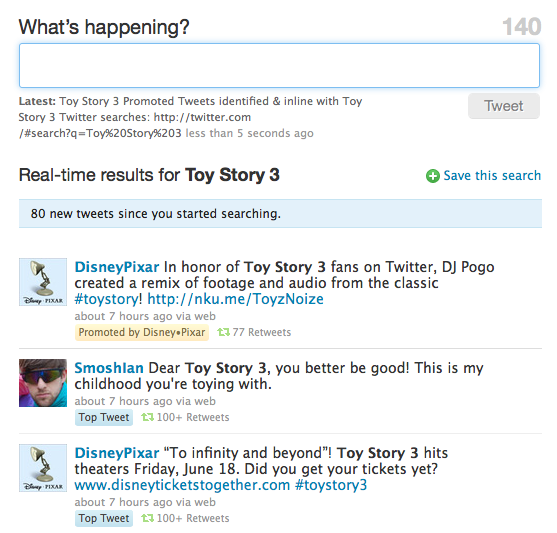
Toy Story 3 from DisneyPixar.
Toy Story 3 Promoted Tweet in Trending Worldwide
DisneyPixar’s Promoted Tweet also found its way into Twitter search results for Toy Story 3.
Promoted Tweets In Twitter Search Results
Whether any of this attention on Twitter translates into measurable increased word of mouth for the film or better yet increased box office sales remains to be seen.
Collective – “The Audience Engine” has produced their fourth annual Display Advertising Study.
Colllective The Audience Engine
The following were the key takeaways from the Collective study:
Data and the Growth of Audience-Based Buying
For the past four years, Collective’s “Display Advertising Study” has charted the evolution of the ad network and its role in online display. This year’s report offers a comprehensive analysis of the digital display-advertising ecosystem in its most demanding year, and the trends that impact how brand advertisers and agencies address audience selling and buying.
Among the key findings in this year’s study:
• Advertisers and agencies demanding greater audience insights, analytics and optimization. Agencies and advertiser continue to rely on comScore and Neilson (62 percent and 53 percent respectively) to measure online media. However, 37 percent say they rely on publisher and ad network data to measure online media more than Quantcast (27 percent).
• Stronger performance metrics needed to evaluate campaign success. About two-thirds (64 percent) percent continue to use click-thru rates (CTRs) to evaluate ad network performance. The study finds a disparity between senior- and lower-level agency decision makers, with the latter relying heavily on CTRs and the former leaning on other metrics.
• Video continues to gain market share, with “targeting” by far the most important factor in choosing a video ad network partner. Overall, 57 percent of those surveyed say they were likely or extremely likely to shift dollars from TV to online video in 2010. That percentage surges to 67 percent among large spenders. Targeting is the leading reason for selecting a video ad network, preferred by 65 percent, followed by reach at 51 percent and price at 45 percent.
What I found most interesting was that lower level staffers consider CTR the most valuable metric in measuring an online advertising campaigns success while top level staffers don’t consider the CTR as an important performance benchmark.
All advertising should produce results, yet what constitutes results for both advertisers and their agencies continues to remain unclear.
Google Advertisers can use the Analyze Competition feature to compare Google AdWords performance to that of advertisers in similar categories.
With data on the competitive landscape, advertisers can then make more informed decisions about which types of optimization changes are right for their account.
Watch this video to learn more about the Google Adwords Analyze Competition feature.
The Adwords Certification program exam materials have increased in size to incorporate changes to the Adwords program since both the Adwords launch and the advent of the Adwords Certification program.
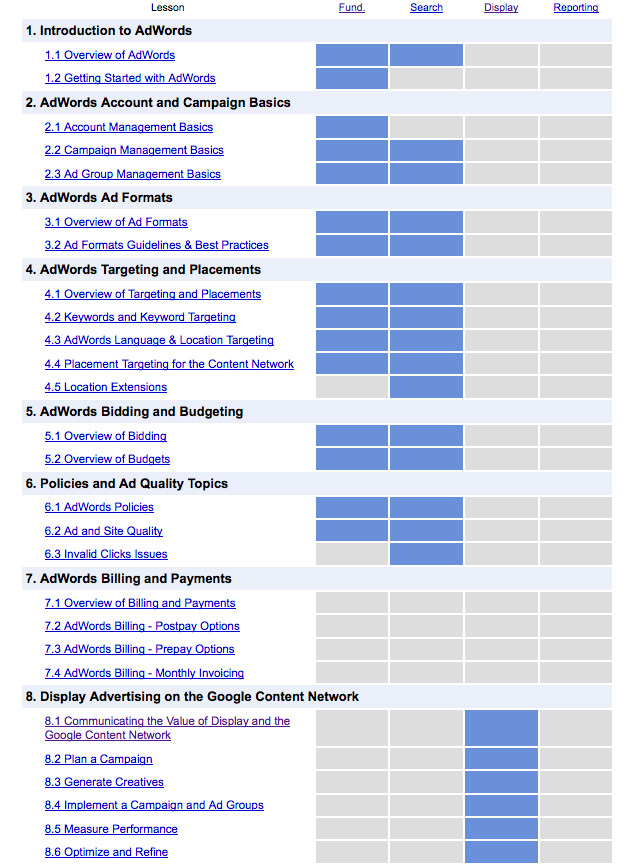
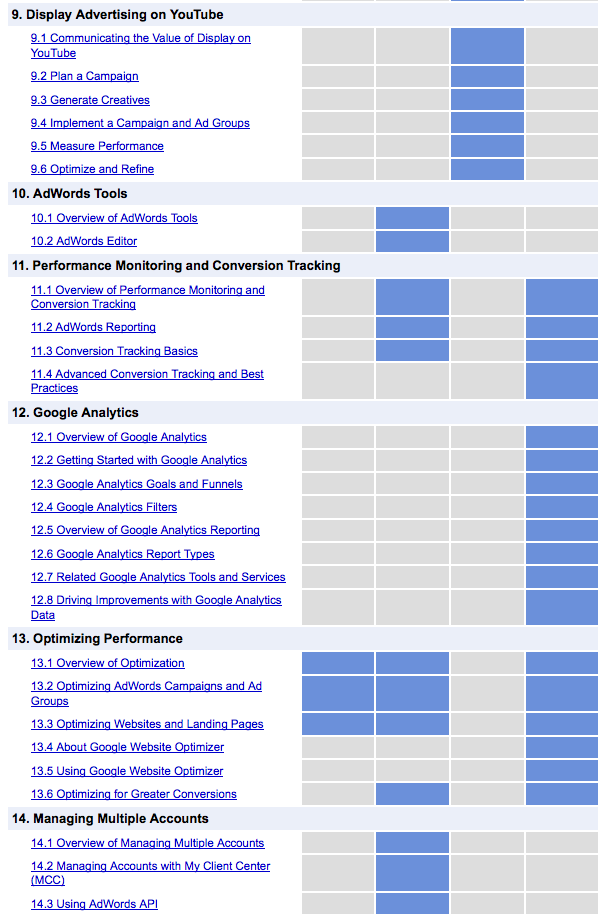
The Adwords Certification program study materials now cover the following fifteen sections.
Adwords Exam Materials 1-7
Adwords Exam Materials 8-14
Adwords Exam Materials 15
Display Advertising on the Google Content Network and YouTube are two new areas of study devoted to Google’s display advertising products within each of their respective distribution channels.
Google plans to offer an advanced Google Adwords exam on Google Display Advertising at some point in the future.
As mentioned in previous posts, I am preparing to take the new Google Certification program tests to obtain my Google Individually Qualified (GIQ) status.
In their new program, Google has cleverly transposed the status term that used to be known as “Qualified Individual” into “Individually Qualified” which in turn produced their new G – “IQ” acronym.
After spending some time inside their program since its migration to the new Google Adwords Interface, navigation to different sections within the Pro Center often seems difficult.
I think a lot of this has to do with the fact that the Google Adwords Certification Program Learning Center is on a secure site which requires logging in over and over again to get in and out of pages.
To obtain Adwords certification, individuals must pass at least two exams.
There are four exams planned while three are available to take at this time.
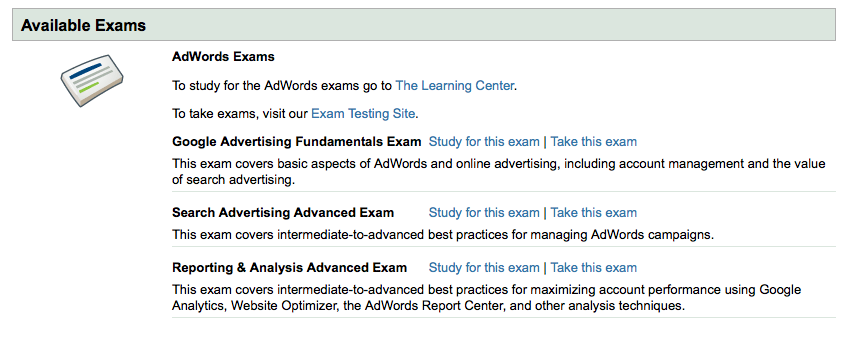
The available exams are the Advertising Fundamentals Exam, the Search Advertising Advanced Exam and the Reporting and Analysis Advanced Exam.
Available Google Exams
Google plans to offer the Display Advertising Advanced Exam at some point in the future.
I had not drilled down into my Google Adsense account in quite some time and was surprised to see some of the new distribution options Adsense now offers.
Google Adsense Options
Obviously Google Adsense for Content and Search have been available since the AdSense program’s inception, while Adsense for Mobile Content, and the latest AdSense for Mobile Applications are both relatively new.
I wasn’t aware of Adsense for Domains.
Adsense for domains effectively lets domain owners park their own pages at a registrar while also directly earning Adsense income as opposed to the registrar profiting off a domain owner’s parked pages.
More about Adsense for Domains from Google:
AdSense for domains allows publishers with unused domains to help users reach relevant information by presenting content on the domains.
Users often type domains into their address bar or follow expired links leading to sites with no content. Instead of an “under construction” page or 404 error, AdSense for domains provides links, search results, advertisements and other content. To do this, we use semantic technology targeted to the domain name. You earn revenue when users interact with the ads on your site.
Domains owners profiting directly from Google ads on their own domains while parked at a registrar is innovative and empowering.









 Search Marketing Communications
You must be logged in to post a comment.