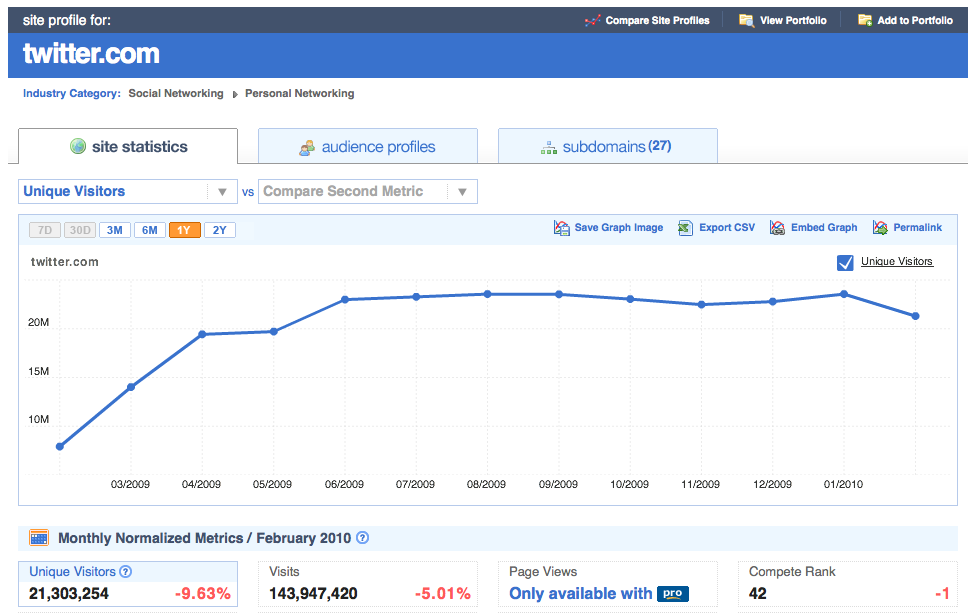
Twitter is tweaking its home page to generate more interest in both the Twitter property and its users data streams.
From the Twitter blog:
Twitter’s homepage is a work-in-progress. Today, we’re testing a new design that bubbles up more of the information flowing through Twitter. This builds on a series of changes starting last year when we redesigned the homepage to make search and trending topics more visible and easily accessible to everyone. With that version, we brought the power of search.twitter.com to the homepage and let people explore the value of Twitter without an account.
With the new design, we’re intentionally featuring more dynamic content on the front page, revealing a sample of who’s here, what folks are tweeting about, and the big topics that they’re discussing. The homepage now features a set of algorithmically-selected top tweets that automatically appear every few seconds. It also highlights a random sampling of suggested sources; hover over any of them to see a profile summary and their latest tweet. Trending topics now scroll across the page, allowing us to present a large set of trends using little page real estate. Hovering over some of these trends will show a description explaining why the keyword is (or has recently been) popular.
All of our recent changes embrace the notion that Twitter is not just for status updates anymore. It’s a network where information is exchanged and consumed at a rapid clip every second of the day. With so much being shared, we know that there’s something of value for everyone. People who internalize the value of Twitter understand the power of this simple medium. But it hasn’t been easy to make that value transparent or obvious for curious folks coming to Twitter for the first time.
We’ll be monitoring the data on this homepage design, and how its effects ripple out to other areas. Expect us to continually try new ideas that help users more easily discover who and what they can find on Twitter, and how they can personalize and filter the stream of rapidly flowing information.
While these tweaks obviously increase the Twitter site’s usefulness, whether or not these improvements increase their site’s web traffic and stickiness remains to be seen.
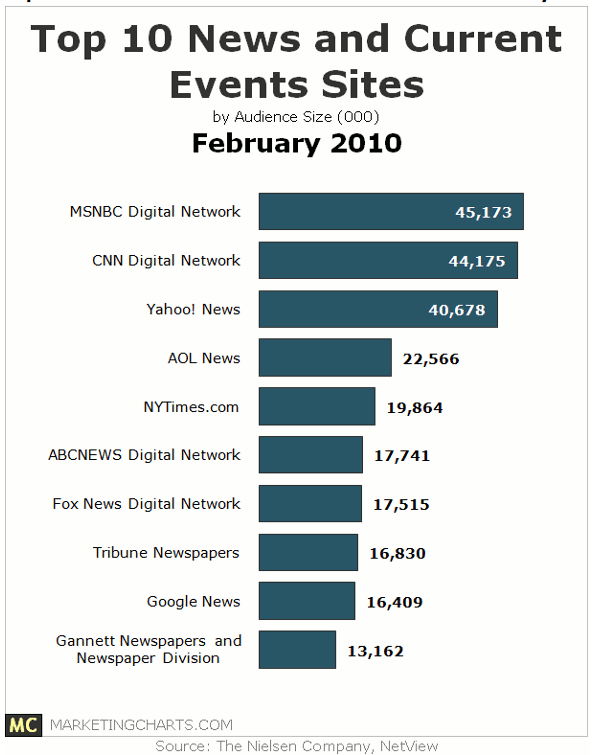
From the Nielsen Company’s NetView and MarketingCharts.com.
Top 10 News and Current Event Sites February 2010
Audience size notwithstanding, if news were transactional for its publishers and advertisers, the future of the news business wouldn’t remain in doubt.
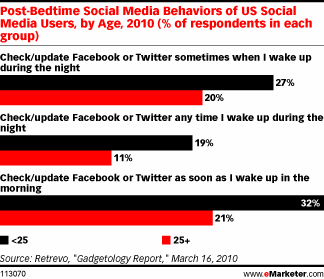
It may seem extreme, but users who can’t resist checking Facebook and Twitter in the middle of the night are not alone. According to the March 2010 “Gadgetology Report” from consumer electronics site Retrevo, 48% of social media users log in to the sites either during the night or as soon as they wake up.
Users under 25 were more likely to check or update their social network status after bedtime, with nearly one-fifth saying they did so anytime they woke up during the night.
Almost as many younger users (18%) checked the sites in the morning before getting out of bed, while 17% of respondents of all ages turned to Facebook and Twitter before TV in the morning. iPhone users were notably more likely than average to do each of these activities, with 23% saying it was how they got their morning news compared with 16% of all social media users.
Depending on how you look at this either social site users are either a group of highly disciplined of people or they are a group of highly undisciplined people.
Anyone have an idea how many man hours are spent each day in the U.S. on social networking sites?
Have any studies shown any correlation between social networking site usage and productivity or the lack thereof?
Forbes reports about a recent Network Advertising Initiative survey on behavioral ad targeting.
Behavioral targeting may keep advertisers front and center with their target audiences. It may also keep some publishers in business.
The practice, which involves tracking consumers’ Web surfing and shopping habits so marketers can deliver ads to audiences most interested in them, is paying off for the companies that are dabbling in this space, according to a survey the Network Advertising Initiative (NAI).
The survey, conducted with 12 advertising networks, shows that conversion rates for the targeted ads are 6.8%, compared to 2.8% for the nontargeted. That means that consumers who click on ads targeted specifically to them are more than twice as likely to buy the advertised product.
Publishers, too, are seeing the benefits of behaviorally targeted ads. The average cost per thousand clicks of a behaviorally targeted ad in 2009 was $4.12, up 108% from a run of the network ad sold in the same year.
The study by the NAI, an association of advertising networks, data exchanges and marketing analytics services, shows that behavioral ads are a small but fast-growing part of their business. For nine of the advertising networks surveyed, the ads brought in 18% of their collective $3.3 billion in revenue last year.
The survey is supposed to bolster the ad industry’s case for behavioral targeting before Federal regulators and policymakers introduce Internet privacy regulation. Policy discussion around advertising and privacy has thus far lacked enough data on the value of behavioral ads to publishers, ad networks and consumers, says Howard Beals, a commissioner of the NAI study and former director of the Federal Trade Commission’s Bureau of Consumer Protection. The FTC is expected to err on the side of consumer protection and may prohibit behavioral targeting not voluntarily chosen by consumers.
“The study demonstrates the increasing significance of behavioral advertising to the economic model supporting free online content and services for consumers,” says Charles Curran, executive director of the NAI.
Indeed, behavioral ad targeting and the marketers who rely on display advertising impressions to presell their products may be the only way to save the publishing industry .
Either behavioral ad targeting or a publishing industry who consistently produce content their audience is interested in and attracted to – kind of like of writing an article about behavioral ad targeting on Forbes.com while getting it sponsored by a behavioral ad marketing company called Autonomy.
Online display and video advertising attribution studies are becoming increasingly more frequent as every medium seeks to quantify the effectiveness of their advertising distribution platforms compared to search advertising.
The following press release from comScore is an example of these new types of online advertising attribution studies.
London, UK, March 25, 2010 – .Fox Networks (pronounced “dot-fox”), the leading global online network from Fox International Channels (FIC) and comScore, a leader in measuring the digital world, today unveiled the findings of a ground-breaking U.K. study. The study, commissioned by online video specialist .Fox, used comScore’s single-source panel methodology to confirm that video and display advertising are effective at driving significant uplift in site visitation and advertiser search queries, even in the face of minimal clicks on ads.
The study evaluated results from four campaigns across four industry sectors and produced the following key findings:
Video and display advertising both successfully increased brand engagement in each of the four campaigns analysed. The average uplift across the campaigns saw site visitation increase by more than a factor of seven over a four week period following exposure to an ad, with consumers three times more likely to conduct search queries using brand or relevant generic terms in the same time period.
When evaluating video and display side by side, consumers exposed to video advertising were 28 percent more likely to visit the brand site and nearly twice as likely to conduct a trademark search.
Confirming expectations and previous industry understanding, video was able to generate a more immediate impact in the first five exposures than display ads in terms of increases in site visitation and search queries; however, behavioural response for those exposed to display climbed steadily as the number of ad impressions increased.
The results, which have been released in full at the Advertising Research Foundation’s 2010 conference in New York this Wednesday, are also particularly significant given sharp decreases in online advertising click-through-rates over recent years, with the U.K. being the worst affected of leading global markets.
The study underscores the fact that consumer search behaviour is positively impacted by the presence of display or video advertising — even in the face of minimal clicks. In each of the four campaigns, search activity increased significantly when consumers were exposed to these online ad formats, suggesting that the last click on a search ad should not be given 100 percent of the credit in attribution studies.
Commenting on the findings, Hernan Lopez, President of .Fox Networks and COO of FIC said, “This study proves that online display and video advertising drives significant results that are either being ignored by click-through-based metrics, or wrongly attributed to search. We make an open invitation to global advertisers to work with us and comScore in a follow-up to the study, measuring the impact on actual sales.”
“As the online industry seeks to increase its share of branding advertising budgets, it’s more important than ever to prove the value of display and video ad formats”, said Gian Fulgoni, chairman of comScore. “This research and our recent Whither the Click study for Europe are helping marketers understand that the internet is indeed a powerful branding medium and how vital it is to measure campaign effectiveness using the appropriate behavioural metrics rather than just the click.”
Americans increased their overall media usage and media multitasking according to The Nielsen Company’s latest Three Screen Report, which tracks consumption across TV, Internet and mobile phones. In the last quarter of 2009, simultaneous use of the Internet while watching TV reached three and a half hours a month, up 35% from the previous quarter. Nearly 60% of TV viewers now use the Internet once a month while also watching TV.
“The rise in simultaneous use of the web and TV gives the viewer a unique on-screen and off-screen relationship with TV programming,” said Nielsen Company media product leader Matt O’Grady. “The initial fear was that Internet and mobile video and entertainment would slowly cannibalize traditional TV viewing, but the steady trend of increased TV viewership alongside expanded simultaneous usage argues something quite different.”
TV & Internet Simultaneous Usage
An unintended consequence of this trend maybe that somehow the television industry will develop tools for more effectively measuring its customer’s advertising performance – or not.
I recently met with the owner of a $10+ million software business who doesn’t advertise.
Unbelievable.
His company only recently hired its first salesman.
I naively took the meeting because I thought the owner had become convinced his company needed to have a more effective presence on Google.
Particularly after his stats revealed 80% of his search engine referrals were for his company’s name with the balance of his traffic coming in under nonsensical terms.
Nope.
While he thought having his message more widely distributed on Google was important, he didn’t think his business was adversely affected by his not extending and expanding his company and brand’s message further via search.
Yet all the while this particular software company owner’s business doesn’t have a majority market share in his industry.
By definition any business with a minority market share means its brand’s message and distribution isn’t strong enough to attract and capture all the new buyers into a market.
So while this software company may enjoy a solid reputation, reputation alone obviously are not strong enough to win the business of new buyers who entered the market who hadn’t heard about his company or its message and who instead fell into the arms of his competition – those with the remaining majority percentage of market share.
This market share analogy alone ought to be enough to convince even the least sophisticated business owner – who has a desire to maintain and even grow their business – about the need for advertising.
Not this guy though.
Maybe one day he will come to understand that no one brand voice drowns out all others in a competitive market.
Until then, this particular software company owner’s business may continue to enjoy its present minority market share but until he advertises – he will continue to lose new business to his competition.
Google Adwords is now providing a new type of report called Adwords Search Funnels.
The AdWords Search Funnels reports describe the Google.com search ad click and impression behavior that led up to a site’s final clicks and conversions.
In order to help you make more informed decisions about your AdWords keywords, ad groups, and campaigns, we’re excited to release a new set of reports for your AdWords account: Adwords Search Funnels (beta).
Currently, conversions in AdWords are attributed to the last ad someone clicks before making a conversion, masking the fact that many customers perform multiple searches before finally converting. AdWords Search Funnels help you see the full picture by giving you insight into the ads your customers interact with during their shopping process.
In addition to a Top Conversions report, Search Funnels consist of 7 reports including Assisted Conversions, First and Last Click Analysis, Time Lag, and Path Length. For an overview of these new reports, check out this video:
I don’t yet have search funnel reports available in any of my Google Adwords accounts.
I had never heard of Google Image Swirl Labs until today when the domain showed up in my stats.
About Image Swirl from Google:
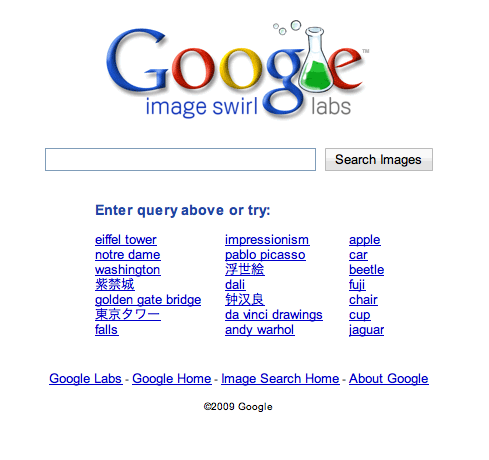
Google Image Swirl organizes image search results into groups and sub-groups, based on their visual and semantic similarity and presents them in an intuitive exploratory interface. Try this tool to resolve an ambiguous query visually (apple, jaguar, beetle) or to explore a concept from different visual perspectives.
Image Swirl Labs
Although I received a referral from Google Image Swirl, the search query inexplicably pointed to a page with no corresponding alt tag or description containing the search term.
Google Image Swirl Labs
Google Image Swirl has a limited set of predetermined available images for viewing.
Each Image Swirl search is auto-filled with the closet available set of images via the spelling of words as they are typed in.
To see a list of potential images to view – type each letter of the alphabet in the search box – one at a time.






 Search Marketing Communications
You must be logged in to post a comment.