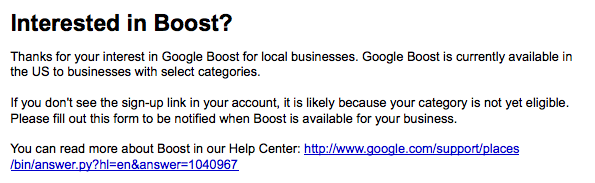
I received the following offer for Google Boost in my Google Places account today.
Google Boost
Google Boost isn’t yet available in my market.
Google Boost Sign Up
if I were to guess about the prospect’s for Google Boost’s future, I would guess its sales will be infinitesimal and thus in the end will have no material impact on Google’s bottom line.
To get and retain audience attention, look for marketers and advertisers to continue to mine the limits of the “what is acceptable” envelope.
The recent Super Bowl XLV provides two examples of “what is acceptable” messaging gone awry – one unacceptable example from Groupon and the other more tolerable example from Christina Aguilera.
Groupon ran a commercial that apparently offended more people than not while Aguilera botched her rendition of the Star Spangled Banner.
While the former disrupted the collective audience schema negatively and thus the brand, the latter appears to have had neither a positive or negative impact on its product.
However, one thing is for certain – Aguilera’s gaffe and its accompanying schema disruption generated considerably more earned media attention than Groupon’s ad did.
Super Bowl Gaffes
Going forward, smart marketers and advertisers alike would be wise to consider the implications of any schema disruption their messaging may have on audiences before they attempt to get their attention.
In an age when everybody thinks their performance is worthy of attention, even those people and companies used to getting attention have to go to even greater lengths to try and capture it.
To wit, everyone who is in the market for attention ought to prepare for the challenge of getting attention like they would if they were a player on a team competing to get to the Super Bowl.
Why?
Because the battle for the attention of any audience is binary – its winner take all – you either get to the big game and the chance to win (mind share and or share of wallet) or you don’t.
Yet without getting its own sex tape, Google Places risks losing both the present and future attention of millions of business owners.
Why?
Because spending time with Google Places leaves users feeling unsatisfied just like they do when they click through on a headline and the accompanying story fails to deliver on its promise.
Case in point:
I recently uploaded the exact same data for 39 stores to my Google Places account including data for one store which was recently opened.
I provided Google Places with the same set of data for each store that was required by Google for bulk upload verification.
Understandably, the recently opened store listing was initially delayed for what I assumed was some type of additional level of review and verification neither of which involved any type of offline authentication by Google.
Today I learned the recently opened and operational store’s listing was rejected because it didn’t meet Google Places quality guidelines!
Google Place Rejection
What – 38 stores meet Google Places quality guidelines and yet new one store with the exact same data doesn’t?
Doesn’t make sense does it?
Nope.
Not unless of course you are Google and you prefer verifying listings through algorithms and not people.
While having a properly formatted new store listing rejected simply because it hasn’t yet generated any other corroborating online data may seem only logical to a computer, I think it makes about as much sense to the rest of us as it would for Google Places to have its own sex tape explaining what it does and doesn’t do for its business owner patrons.






 Search Marketing Communications
You must be logged in to post a comment.