Archive for August, 2010

Make Calls From Gmail But Not Google Voice?

August 31, 2010

Google recently enabled telephone calling from within gmail accounts.

I have already placed several telephone calls and appreciate the convenience of making calls while I am in my gmail account.

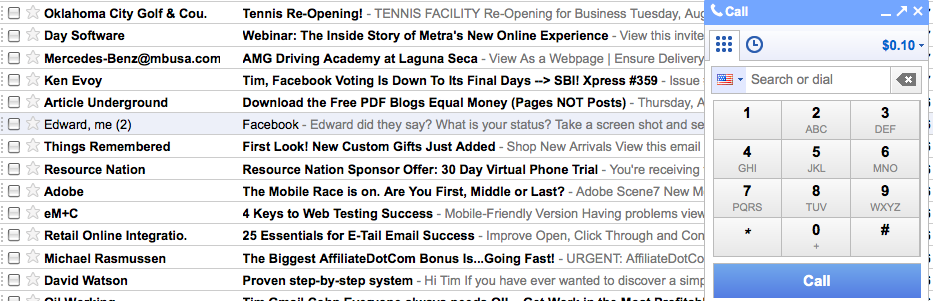
Dialing phone numbers in gmail is as simple as typing an email – just type in the phone number and click call.

Gmail Phone

Gmail Phone

While placing calls from gmail, I discovered their service automatically syncs with a Google Voice number that uses the same Google account login.

Google Voice Account

Google Voice Account

How do I know?

Calls placed from gmail with an attached Google Voice account push the Google Voice number through the network with its ANI.

Simply put – calls made from a gmail enabled Google Voice account shows the Google Voice number in the call receiver’s Caller ID.

Pretty cool.

While there are surely millions more gmail users than there are Google Voice users, Google Voice accounts inexplicably don’t offer the same calling functions from Google Voice accounts.

Why not?

Seems like Google Voice would be the natural location for Google’s phone services.

Will Google eventually push its phone dialing keypads into Google Voice accounts?

I can’t wait to hear Google’s answer.

Google My Client Center: Using Labels

August 30, 2010

In this video learn how to create and manage labels within your My Client Center (which helps you manage multiple Google AdWords accounts).

The Google Content Network

August 29, 2010

This first of three videos explains how the Google Content Network works for advertisers who want to be able to target customers when they browse beyond search.

It explains how, like on search, you can easily focus your advertising to websites where your customers are.

Google Advertising Professionals Qualification Update Deadline

August 28, 2010

From the Adwords Agency Blog:

We recently launched the Google Certification Program and we’re glad that thousands of you all over the world have taken the new exams and joined the program. This certification program replaces the Google Advertising Professionals program. To provide you with time to make the transition, we’ve run both programs side by side during a six month grace period which ends in October. To retain certified status and continue using the badge within your marketing collateral, you’ll need to meet the requirements of the new program.

What’s the difference between the two programs? With the Google Certification Program, we’re offering updated learning materials written by Google experts. We’ve developed four in-depth exams on AdWords management called Fundamentals, Advanced Search, Advanced Display and Advanced Reporting & Analysis. The exams are designed to prove proficiency in these areas and are being widely adopted by employees of search marketing agencies. In addition to this, we launched Google Partner Search, a directory to help advertisers find agencies to manage their campaigns. Currently, all Google Advertising Professionals who have opted in are part of Google Partner Search, but this will not be the case by the end of October.

We’re informing all of you who have qualified under the old Google Advertising Professionals program to update to the Google Certification Program. In order to do so, a company must meet a minimum Adwords spend level, and have at least one employee become individually qualified under the Google Certification Program.

If you have an employee that already qualified under the old program, this is a great time for them to update their skills through the Google Certification Program. Upon completion, just update your company profile so that advertisers can find you using Google Partner Search.

To learn more about the Google Certification Program visit our Help Center.

I am planning to update my Qualifications this week.

The Unique Selling Proposition For Small Business

August 27, 2010

I spent three hours yesterday working on a foundational marketing issue for a client – the development of their unique selling proposition.

It was the first time I had worked on developing a unique selling proposition in years.

Having competed online now since 1999 – which by definition is a global market – differentiation and competition offline looks almost pedestrian.

Yet the skills required to successfully compete online are quite handy when it comes to developing positioning and messaging for any business whether their byproducts are executed online or offline.

There were several key points surfaced during my meeting yesterday.

1. Every business competes within a competitive monopoly.

2. Most “new” business is not new at all but new to that particular business. “Switchers” – as I like to call them – are how most small businesses gain new customers – not orchestrated customer acquisition campaigns.

That being said – in order to attract Switchers, small business owners must have a unique selling proposition and the accompanying messaging that speaks to those buyers unmet needs – those needs not being met by their present provider.

Buyers switch when they aren’t getting what they want and when the attractiveness of alternatives attract their attention.

This is where a well researched unique selling proposition embedded within consistent messaging can prove to become an invaluable investment for the small business.

Ideally – the sophisticated small business owner employs a unique selling proposition that plays to the weaknesses of their competition while simultaneously emphasizes their unique strengths.

Simply put – the small business owner’s best prospects for attracting “switchers” – buyers who are switching providers – is to first determine who of their competitors customers are not going to become their customers.

Once these static segments are identified, the unique selling proposition should be built on communicating what value the business offers to those customers who will switch provided  they become convinced their needs can be met by a new provider.

For the small business competing in a crowded niche, their best prospects for new business aren’t going to be created out of the blue but out of the “blues” – the blues they get from dealing with their present vendor.

Customer “blues” are the pallet from which a successful unique selling proposition is created  – a unique message that the small business can predictably and confidently use to acquire new business.
Google Real Time Search

August 26, 2010

From the Official Google Blog:

When we first introduced our real-time search features last December, we focused on bringing relevance to the freshest information on the web. Our goal was to provide real-time content from a comprehensive set of sources, integrated right into your usual search results. Today we’re making our most significant enhancements to date, giving real-time information its own home and more powerful tools to help you find what you need. Now you can access Google Realtime Search at its own address, http://www.google.com/realtime (the page is rolling out now and should be available soon. Use this link if you want to try out the new features right away).

Here is what the new Google search property looks like.

Google Real Time Search

Google Real Time Search

Watch this video to learn more about Google Real Time Search:

ManageFlitter: How To Manage Who You Follow

August 25, 2010

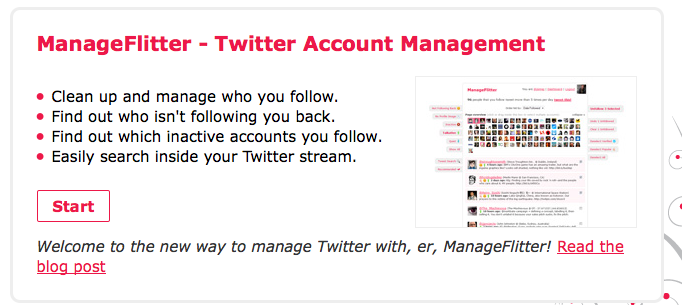
ManageFlitter has a great tool for visualizing your Twitter account data in ways Twitter doesn’t provide.

My interest in their tool began with its ability to produce lists of people I follow based on several different types of criteria.

I use Twitter as a research tool and as such, I follow more people than I am followed by.

ManageFlitter has helped me identify Twitter accounts that don’t Tweet very often or have user profile pictures – two metrics with which to evaluate whether or not I wish to continue following an account.

ManageFlitter

ManageFlitter

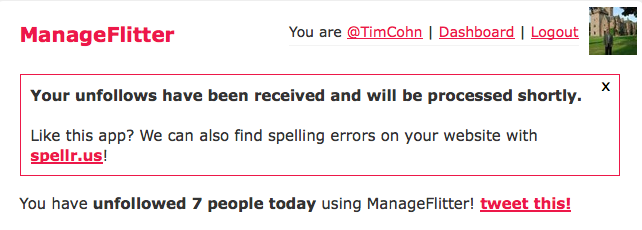
ManageFlitter identified seven accounts who hadn’t Tweeted recently, this in turn helped me decide whether to continue following them or not.

I decided to discontinue following them while ManageFlitter executed the unfollows.

Unfollowed

Unfollowed

Since I had reached Twitter’s 2000 follow limit, this service was beneficial albeit not as helpful as I had hoped.

If I could sort the accounts I follow by whether they had Tweeted within the last 30, 60 or  90 days – the service would be considerably more valuable to me.

Maybe at some point in the future, ManageFlitter will manage to come up with these three search and filter follow criteria for identifying and pruning the Twitter accounts I no longer desire to follow.

?

August 24, 2010

Seeing if I can post from my iPad without having to download additional apps….

I can type a post but not add images.

Fastest Growing Domains July 2010

August 23, 2010

From the Compete Blog:

Fast Movers July 2010

Fast Movers July 2010

A brief synopsis:

Looks like Groupon is growing in popularity. I expect we’ll see Groupon on this list again. Last week they had a “get $50 at Gap for $25″ offer that sold over 445,000 vouchers in a day.

Discovery.com saw an increase in traffic for Shark Week, while match.com members were looking for other fish in the sea in the month of July. Summer blockbusters have driven moviegoers to seek out air conditioning (and buttery popcorn by the gallon), booking their tickets on moviefone.com. I couldn’t restrain the giggles while remembering the Seinfeld episode where Kramer pretends to be the moviefone guy.

Reaching The Local Audience

August 22, 2010

From eMarketer:

Social media has increased its importance around the world, and while social network advertising continues to grow quickly in the US, spending in other markets is set to rise even faster. But brand marketers still don’t feel social media is the most effective way to reach their international audiences.

A June 2010 survey conducted by Harris Interactive for social marketing platform Buddy Media found that more than 90% considered it at least somewhat challenging to reach audiences in local markets with a unified brand message.

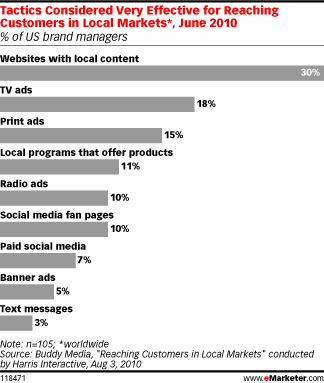
The most popular tactics used to market to local audiences were websites with local content (69%), print ads (62%) and event promotion (59%). Less than half of respondents used social media fan pages for this purpose, and less than one in three used paid social media advertising. Websites with local content were considered the most effective tactic, named by 30% of brand marketers, compared with just 10% who thought fan pages were best.

Reaching The Local Audience

Reaching The Local Audience

If Brand Managers consider websites with local content the best way to reach customers in local markets, why would any other category of advertiser regardless of size or budget think otherwise?