Bill Gates recently launched a Twitter account and began tweeting his thoughts to the masses.
Like the majority of Twitter account holders, Gates uses the Bit.ly URL shortener to Tweet web pages addresses too long for inclusion along with his Tweets.
Bill Gates Bit.ly
Mr. Gates apparently still isn’t aware of his old company Microsoft’s recently launched URL shortener – Binged.it.
You’d think if we was aware of it, he would be using it to bring Binged.it to the attention of his Twitter followers.
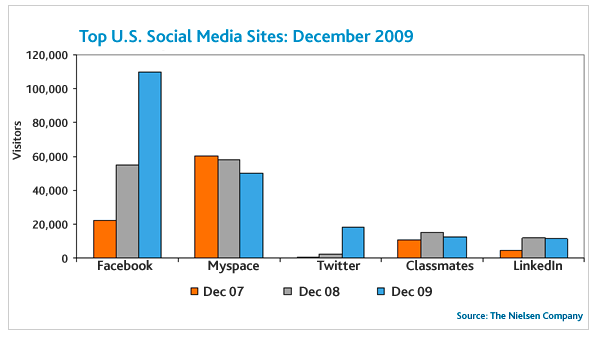
U.S. Growth in Average time Person on Facebook and Twitter Outpaces Growth of Overall Category
People in the U.S. continue to spend more time on social networking and blog sites as well, with total minutes increasing 210% year-over-year and the average time per person increasing 143% year-over-year in December 2009. Year-over-year growth in average time spent by U.S. users, for both Facebook and Twitter.com, outpaced the overall growth for the category, increasing 200% and 368%, respectively. Among, the top five U.S. social networking sites, Twitter.com continued its reign as the fastest-growing in December 2009 in terms of unique visitors, increasing 579% year-over-year, from 2.7 million unique visitors in December 2008 to 18.1 million in December 2009. However, month-over-month, unique visitors decreased 5%
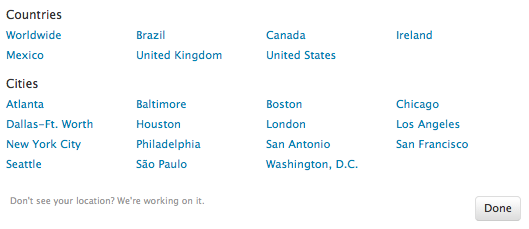
Twitter has added Location settings for account holders to see what is happening in their particular city.
Twitter Local Trends
Twitter presently offers their location service at a Worldwide level or at the country level for Brazil, Canada, Ireland, Mexico, United Kingdom and the United States.
Further localized selections are available at the city level for fifteen cities thirteen of which are in the US.
Twitter Local
If I were to guess why Twitter’s initial selections were so sparse I would guess its because they don’t yet have enough data from any other areas to populate and refresh real time lists.
I won’t expect to see the top 50 DMAs on their options list anytime soon.
“Search is clearly becoming a more ubiquitous behavior among Internet users that drives navigation not only directly from search engines but also within sites and across networks. If you equate the advancement of search with the ability of humans to cultivate information, then the world is rapidly becoming a more knowledgeable ecosystem.”
Top Search Markets Worldwide
The total worldwide search market boasted more than 131 billion searches conducted by people age 15 or older from home and work locations in December 2009, representing a 46-percent increase in the past year. This number represents more than 4 billion searches per day, 175 million per hour, and 29 million per minute. The U.S. represented the largest individual search market in the world with 22.7 billion searches, or approximately 17 percent of searches conducted globally. China ranked second with 13.3 billion searches, followed by Japan with 9.2 billion and the U.K. with 6.2 billion. Among the top ten global search markets, Russia posted the highest gains in 2009, growing 92 percent to 3.3 billion, followed by France (up 61 percent to 5.4 billion) and Brazil (up 53 percent to 3.8 billion).
Top 10 Countries By Number of Searches December 2009
*Searches based on “expanded search” definition, which includes searches at the top properties where search activity is observed, not only the core search engines.
The main takeaway from this month’s comScore data is that the 22 Billion US searches translates into approximately 73 searches per month per capita.





 Search Marketing Communications
You must be logged in to post a comment.